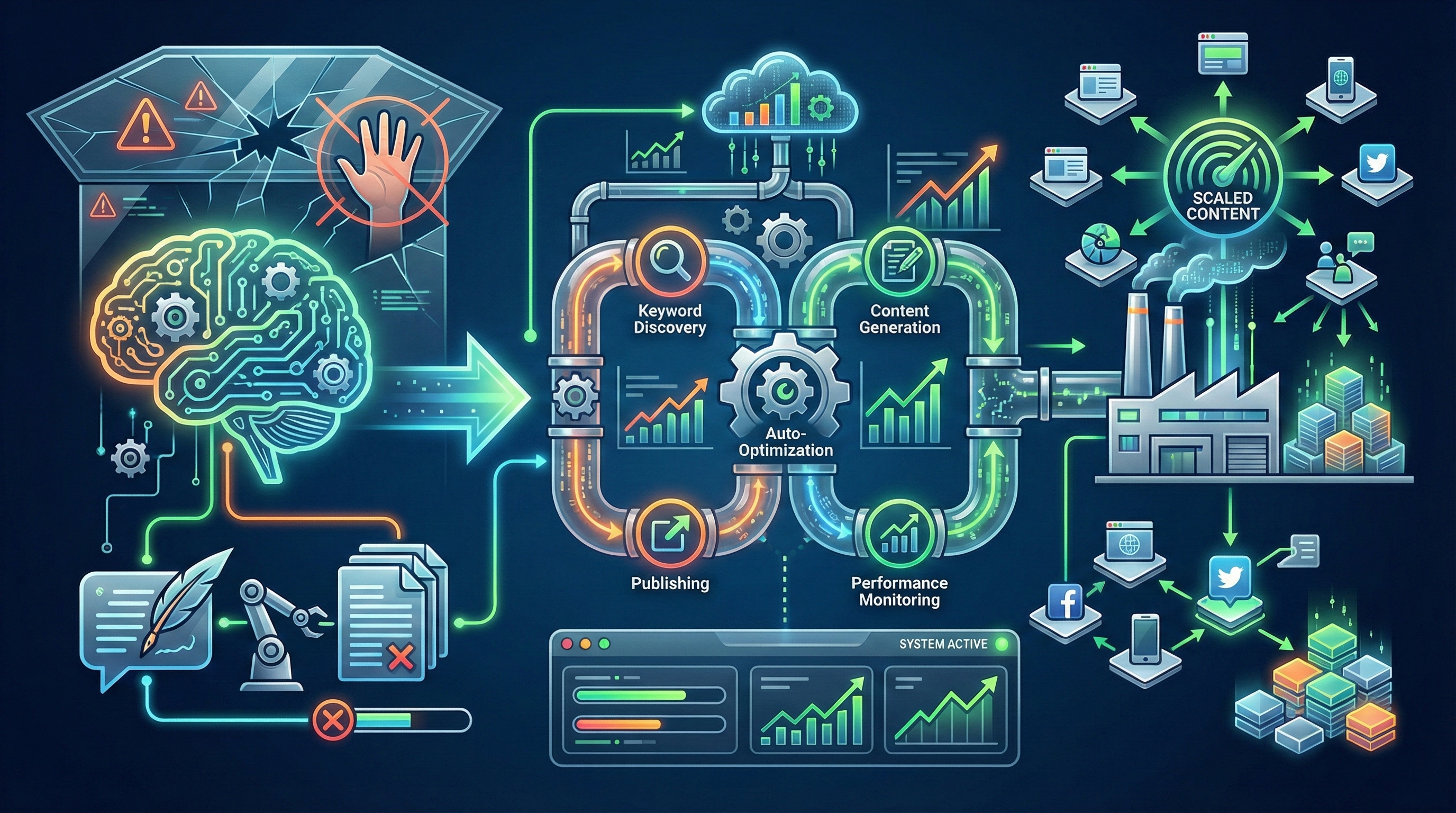
AI-Powered Writing Assistant: What They Do, What They Can't, and What Actually Scales Content
Every agency owner and SaaS founder has the same tab open right now: some AI writing assistant they're hoping will finally kill the content bottleneck. Spoiler — most of them just move the bottleneck upstream.
In 2026, the AI-powered writing assistant market is fully saturated. From Grammarly to ChatGPT to a dozen
Frequently Asked Questions
Q: What is the best AI writing assistant?
The best AI-powered writing assistant depends on your specific use case. In 2026, top contenders include Jasper for long-form marketing content, Copy.ai for sales copy, Grammarly for grammar and style refinement, and ChatGPT for versatile, conversational writing support. For agencies and SaaS founders managing content at scale, the 'best' tool is often the one that integrates seamlessly into your existing workflow and reduces manual editing time. No single tool dominates every category, which is why many professionals use a combination — one for drafting, another for editing, and a third for SEO optimization. The key is to evaluate each tool based on output quality, customization options, team collaboration features, and cost per output rather than hype alone.
Q: Is it illegal to publish a book written by AI?
As of 2026, it is not illegal to publish a book written by an AI-powered writing assistant in most countries. However, there are important legal and ethical nuances to consider. The U.S. Copyright Office has clarified that purely AI-generated content without meaningful human creative input cannot be granted copyright protection, meaning you may not own exclusive rights to the work. Publishers, literary agents, and self-publishing platforms like Amazon KDP now require authors to disclose AI involvement. Failing to disclose this can violate platform terms of service. While publishing AI-written books is legal, transparency with readers and platforms is strongly advised to avoid reputational or contractual consequences.
Q: Is there a free AI to help me write?
Yes, there are several free AI-powered writing assistants available in 2026. ChatGPT offers a free tier with access to GPT-4o. Google's Gemini provides free access through your Google account. Microsoft Copilot is free for personal use and integrated into Bing. Grammarly offers a free plan covering basic grammar and clarity suggestions. These free tools are capable of helping with blog posts, emails, social media captions, and short-form content. However, free plans typically come with usage limits, fewer customization options, and restricted access to advanced features like brand voice training or long-form document generation. For professional or agency-level output, a paid plan is usually worth the investment.
Q: Is ChatGPT a writing assistant?
Yes, ChatGPT functions as an AI-powered writing assistant, but it's more accurately described as a general-purpose large language model. It can draft articles, emails, scripts, product descriptions, and even books. However, unlike purpose-built writing tools, ChatGPT lacks native SEO optimization, built-in plagiarism checks, or direct CMS integrations out of the box. It excels at generating drafts quickly and iterating based on feedback, making it a strong starting point. For writers and marketers, ChatGPT works best when paired with specialized tools that handle formatting, fact-checking, and publishing workflows. Think of it as a highly capable writing collaborator rather than a fully autonomous content production system.
Q: Is ChatGPT the best AI writer?
ChatGPT is one of the most capable and widely used AI writing tools available, but it is not universally the best for every writing task. It performs exceptionally well for conversational content, creative writing, brainstorming, and flexible drafting. However, tools like Jasper, Writesonic, and Surfer AI offer more structured workflows tailored specifically for SEO-driven content marketing. Specialized tools often include SERP analysis, keyword density guidance, and content briefs built into the platform — features ChatGPT lacks natively. The answer depends on your goals: for raw versatility, ChatGPT leads the pack; for structured, scalable content production, purpose-built AI writing assistants may outperform it in measurable ways. Learn more about AI-Powered Writing Assistant: What Works in 2026. Learn more about AI Writing Assistant: When to Automate Beyond Writing.
Q: Which AI is 100% free?
Several AI-powered writing assistants offer fully free access in 2026, though with limitations. Microsoft Copilot (formerly Bing Chat) is free with no subscription required. Google Gemini offers a free tier accessible via your Google account. ChatGPT's free version provides access to GPT-4o with some daily usage limits. Grammarly's free plan covers essential writing improvements without a paywall. QuillBot offers a free paraphrasing and summarization tool with word limits. It's important to note that '100% free' tools often monetize through data usage, upsells, or limited output caps. For occasional writing assistance, these free options are genuinely useful. For consistent, high-volume content production, budget for a paid plan to avoid frustrating constraints. Learn more about AI-Powered Writing Assistant: Uses, Limits & SEO Impact. Learn more about AI Writing Assistant: Beyond Basic Tools in 2026.
Q: How many books do you have to sell to make $100K?
The number of books you need to sell to earn $100,000 depends on your royalty rate and book price. For a self-published ebook priced at $9.99 on Amazon KDP, you earn approximately 70% royalties, or about $7 per sale. At that rate, you'd need to sell roughly 14,286 copies to reach $100K. For a $2.99 ebook, you'd need to sell around 47,619 copies. Print books through traditional publishing typically pay 8–15% royalties, requiring far more sales. AI-powered writing assistants can help authors produce more books faster, increasing earning potential through volume. Many successful indie authors use AI tools to draft, edit, and publish multiple titles per year, building catalog depth that drives passive income over time. Learn more about AI Writing Tools 2025: Complete Breakdown for Operators. Learn more about AI Writing Assistant: How It Works & SEO Limitations.
Q: Can you tell if a book is written by AI?
Detecting AI-written books has become increasingly difficult in 2026 as AI-powered writing assistants have grown more sophisticated. AI detection tools like GPTZero, Originality.ai, and Copyleaks can flag likely AI-generated text, but they are not perfectly accurate and can produce false positives on human-written content. Common telltale signs of AI-written books include overly uniform sentence structure, lack of specific personal anecdotes, repetitive phrasing, and generic transitions. Skilled human editors who refine AI drafts can significantly reduce these markers. Publishers and literary contests are increasingly using detection tools as part of submission screening. The safest approach for authors using AI assistance is to heavily edit outputs, add personal voice, and disclose AI involvement where required by platform policies. Learn more about AI Writing Assistant: Capabilities & Scaling Limits 2026. Learn more about AI Writing Tools Guide: Best Options & What Works.