Automated Content Creation for Multiple Websites: Build the System That Scales Itself
Most agencies and founders don't have a content problem — they have a systems problem. They're manually producing, publishing, and refreshing content across five, ten, or twenty sites and wondering why they're always behind. The briefs pile up. The writers miss deadlines. The editor bottleneck never clears. And somewhere underneath all that operational drag, the actual strategy work — the kind that moves clients and products forward — never gets touched.
Automated content creation for multiple websites has moved from a fringe experiment to a core operational strategy for agencies, SaaS founders, and media operators who can't afford to scale headcount with every new client or product line. The tooling has matured. The workflows are proven [1]. The only question left is whether you're running the system — or the system is running you.
This guide breaks down exactly how automated content creation works at scale across multiple websites, which tools and workflows actually move the needle, and how to architect a closed-loop content engine that publishes and optimizes without requiring your daily attention.
Why Manual Content Creation Breaks at Scale
The math is brutal and simple: manual content output scales linearly with human effort. Every new client site, every new product vertical, every new keyword cluster requires a proportional increase in briefs, writers, editors, publishers, and performance trackers. There's no compounding. No leverage. Just more headcount.
Agencies burning 60–80% of retainer hours on repeatable content tasks have no margin left for strategy. Solo SaaS founders can't split focus between product and content — one always loses, and it's usually the content. The inflection point arrives when managing the content operation becomes more expensive than the revenue it generates [2].
The Hidden Cost of Running Content Manually Across Sites
Time-to-publish lag is the silent killer of topical authority. When a trending keyword cluster emerges and it takes three weeks to brief, write, edit, and publish a response, a competitor who automated that workflow captured the window. Do that across ten client sites simultaneously, and you're perpetually losing ground you can't see losing.
Inconsistent publishing cadence across client sites creates ranking volatility. Google's systems reward predictable, consistent content signals. A manual workflow that publishes four articles one month and one the next sends irregular signals that suppress ranking momentum.
Manual keyword-to-brief-to-publish workflows have too many handoff failure points. A brief gets miscommunicated. A writer misses a deadline. An editor sends feedback that never gets implemented. The draft sits in a folder. Meanwhile, the keyword opportunity ages out. Multiply these failure points across a multi-site portfolio and you're not running a content operation — you're running a coordination operation that happens to produce content as a side effect.
Tracking performance across multiple sites without automation means data always lags action. By the time you've manually aggregated rankings, traffic, and decay signals across ten domains, the actionable window for intervention has already closed [2].
What Automated Content Creation for Multiple Websites Actually Means
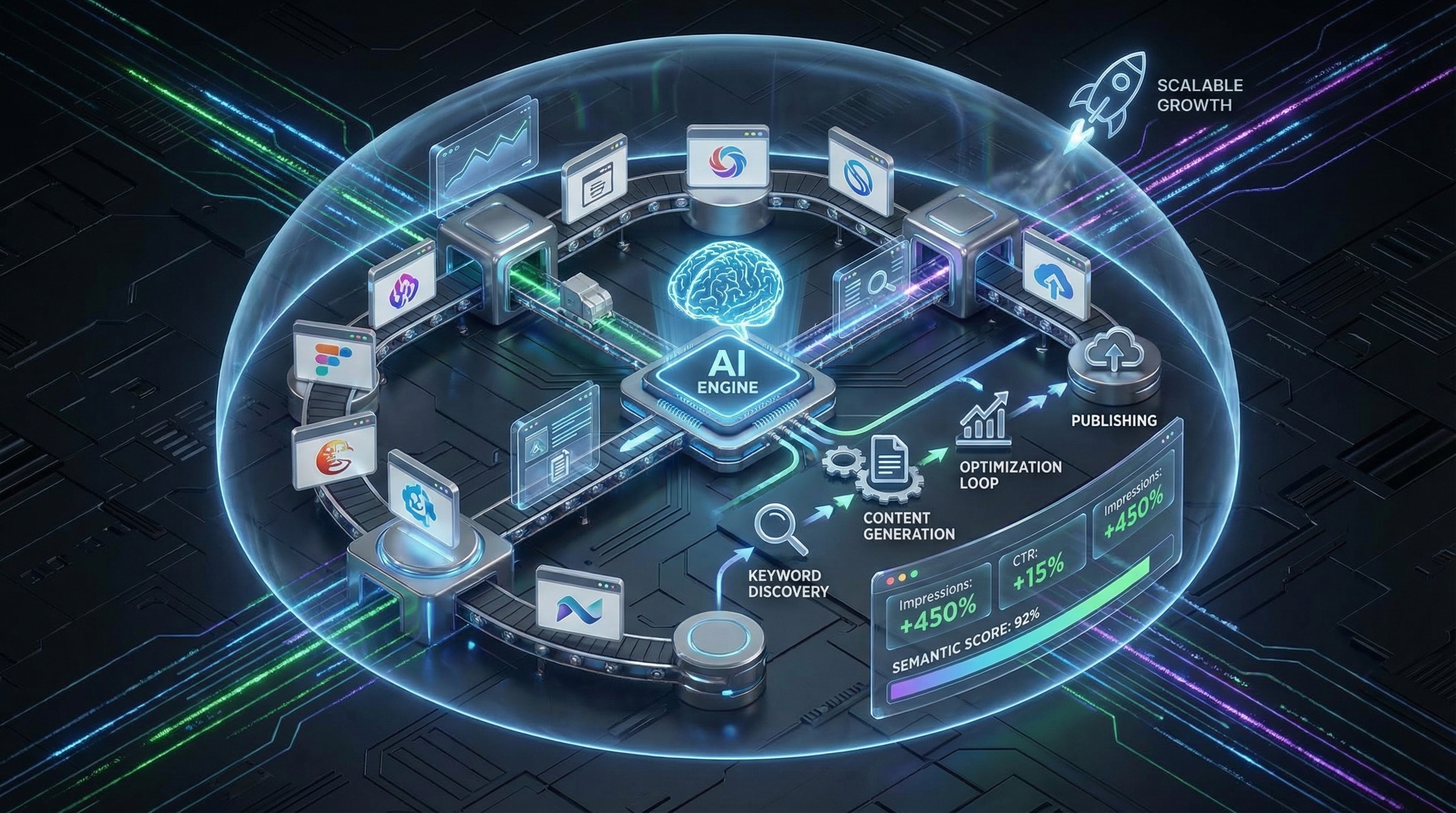
Automation isn't just AI writing. That's the single most common misconception that leads agencies and founders to buy an AI copywriting tool, feel underwhelmed, and conclude that automation doesn't work. It does work — but only when the full stack is automated: keyword discovery, content generation, SEO optimization, publishing, and performance monitoring [3].
True multi-site automation requires site-level configuration — tone, topic clusters, internal linking rules, and publishing schedules per domain. A healthcare client site and a SaaS productivity tool don't share voice parameters, keyword difficulty thresholds, or content cadences. The system has to know the difference.
The goal isn't cheaper content. It's a content operation that doesn't require your attention to function.
The Four Layers of a Multi-Site Content Automation Stack
Layer 1 — Discovery: Automated keyword and topic identification per site or niche. Programmatic pipelines pulling from search data and competitor gap analysis, segmented by domain, continuously surfacing opportunities without manual research cycles.
Layer 2 — Generation: AI-driven content creation calibrated to each site's voice and topical authority targets. Not generic output — site-specific generation with internal linking logic, structured formatting, and SEO parameters baked in [4].
Layer 3 — Publishing: Direct CMS integration with structured scheduling across multiple domains. Content that reaches 'ready' state publishes on schedule without a human clicking a button. WordPress, Webflow, Ghost — whatever the client stack is, the automation connects directly.
Layer 4 — Optimization: Continuous performance monitoring and content refresh triggers without manual input. Articles that drop in ranking automatically enter a refresh queue. Articles performing well get internally linked from new content. The system self-corrects [1].
Assisted vs. Autonomous: Know Which Mode You're Building
Assisted tools — Jasper, Copy.ai, Surfer SEO — require human input at every stage. They make individual tasks faster, but they don't eliminate the human-in-the-loop requirement. For a single operator managing one site, that's fine. For a ten-site agency portfolio, assisted tools just move the bottleneck. You still need someone to trigger, review, and publish every piece.
Autonomous platforms handle the full lifecycle without requiring a human in the loop for each piece. For multi-site operations, only autonomous systems produce compounding returns. The difference isn't speed — it's leverage.
Best Tools for Automated Content Creation Across Multiple Websites
The right tool stack depends on whether you need assisted acceleration or full-lifecycle autonomy [3]. Evaluate tools on four criteria: multi-site support, CMS integration depth, keyword-to-publish pipeline completeness, and content refresh capabilities. Avoid assembling five-tool Frankenstacks — integration failure points compound across sites and the maintenance overhead defeats the automation benefit.
Full-Lifecycle Autonomous Platforms
Ranklynk is built specifically for this problem: a closed-loop SEO engine that handles discovery, generation, publishing, and optimization across multiple sites without human handoffs. Configure site-level parameters once — tone, topic clusters, keyword thresholds, CMS credentials, publishing cadence — and the system executes continuously. It's designed for agencies managing client sites and founders who need SEO to run without them. See how it works
Assisted AI Content Tools (and Their Limits at Scale)
Jasper, Copy.ai, and Writesonic are strong for single-site operators with editors in the loop. They accelerate drafting but require manual brief creation, human review, and manual publishing. Surfer SEO adds a content optimization layer but requires manual brief creation and publishing steps. None of these tools natively support true multi-site autonomous publishing pipelines [3]. They're useful instruments — they're not a system.
Workflow Automation Connectors
Zapier and Make can bridge point tools into multi-step workflows [5], but they add fragility across multi-site operations. Every connector is a potential failure point, and when you're running parallel pipelines across ten domains, fragility compounds. Native integrations — direct WordPress, Webflow, and Ghost connectors — are more reliable at volume. API-first platforms allow custom orchestration but require developer resources that most agencies and solo founders don't want to allocate to content infrastructure.
How to Build an Automated Content Workflow for Multiple Sites
Broken manual processes become faster broken automated processes. Map the workflow end-to-end before automating anything. The configuration work you do upfront determines whether the system runs cleanly at scale or breaks in ways you won't catch until rankings decay.
Step 1: Configure Site-Level Content Parameters
Define topical authority targets per site — don't let the system publish off-topic at scale. A single off-topic article is a minor inefficiency. A hundred off-topic articles published autonomously across a portfolio is a topical authority disaster.
Set keyword difficulty and search volume thresholds per site based on domain authority. A new site shouldn't be targeting the same difficulty range as a five-year-old authority domain. Build internal linking maps per site to automate contextual link insertion — this is the highest-leverage on-page SEO signal that most automations skip entirely.
Step 2: Automate Keyword Discovery and Topic Clustering
Use programmatic keyword pipelines that pull from search data and competitor gap analysis per domain. Cluster keywords into content briefs automatically — eliminate manual brief creation entirely. Prioritize by traffic potential and ranking probability, not just raw volume. A 200-search/month keyword with low competition on a new domain outperforms a 5,000-volume keyword you'll never rank for.
Scaling Content Output Without Scaling Headcount
The only way to serve more client sites or cover more product verticals without hiring is through autonomous systems — not faster manual processes [2]. Document the content system, not the content. The SOP is for the machine, not the human.
Agencies that automate content production redeploy human talent to strategy, client relationships, and the creative decisions that actually require judgment. SaaS founders who automate SEO content reclaim product development time while compounding organic growth in the background.
Agency Use Case: Managing Content Across 10+ Client Sites
Configure once per client site — tone, topics, cadence, CMS credentials. The system runs parallel publishing pipelines without proportional staff increases. A four-person agency managing twelve client sites doesn't need twelve content managers. Monthly reporting pulls from automated performance data — no manual aggregation, no spreadsheet maintenance, no hours lost to status updates.
The operators who've built this correctly have stopped babysitting their content. The pipeline runs. The reports generate. The strategy conversations replace the execution conversations.
Founder Use Case: Autonomous SEO While Building Product
Set up content automation for your SaaS niche on day one and let it compound while you ship features. The trap most founders fall into is 'I'll do SEO when I have time' — which translates to 'I'll do SEO never.' Autonomous systems don't need your time. They need your configuration once, and then they run.
Organic traffic that compounds while you're focused on the product is the only traffic strategy that makes sense for a bootstrapped SaaS. Paid acquisition stops the moment you stop paying. A content system that publishes and optimizes continuously builds an asset that appreciates over time.
Brand Voice Profiles, Duplicate Content, and Managing Tone at Scale
A critical operational concern for multi-site content automation is maintaining brand consistency across domains while avoiding Google's duplicate content penalties — especially when managing similar niches or syndicating content across properties.
Configuring Brand Voice Profiles Per Site: Within any serious content automation platform, each site should have its own voice profile — defined by tone parameters (formal vs. conversational), industry vocabulary, persona, and content formatting rules. Don't run one generic voice profile across multiple client sites. Define these parameters during onboarding and enforce them at the generation layer, not as a post-editing step.
Canonical Tag Strategies and Content Variation: When content themes overlap across domains, canonical tags tell Google which version is the primary source. For genuinely different sites serving different audiences, canonical tags on cross-posted content prevent duplicate content penalties. Beyond canonicalization, content variation techniques — different angles, different primary keywords, different structural approaches to the same topic — ensure that similar subject matter produces genuinely distinct articles per domain. Thin content that's slightly reworded across sites is the fastest way to trigger algorithmic penalties at scale [4].
Managing Site-Specific Tone Guidelines at Scale: Maintain a documented tone profile for each site in a structured format your automation platform can reference. This isn't a style guide PDF — it's a machine-readable parameter set: reading level, vocabulary restrictions, preferred sentence structure, brand terminology, and prohibited phrases. The discipline of treating voice as a configurable parameter rather than a human editorial judgment is what makes multi-site automation sustainable.
Cost Comparison and ROI Framework for Multi-Site Content Automation
The pricing question is legitimate and almost never answered concretely. Here's a framework.
Tool Pricing Tiers (2026 Reference Points):
- Assisted tools (Jasper, Writesonic, Copy.ai): $49–$125/month per user. Designed for single-site, human-in-the-loop workflows. Cost scales with seat count, not site count.
- Mid-tier automation platforms (ContentBot, similar): $19–$99/month. Limited multi-site support, minimal native CMS integration.
- Full-lifecycle autonomous platforms (Ranklynk): Priced for multi-site portfolios with site-level configuration, autonomous pipelines, and native CMS publishing. The cost model aligns with the operational model — you pay for sites managed, not hours spent.
Break-Even vs. Freelance Writers:
| Portfolio Size | Freelance Cost/Month (est.) | Automation Platform Cost | Break-Even Timeline |
|---|---|---|---|
| 3 sites | $1,500–$2,500 | $150–$300 | Month 1 |
| 5 sites | $2,500–$4,500 | $200–$500 | Month 1 |
| 10+ sites | $5,000–$12,000+ | $400–$900 | Immediate |
These estimates assume 8–12 articles per site per month at $35–$80 per article (mid-tier freelance), plus editorial review time at $50/hour. Automation platforms at scale deliver unit economics that freelance models structurally cannot match past the three-site threshold.
ROI Metrics to Track:
- Cost-per-published-article (automated vs. manual baseline)
- Ranking velocity: time from publish to page-one position
- Hours reclaimed per client site per month (agency metric)
- Content decay rate reduction over 6–12 month windows
- Organic traffic compound growth rate per domain
The honest ROI story isn't just cost savings — it's the strategic capacity unlocked when execution is automated. The hours reclaimed from content production don't disappear; they get redeployed to the work that generates higher-margin outcomes.
Common Mistakes in Multi-Site Content Automation
Treating all sites identically is the most expensive mistake. Each domain needs its own content profile or automation produces generic, underperforming content at scale — and at scale, that failure is catastrophic.
Automating publication without automating optimization is the second major failure mode. Content that isn't refreshed decays in rankings. An autonomous system that only publishes and never optimizes is half a system. Over-relying on volume — publishing 500 thin automated articles per site — destroys topical authority faster than no content would. Quality and topical depth still matter; automation just means you can produce quality at volume without proportional labor.
Ignoring internal linking automation leaves the highest-leverage on-page SEO signal on the table. Skipping native CMS integration — stopping the automation at 'draft ready' — means a human still has to click publish. That's not automation. That's a fancy drafting tool.
The Bottom Line
Automated content creation for multiple websites isn't a future state — it's the current operating model for agencies and founders who've stopped treating content as a manual process. The system works when you configure it correctly: site-level parameters, autonomous keyword-to-publish pipelines, voice profiles per domain, canonical strategies to protect against duplicate content penalties, and continuous optimization loops that don't require daily management.
The operators winning in organic search right now aren't working harder. They built the machine and let it run. They're compounding while their competitors are still writing briefs.
If you're managing multiple sites and still doing this manually — or stitching together assisted tools that require human input at every stage — you're not running a content operation. You're running a content treadmill. The machine exists. The only remaining question is when you step off the treadmill and let it run without you.
See how Ranklynk runs autonomous content pipelines across multiple sites — from keyword discovery to published and optimized articles — without a single manual step. See how it works
Frequently Asked Questions
Q: What is automated content creation for multiple websites?
Automated content creation for multiple websites refers to a full-stack system that handles every stage of the content lifecycle across multiple domains — from keyword discovery and content generation to SEO optimization, publishing, and performance monitoring — without requiring manual intervention at each step. It's not simply using an AI writing tool to produce articles. True multi-site automation means configuring site-level rules for tone, topic clusters, internal linking, and publishing schedules for each domain, then letting the system execute consistently and at scale. Agencies managing five to twenty client sites, SaaS founders running multiple product verticals, and media operators use these systems to publish high-quality, optimized content without proportionally scaling headcount.
Q: Why does manual content creation break down when managing multiple websites?
Manual content creation scales linearly with human effort — every new client site or keyword cluster requires more briefs, writers, editors, and publishers. There's no leverage or compounding. Agencies often burn 60–80% of retainer hours on repeatable content tasks, leaving no margin for strategic work. Across a multi-site portfolio, the problem compounds: inconsistent publishing cadences send irregular signals to search engines, causing ranking volatility; handoff failures between writers and editors leave drafts unpublished; and time-to-publish lag means trending keyword windows are missed while competitors with automated workflows capture them first. Managing performance data manually across ten domains means insights always arrive too late for timely action.
Q: How does automated content creation for multiple websites actually save time?
Automation saves time by eliminating the repetitive, sequential handoffs that slow manual workflows. Instead of individually briefing a writer, waiting for a draft, routing it to an editor, implementing feedback, and then publishing — all of which can take weeks — an automated system compresses that cycle dramatically. Keyword discovery, brief creation, draft generation, SEO optimization, and publishing all happen within a unified workflow. For multi-site operators, this means publishing across ten domains simultaneously rather than sequentially, capturing keyword opportunities while they're relevant, and maintaining consistent publishing cadences that support ranking momentum — all without daily operational oversight.
Q: What are the key components of a full-stack automated content system for multiple sites?
A complete automated content creation system for multiple websites includes five core components: keyword discovery (automatically identifying high-value opportunities per site), content generation (producing drafts aligned to site-specific tone and topic clusters), SEO optimization (ensuring on-page signals, internal links, and structure are correct per domain), automated publishing (scheduling and deploying content without manual uploads), and performance monitoring (tracking rankings, traffic, and content decay signals to trigger updates). Each site also requires its own configuration layer — defining tone of voice, topic authority focus, internal linking rules, and publishing cadence — so the automation produces contextually appropriate output rather than generic content across every domain.
Q: What is the most common mistake agencies make with content automation?
The most common mistake is treating AI content writing tools as the entire automation solution. Agencies buy an AI copywriting tool, find the output underwhelming without proper configuration or workflow integration, and conclude that automation doesn't work. In reality, a single AI writing tool addresses only one stage of the content process. Without automated keyword research feeding the system, without site-specific configuration governing tone and topic focus, without automated publishing and performance monitoring closing the loop, the workflow still breaks down at every manual handoff point. Effective automated content creation for multiple websites requires the full stack to be connected — not just the writing step.
Q: How does inconsistent publishing frequency affect SEO across multiple websites?
Inconsistent publishing cadence is one of the most damaging and least visible problems in multi-site content management. Search engines reward predictable, consistent content signals — sites that publish regularly tend to be crawled more frequently and maintain stronger ranking momentum. A manual workflow that produces four articles one month and one the next sends irregular signals that suppress that momentum. Across a portfolio of multiple websites, this problem multiplies: some sites may go weeks without new content while others are temporarily over-prioritized. Automated content creation solves this by maintaining site-level publishing schedules that execute consistently regardless of team bandwidth or competing priorities.
Q: Who benefits most from automated content creation across multiple websites?
Three groups benefit most from automated content creation for multiple websites. First, digital agencies managing content retainers for multiple clients — automation lets them scale output without adding headcount for every new account. Second, SaaS founders running multiple product lines or content sites who can't split focus between product development and content strategy without one suffering. Third, media operators and programmatic SEO practitioners publishing at volume across multiple domains, where manual production is simply not economically viable. In all three cases, the core benefit is the same: decoupling content output from human labor hours so that growth in the number of sites managed doesn't require proportional growth in the team.
Q: How do you maintain content quality across multiple websites when using automation?
Maintaining quality in automated content creation for multiple websites requires robust site-level configuration rather than relying on generic prompts or default settings. Each domain needs its own defined tone of voice, topic authority focus, internal linking rules, and content standards that the automation system enforces consistently. Quality control layers — such as automated SEO audits, readability checks, and human editorial review gates for sensitive or high-stakes content — should be built into the workflow rather than bolted on afterward. Performance monitoring also plays a quality role: tracking rankings and engagement signals per site allows the system to identify underperforming content and trigger updates, creating a closed-loop improvement cycle rather than a publish-and-forget approach.
References
[1] https://www.coredna.com/blogs/content-automation. coredna.com. https://www.coredna.com/blogs/content-automation
[2] https://www.getblend.com/blog/10-best-ai-tools-to-use-for-content-creation/. getblend.com. https://www.getblend.com/blog/10-best-ai-tools-to-use-for-content-creation/
[3] https://www.leadpages.com/blog/automated-content-creation. leadpages.com. https://www.leadpages.com/blog/automated-content-creation
[4] https://www.smartling.com/blog/automated-content-generation. smartling.com. https://www.smartling.com/blog/automated-content-generation
[5] https://www.coredna.com/blogs/content-automation. coredna.com. https://www.coredna.com/blogs/content-automation