Autonomous SEO System for Agencies: Stop Managing SEO and Start Running a Machine
Your agency is leaking time. Every hour your team spends manually auditing content, chasing keyword gaps, and babysitting publishing workflows is an hour not spent on client strategy, new business, or anything that actually scales. Multiply that across 10, 20, or 50 client sites and you don't have an SEO operation — you have a treadmill.
In 2026, the agencies pulling ahead aren't hiring more SEO specialists. They're deploying autonomous SEO systems. Agentic AI has moved from buzzword to infrastructure, with platforms now capable of running the full SEO lifecycle — discovery, content generation, publishing, and continuous optimization — without a human in the loop [1]. The competitive gap between agencies that automate and those that don't is widening fast.
This guide breaks down what an autonomous SEO system actually is, how agentic AI makes it possible, and what to look for when choosing one for your agency — so you can stop operating SEO like a manual service and start running it like a self-correcting machine.
What Is an Autonomous SEO System (And Why Agencies Can't Afford to Ignore It)
An autonomous SEO system is a closed-loop engine that handles keyword discovery, content generation, publishing, and performance optimization without manual intervention. Not a tool. Not an assistant. Infrastructure.
This is the critical distinction. Most of what's marketed as "AI SEO" is still AI-assisted — tools that speed up tasks while humans make every decision. An autonomous system inverts that model. Agents make decisions, execute tasks, and course-correct based on live performance data. The human role shifts from operator to overseer.
For agencies, this matters because the agency-specific problem isn't capability — it's capacity. Managing SEO across multiple client sites breaks every manual workflow. Content calendars collapse. Keyword-to-publish pipelines require too many handoffs. Refreshing underperforming content gets deprioritized because it's invisible and time-consuming. The hidden cost compounds: your best people are burning hours on repeatable execution instead of strategy.
To compete organically in 2026, brands need consistent, high-volume content output across clusters — a volume that human teams simply can't sustain across a full client portfolio [2]. The agencies winning right now have made a structural decision: SEO is a system, not a service.
The Difference Between AI-Assisted SEO and Truly Autonomous SEO
AI-assisted SEO means your team uses tools to move faster. Jasper drafts the copy. Ahrefs surfaces the keywords. Screaming Frog runs the audit. Humans still make every call, approve every piece, push every publish button.
Truly autonomous SEO means agents make decisions, execute tasks, and adapt — without step-by-step human instruction. The system identifies what to write, writes it, publishes it, monitors its performance, and triggers updates when rankings move. Self-publishing. Auto-optimization. Closed-loop reporting. No babysitting.
For agency delivery capacity and margin, the distinction is everything. AI-assisted tools improve individual productivity. Autonomous systems multiply operational throughput without headcount growth.
Why Traditional SEO Workflows Break at Scale
Manual content calendars collapse when you're managing 10+ client sites. The math doesn't work: if each client needs 8-12 pieces per month, you need writers, editors, SEO reviewers, and a project manager to hold it together — and the whole thing breaks the moment anyone leaves or a deadline shifts.
Keyword-to-publish pipelines require too many handoffs. Research in one tool, briefs in another, writing in a third, publishing in a fourth. Each handoff is a failure point. Each failure point costs time and introduces inconsistency.
Refreshing underperforming content is always deprioritized. It's invisible, unglamorous, and time-consuming — even though it's often the highest-ROI SEO activity on the table. A system that never sleeps catches content decay before it costs you rankings.
How Agentic AI Powers the Autonomous SEO Engine
Agentic AI means AI that plans, acts, and adapts toward a goal without step-by-step human instruction. Unlike prompt-based tools where a human inputs a request and receives an output, agents operate autonomously within a defined objective — taking sequential actions, evaluating results, and adjusting behavior based on what they find.
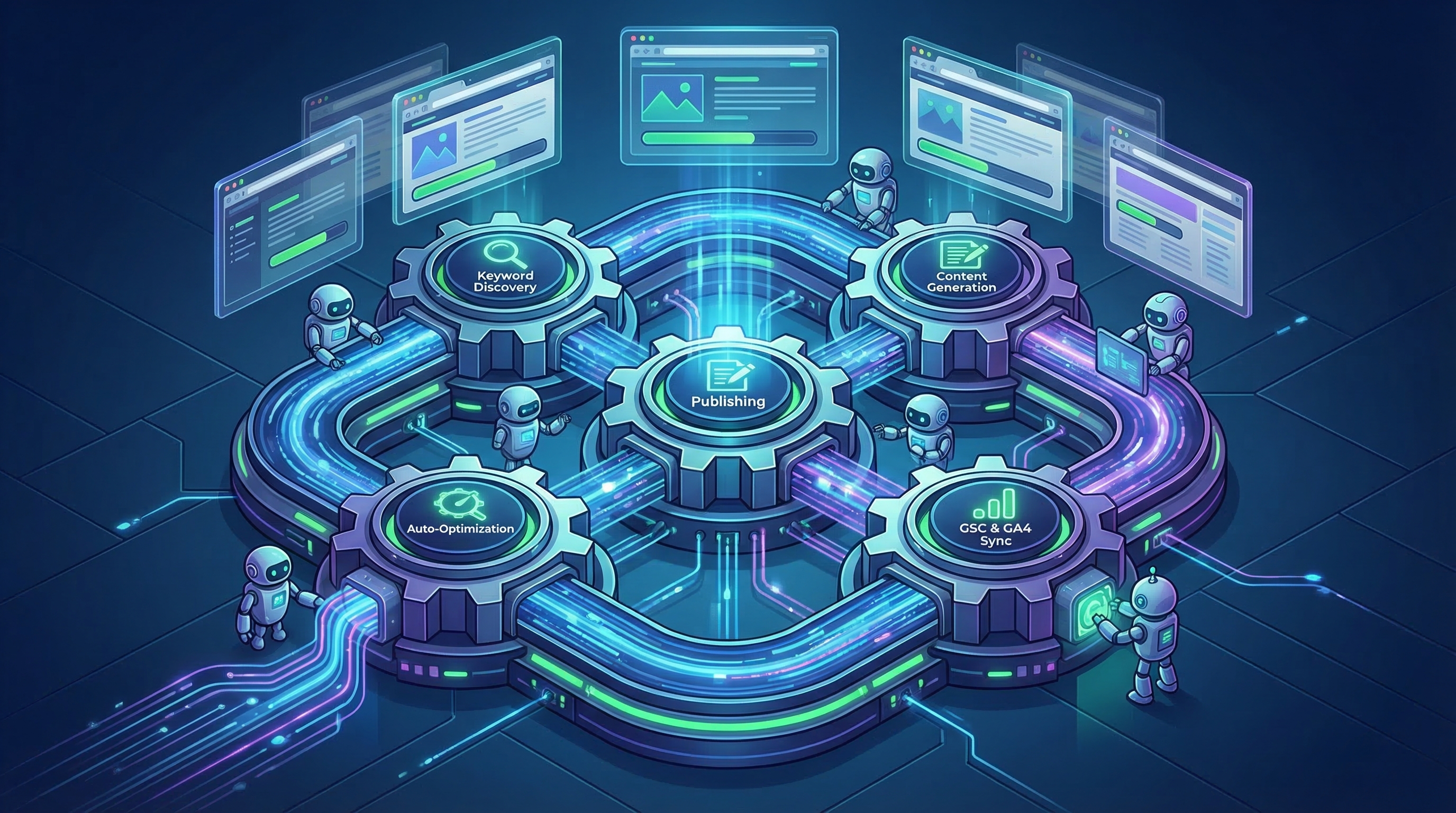
In a modern autonomous SEO stack, this translates to four core agents operating in coordination: a discovery agent, a content agent, a publishing agent, and an optimization agent. Each handles a discrete phase of the SEO lifecycle. Together, they form a closed-loop system [1].
The Four Agents Running a Modern SEO System
Discovery Agent: Crawls SERPs continuously, identifies keyword opportunities, and maps content gaps without human input. It knows what to target next based on competition signals, search volume, and existing content coverage across your client's domain.
Content Agent: Takes keyword targets and intent signals from the discovery agent and generates structured, optimized content. Not generic output — content aligned to the specific search intent, competitive landscape, and client niche.
Publishing Agent: Handles CMS integration, formatting, scheduling, and deployment without human touchpoints. This is the hardest piece to build and the most valuable piece of the stack. When publishing is automated, the entire pipeline runs without bottlenecks.
Optimization Agent: Monitors rankings, identifies content decay, and triggers targeted refreshes and on-page updates automatically. This is where compounding begins — the system doesn't just generate content, it continuously improves what it's already deployed.
Why Closed-Loop Matters More Than Content Quality Alone
One-time content generation is a dead end. Any tool can produce an article. What separates autonomous SEO infrastructure from an AI writing assistant is what happens after publish.
Closed-loop means rankings data, CTR signals, and crawl feedback re-enter the system and inform the next cycle. The system learns which content is gaining traction, which is decaying, and what adjustments are needed. Agencies deploying closed-loop systems compound their SEO output over time — every optimization cycle makes the next one more effective.
Contrast this with tools that generate content but have no feedback mechanism. You publish, hope for rankings, and run a manual audit six months later to figure out what went wrong. That's not a system. That's a workflow with extra steps.
What to Look for in an Autonomous SEO System for Your Agency
Not every platform that calls itself "autonomous" actually runs itself. Here's what separates genuine autonomous infrastructure from AI tools with good marketing.
Multi-Client Architecture: The Non-Negotiable for Agencies
Single-tenant tools force agencies to duplicate work across every client. True agency-grade systems manage separate keyword strategies, content pipelines, and optimization loops per client — from a single interface.
Look for role-based access, client segmentation, and portfolio-level reporting. The red flag: tools that require manual setup replication for each new client. If onboarding client #15 takes the same effort as client #1, the system isn't built for agencies.
The Keyword-to-Publish Pipeline Explained
A fully automated pipeline looks like this: SERP analysis → intent mapping → brief generation → content creation → CMS publish. No human handoffs. No approval queues. No publishing bottleneck.
Most tools drop the baton somewhere in that chain — usually between research and execution, or between generation and publishing. Publishing automation is the hardest piece to implement and the one most vendors skip. Before committing to any platform, ask one question: how many human steps are in your publish workflow? If the answer is more than zero for routine content, it's not autonomous.
Evaluating Agentic SEO Platforms: A Decision Framework
When evaluating platforms, cut through feature lists and assess on these dimensions:
- Autonomy depth: How many steps require human input before content goes live?
- Optimization frequency: Does the system re-evaluate content on a schedule or on performance triggers?
- Client scalability: What happens to system performance when you add client #20?
- Integration layer: Native CMS connectors vs. API-only vs. manual export — native wins for true automation
- Support model: Does this require ongoing onboarding support to function, or does it genuinely run itself?
Top Autonomous SEO Platforms for Agencies in 2026
The agentic SEO category is still forming. Most tools marketing themselves as autonomous still require significant human orchestration. A few are building toward genuine full-lifecycle automation.
Ranklynk: The Fully Autonomous SEO Engine Built for Operators
Ranklynk is positioned as the first fully autonomous SEO engine — a complete operating system for SEO, not an AI writing assistant or standalone keyword tool. The architecture runs the full lifecycle: discovery → generation → publishing → optimization, in a single closed-loop system.
Built specifically for agencies managing multiple client sites and content-heavy operations, Ranklynk operates on a deploy-once, compound-over-time model. The system identifies keyword opportunities, generates and publishes content, monitors ranking performance, and triggers optimization — without a human in the loop at any stage. See how it works and understand why this is fundamentally different from tools that still require human orchestration between phases.
The key differentiator: Ranklynk doesn't just assist — it operates. Account managers oversee the system rather than executing the tasks the system owns.
How Other Agentic SEO Tools Fit the Market
Several platforms are building in this direction, each with a different scope of automation:
Synscribe launched an autonomous AI SEO agent focused on content generation and publishing automation [3]. Strong on the content creation side, with growing publishing capabilities — a solid option for teams prioritizing content velocity.
Nightowl (Nightwatch) offers an SEO AI agent with autonomous optimization features [1]. Particularly strong on monitoring and rank tracking with agent-driven alerting, though full pipeline autonomy is still developing.
Nytro SEO brings automated on-page optimization with a strong technical SEO foundation [4]. Best suited for teams that have the content side covered and need automated on-page execution.
The honest evaluation framework: match the tool to your autonomy requirements. If you need full lifecycle autonomy across a client portfolio, assess whether the platform eliminates human steps or just reduces them.
How Agencies Are Deploying Autonomous SEO Systems Across Client Portfolios
The operational model shifts when you deploy an autonomous system. Account managers stop doing SEO tasks and start overseeing SEO systems. The work becomes strategic and relationship-focused — the execution runs in the background.
Replacing the Manual Content Calendar With an Autonomous Pipeline
Content calendars are a symptom of a broken workflow, not a solution. They exist because someone has to decide what to publish next, coordinate who writes it, and track whether it got done. In an autonomous system, the discovery agent makes the publish-next decision based on live opportunity signals. There's no brief-writer-editor-publisher chain — there's a pipeline that runs.
What does the agency team actually do when the pipeline runs itself? Strategy, client relationships, and growth. The highest-leverage work that was always being crowded out by execution.
Continuous Optimization at Scale: What Human Teams Can't Keep Up With
Content decay is invisible until rankings drop. By the time a manual audit catches a declining page, you've already lost positions — and potentially the client's trust. Autonomous optimization agents monitor ranking changes continuously and trigger targeted content updates before decay becomes a drop.
The compounding effect is real: a system that constantly improves deployed content builds domain authority faster than a team that publishes new content without revisiting old work. And from a client retention perspective, clients see consistent ranking improvement without the agency over-reporting effort. The results speak. The system delivers them.
Autonomous SEO for Startup Founders and Solo SaaS Builders
The agency model isn't the only fit. Solo founders building SaaS products need SEO that runs without a team — and without the runway cost of hiring one.
Why Founders Shouldn't Hire an SEO Agency (And What to Do Instead)
Agency retainers for content-heavy SEO programs run $3K-$15K per month [2]. That's significant runway for an early-stage startup. Worse, it's a service relationship, not an asset. When you stop paying, the SEO stops working.
Autonomous SEO is owned infrastructure. You deploy the system, it builds your content asset, and it compounds over time — independent of an agency relationship. For founders who built a product and need organic traffic without diverting attention from the product itself, autonomous SEO is the only model that scales without a team. Target the right keyword clusters, let the system generate and publish, stay focused on building. The organic growth flywheel runs itself [5].
Implementing an Autonomous SEO System: What the First 90 Days Look Like
Deployment is faster than most agencies expect. The system does the heavy lifting — your job is configuration, not execution.
Weeks 1-2: System configuration. Client sites, target keyword clusters, CMS integrations. Resist the urge to over-customize before the system has data to work with — this is the most common setup mistake.
Weeks 3-4: First autonomous content pipeline runs. Discovery, generation, and publish cycle completes. Initial content goes live without manual intervention.
Month 2: Optimization loop activates. The system begins monitoring rankings and triggering updates based on performance signals. The feedback cycle starts feeding forward.
Month 3: Compounding begins. Portfolio-wide content velocity increases without additional team input. Indexed content volume climbs. Ranking velocity improves. Team hours previously spent on repeatable SEO execution are reclaimed.
Measure what matters: indexed content volume, ranking velocity, time-to-publish, and team hours recovered. These are the signals that tell you the system is running — not just running reports.
How to Sell Autonomous SEO to Clients: ROI Calculators and Reporting That Sells Itself
Agency decision-makers who've evaluated autonomous systems face a consistent follow-up challenge: how do you justify this investment to clients and internal stakeholders?
Start with the hours math. A mid-size agency managing 10 client sites typically spends 15-20 hours per client per month on SEO execution — research, content creation, publishing, reporting. At 10 clients, that's 150-200 hours monthly of repeatable execution. At a fully loaded internal cost of $75/hour, that's $11,250-$15,000/month in execution cost — before you account for tool subscriptions.
An autonomous system replaces the execution layer. The remaining team hours shift to strategy and client management — higher-margin work that actually differentiates the agency.
For client-facing reporting, the shift is equally important. When AI handles monitoring and audits continuously, client reports stop being backward-looking summaries of what happened and start being forward-looking signals of what's improving. Clients see ranking trajectories, content velocity, and optimization activity — not a list of tasks your team completed. The report becomes proof of a system working, not proof of hours logged.
Agency Migration Playbook: Transitioning From Legacy Tools Without Disrupting Rankings
Migrating from an Ahrefs + Screaming Frog + manual reporting stack to an autonomous system requires a structured approach. Here's the playbook:
Step 1 — Audit Current Tool Dependencies
- Map every tool in your current stack and its primary function
- Identify which tools handle: keyword research, content creation, publishing, monitoring, reporting
- Flag any tool that a client contract depends on for specific deliverable formats
Step 2 — Map Workflows to Autonomous Equivalents
- Replace manual keyword research with discovery agent configuration
- Replace content briefs and writer assignments with content agent pipeline
- Replace manual CMS publishing with publishing agent CMS integration
- Replace monthly audits with continuous optimization agent monitoring
Step 3 — Phased Client Rollout
- Start with 1-2 lower-risk client accounts for the first 30 days
- Validate that autonomous content meets quality bar before expanding
- Migrate 3-5 clients in month 2 after the system has baseline performance data
- Full portfolio migration in month 3 with optimization loops active
Step 4 — Risk Mitigation
- Keep existing tool subscriptions active during the overlap period — do not cut access before the new system has indexed content
- Monitor ranking stability weekly during migration, not monthly
- Document any client-specific content guidelines before configuration to prevent off-brand output
- Establish rollback criteria: if rankings decline more than 10% in 30 days, pause and audit
The transition is low-risk when it's phased. The biggest mistake agencies make is migrating their entire portfolio at once and losing visibility when something goes wrong.
The Bottom Line
Autonomous SEO systems aren't a future concept. They're the operational infrastructure that agency leaders and growth-focused founders are deploying right now to scale output without scaling headcount.
The agencies and builders who win in 2026 are the ones who stopped treating SEO as a manual service and started running it as a self-optimizing machine. Full lifecycle automation — from keyword discovery to continuous optimization — is the only model that compounds. Every other approach keeps you on the treadmill.
The math is clear. The technology is here. The only question is whether your agency deploys the system or keeps doing it manually while competitors who already have pull further ahead.
Ready to stop babysitting your SEO workflows? See how Ranklynk runs the full SEO lifecycle without a single manual step.
Frequently Asked Questions
Q: What is an autonomous SEO system for agencies?
An autonomous SEO system for agencies is a closed-loop engine that handles the entire SEO lifecycle — keyword discovery, content generation, publishing, and performance optimization — without requiring manual intervention at every step. Unlike AI-assisted tools that simply speed up tasks while humans make every decision, a truly autonomous SEO system uses agentic AI to make decisions, execute tasks, and course-correct based on live performance data. The human role shifts from hands-on operator to high-level overseer. For agencies managing multiple client sites, this is infrastructure, not just a productivity tool. It enables consistent, scalable SEO output across an entire client portfolio without proportional headcount growth.
Q: What is the difference between AI-assisted SEO and truly autonomous SEO?
AI-assisted SEO means your team uses tools like Jasper, Ahrefs, or Screaming Frog to work faster, but humans still approve every piece of content, make every strategic call, and manually push every publish button. Truly autonomous SEO inverts this model entirely. Agentic AI identifies what to write, generates the content, publishes it, monitors performance, and triggers updates when rankings shift — all without step-by-step human instruction. For agencies, this distinction is critical: AI-assisted tools improve individual productivity, while autonomous systems multiply operational throughput across dozens of client sites without requiring additional hires. In 2026, the competitive gap between these two approaches is growing rapidly.
Q: Why do traditional SEO workflows break down at scale for agencies?
Traditional SEO workflows were designed for managing one or a few sites, not a full agency portfolio. When scaled to 10, 20, or 50 client sites, the math falls apart quickly. If each client needs 8–12 pieces of content per month, you need writers, editors, SEO reviewers, and project managers to keep it running — and the entire system becomes fragile the moment someone leaves or a deadline slips. Keyword-to-publish pipelines involve too many handoffs across multiple tools, each one a potential failure point that introduces delays and inconsistency. Content refreshes get deprioritized because they are time-consuming and invisible. The result is that your best people burn hours on repeatable execution tasks instead of client strategy or new business development.
Q: How does an autonomous SEO system benefit agency capacity and margins?
An autonomous SEO system directly addresses the core agency bottleneck: capacity. Agencies don't typically lack SEO knowledge — they lack the bandwidth to deliver consistently at scale across multiple clients. By automating keyword discovery, content production, publishing, and optimization, an autonomous system allows agencies to serve more clients without a proportional increase in headcount or operational costs. This means better margins on existing accounts and the ability to take on new business without overstretching teams. Instead of hiring more SEO specialists to keep up with volume, agencies can redeploy talent toward higher-value activities like strategy, client relationships, and business development — the work that actually differentiates an agency and drives growth.
Q: What tasks does an autonomous SEO system handle without human intervention?
A fully autonomous SEO system for agencies can handle several key tasks without requiring humans in the loop. These include keyword and topic discovery based on competitive gaps and search trends, content brief creation, AI-driven content generation, publishing directly to client websites, performance monitoring using live ranking and traffic data, and triggering content updates or optimizations when rankings decline. This closed-loop process means the system is continuously learning and adapting. Rather than waiting for a human to notice that a piece of content has dropped in rankings and then scheduling a refresh, the system detects the signal and acts on it automatically, maintaining SEO momentum across every client account simultaneously.
Q: Is 2026 the right time for agencies to adopt an autonomous SEO system?
Yes — in fact, for many agencies, adopting an autonomous SEO system is becoming a competitive necessity rather than an optional upgrade. As of 2026, agentic AI has matured from a buzzword into deployable infrastructure. Platforms now exist that can run the full SEO lifecycle end-to-end with minimal human oversight. Brands competing organically need consistent, high-volume content output across topic clusters — a level of output that manual human teams cannot sustain across a full client portfolio. Agencies that have already deployed autonomous SEO systems are pulling ahead in delivery capacity and margin efficiency. Those still operating manual workflows are at a structural disadvantage that will only widen as AI capabilities continue to improve.
Q: What should agencies look for when choosing an autonomous SEO system?
When evaluating an autonomous SEO system for your agency, look for several critical capabilities. First, true autonomy — the system should be able to execute the full keyword-to-publish pipeline without requiring human approval at every step. Second, closed-loop optimization, meaning the system monitors live performance data and automatically triggers content updates based on ranking signals. Third, multi-site management, since agency-specific value comes from handling dozens of client accounts simultaneously without separate manual workflows for each. Fourth, publishing integrations with the CMS platforms your clients use. Fifth, transparent reporting so clients and account managers can see what the system is doing and why. Avoid platforms that are simply AI writing tools rebranded as autonomous — real autonomy means agents making decisions, not just drafting suggestions.
References
[1] https://sedestral.com/en/blog/agent-seo-ai-tools-that-autonomously-optimize-seo. sedestral.com. https://sedestral.com/en/blog/agent-seo-ai-tools-that-autonomously-optimize-seo
[2] https://seobotai.com/. seobotai.com. https://seobotai.com/
[3] https://nytroseo.com/. nytroseo.com. https://nytroseo.com/
[4] https://www.synscribe.com/blog/ai-seo-agent-launch. synscribe.com. https://www.synscribe.com/blog/ai-seo-agent-launch
[5] https://www.onely.com/blog/best-ai-seo-agencies/. onely.com. https://www.onely.com/blog/best-ai-seo-agencies/