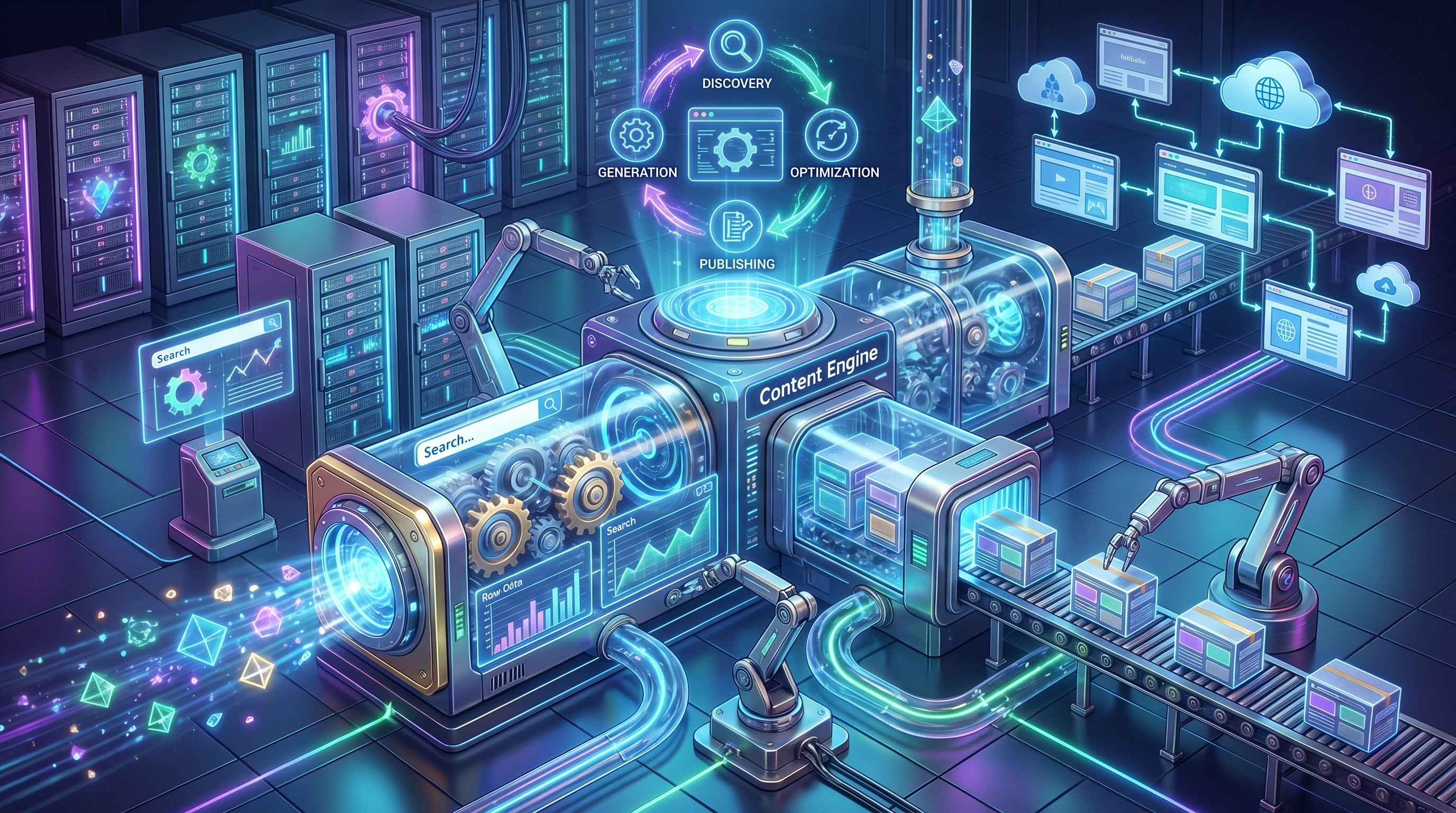
How to Build a Content Engine Without a Content Team (2026 Guide)
Most founders and agency operators are stuck in the same trap: they know content drives compounding organic growth, but building a content team feels like a full-time job before the content even starts. Hire a writer. Brief the writer. Edit the draft. Fix the SEO. Schedule the post. Repeat — forever — at whatever pace your headcount allows.
In 2026, that playbook is obsolete. Hiring a content team — writers, editors, SEO strategists, publishers — is no longer the only path to high-volume, high-quality content output. The rise of AI-driven content systems has made it possible to build a fully operational content engine that runs discovery, production, optimization, and publishing as a closed-loop system, not a headcount problem [1].
This guide breaks down exactly how to build a content engine without a content team — covering the systems, tools, and automation logic that replace manual workflows so your content scales while you stay focused on the product or the client.
What Is a Content Engine (and Why It's Not a Content Calendar)
A content engine is a repeatable, systematic process that produces and distributes content at scale. It is not a one-off campaign. It is not a spreadsheet of topics with color-coded due dates. And it is definitely not a content calendar.
A content calendar is a scheduling tool. A content engine is a production and distribution system. The difference matters more than most operators realize. Calendars tell you when to publish. Engines handle everything else — discovery, generation, optimization, publishing, and performance tracking — automatically and continuously.
Most founders and operators mistake busywork for a system. Posting sporadically, drafting reactive content, or outsourcing individual articles to freelancers isn't running a pipeline — it's running in place. The output looks like content work, but there's no compounding effect [2].
The goal is a closed-loop engine: keyword discovery feeds content generation, publishing feeds indexing, and performance data feeds optimization. Content that runs itself, not content that depends on you showing up every Monday with a fresh idea.
The 4 Core Content Types Your Engine Needs to Cover
A complete content engine covers four fundamental content types, each targeting a different stage of the funnel:
- Informational content (guides, how-tos, explainers) captures top-of-funnel search demand — the queries people ask before they know what product they need.
- Comparative and commercial content intercepts mid-funnel buyers evaluating options. "Best X for Y" and "X vs. Y" formats dominate commercial-intent SERPs.
- Programmatic or long-tail content at scale dominates niche keyword clusters that competitors haven't bothered to target — high signal, low competition, high conversion.
- Evergreen content designed to compound over time, not expire after a news cycle. This is the content that keeps earning rankings and traffic months after it was published.
A proper system generates across all four types — not just the easiest one.
Why You Don't Need a Content Team to Scale Content Output
The default assumption is that more content requires more headcount. That assumption is wrong — and expensive [3].
The real bottleneck in a traditional content team isn't the writing. It's the coordination: briefing cycles that span days, writer management overhead, editing queues that become backlogs, and publishing delays caused by CMS access issues or approval chains. A 3-person content team, operating at a realistic pace, produces 8 to 12 articles per month. An automated system can produce multiples of that output without the coordination overhead, the salary burn, or the scheduling conflicts.
This is not a quality-versus-quantity trade-off. Modern AI content systems built on SEO-grounded generation don't produce generic text — they produce intent-matched, structurally sound drafts calibrated to rank. The output isn't filler. It's infrastructure.
That said, there are cases where humans belong in the loop: brand storytelling, executive thought leadership, community-driven content, and high-stakes editorial decisions. Those exist. But they represent a fraction of the total content surface area a growing SaaS or agency business needs to cover. The scalable SEO content layer — the volume work — doesn't need a human in every step.
What You Actually Need Instead of a Team
Four components replace the content team entirely:
- A keyword-to-publish workflow that removes human handoffs at every stage
- A content generation layer trained on your niche, competitor content, and target SERPs — not a generic prompt-and-paste setup
- An automated publishing and internal linking system that handles CMS delivery and link architecture without manual input
- A performance monitoring loop that flags and refreshes underperforming content before rankings decay, without requiring manual audits
How to Build a Content Engine From Scratch: The System Stack
Every functional content engine has five core components: keyword discovery, content brief generation, content production, publishing and on-page optimization, and performance monitoring and refresh. Each component must feed the next automatically. Any manual handoff is a bottleneck — and bottlenecks are where content pipelines die [4].
Most operators today cobble together four to six disconnected tools to cover these layers. That works until it doesn't — usually when volume increases and the coordination cost becomes unsustainable. In 2026, unified systems that close the entire loop are production-ready for agency and SaaS use cases.
Step 1 — Keyword Discovery That Never Stops
Keyword research is not a quarterly sprint. By the time you've finished a one-time research project and started executing against it, the SERP landscape has shifted.
A content engine runs continuous keyword discovery — using SERP data, competitor gap analysis, and search trend signals to surface opportunities automatically. It prioritizes by traffic potential, ranking difficulty, and business relevance — not raw search volume. High-volume vanity keywords with no conversion pathway don't belong in a production pipeline. Low-competition, high-intent clusters do.
The discovery layer never stops running. It surfaces new opportunities, monitors competitor movement, and queues content automatically so the pipeline is always full.
Step 2 — From Keyword to Brief to Draft Without Human Bottlenecks
Brief generation is where most manual systems collapse. Writing a comprehensive content brief — analyzing the top-ranking pages, extracting People Also Ask data, mapping competitor structure, identifying semantic gaps — takes hours per article. At scale, it becomes the primary constraint on output.
An automated brief generation layer handles this in minutes: SERP analysis, PAA extraction, competitor structure mapping, E-E-A-T signal identification. The output isn't a generic outline — it's a SERP-grounded brief that tells the generation layer exactly what to produce and why.
Content generation that follows structured, SEO-grounded prompting produces rankable drafts, not filler. The difference between AI content that ranks and AI content that gets ignored is the quality of the brief it was built on.
Step 3 — Publishing, Internal Linking, and On-Page Optimization on Autopilot
Once a draft is approved, most manual pipelines introduce another delay: CMS upload, formatting, meta tag creation, internal link selection, schema markup. Each step is repetitive, low-value, and a candidate for automation.
An automated publishing pipeline pushes content directly to CMS — structured, formatted, and metadata-complete — without manual upload. Programmatic internal linking builds topical authority across your content graph by connecting related posts based on semantic relevance and site architecture, not editorial memory.
Structured data, meta tags, and on-page optimization elements are handled at the system level. Not by a writer, not by an SEO specialist, not by a VA. By the system — every time, without variation.
Step 4 — The Refresh Loop: Stopping Content Decay Before It Costs You Rankings
Content decay is the silent killer of organic traffic. A post that ranked in position 3 six months ago may have drifted to position 11 today — not because anything broke, but because the SERP evolved, competitors updated their pages, and your content didn't keep up. Most teams catch this too late, after the traffic has already dropped [2].
An automated performance monitoring layer detects ranking drops, impressions decline, and CTR degradation in real time. When a content piece crosses a performance threshold, it triggers a refresh cycle automatically — pulling updated SERP data, regenerating sections that have gone stale, and republishing without a manual audit cycle.
The refresh loop is what separates a content engine from a content publisher. Publishing alone doesn't compound. Publishing plus systematic refreshing does.
The 5 C's of Content — Applied to an Automated Engine
The 5 C's of content — Clarity, Consistency, Compelling, Credibility, and Call-to-Action — are a useful framework. But most operators treat them as traits to manage manually. That doesn't scale.
Run through the lens of an automated content engine, each C becomes a system output:
- Clarity is enforced by brief structure and intent alignment — the engine generates content that answers the query directly because it was built on SERP data.
- Consistency is a system property, not a discipline. When publishing is automated, output cadence doesn't depend on motivation or bandwidth.
- Compelling content is a function of search intent alignment. Content that matches what a searcher actually wants is more engaging than content that doesn't — regardless of how "creative" the writing is.
- Credibility is built through topical depth and E-E-A-T signals baked into the generation layer — structured citations, expert framing, comprehensive coverage of related subtopics.
- Call-to-Action is templated at the system level and deployed consistently across every piece of content without relying on a writer to remember to include it.
A well-built content engine operationalizes all 5 C's by default. They become outputs of the system, not traits you have to enforce.
What the 3-3-3 and 5-3-2 Content Rules Tell You About Scaling Systems
The 3-3-3 rule in marketing refers to audience segmentation across awareness stages — reaching the right audience, with the right message, at the right stage of awareness. The 5-3-2 content rule describes a content mix: for every 10 pieces published, five should be curated from external sources, three should be original content, and two should be personal or brand-driven.
Both are useful mental models for content strategy. Both are completely unsustainable to apply manually at scale.
When you're publishing 50+ pieces of content per month across multiple sites or clients, manually tracking content mix ratios and audience stage targeting per post is operationally impossible. What is possible is encoding those ratios into your content engine's generation and publishing logic — turning strategic frameworks into automated execution rules. The system maintains the ratio. You maintain the strategy.
Is Blogging Dead in 2026? (What the Data Actually Says)
The short answer: undifferentiated blog spam is dying. Systematically-built, intent-matched content is compounding.
Organic search remains the highest-ROI acquisition channel for SaaS and agency businesses — but only when executed with a proper system. The threat isn't AI-generated content. It's AI-generated content with no SEO grounding, no topical authority framework, and no refresh loop. That content floods SERPs with noise and gets filtered out by Google's quality signals [5].
The operators winning on organic in 2026 are not the ones avoiding AI content. They're the ones using AI content correctly — grounded in SERP data, built for topical authority, and maintained by a refresh loop that prevents decay. A proper content engine isn't a contributor to the AI content quality problem. It's the answer to it.
Blogging isn't dead. Blogging without a system is.
Content Engine Mistakes That Stall Growth (And How to Avoid Them)
Most content operations that plateau aren't failing because of bad writing. They're failing because of bad architecture. The most common structural mistakes:
Mistake 1: Treating a content calendar as a system. Scheduling without a production pipeline is just organized chaos. The calendar tells you when to publish. Without a system behind it, you'll miss deadlines and publish inconsistently.
Mistake 2: Generating content without keyword grounding. Publishing posts nobody is searching for is expensive busywork. Every piece of content needs to map to a search demand signal before it enters the pipeline.
Mistake 3: Publishing without internal linking. Orphaned content never builds topical authority. Every published piece needs to connect to the broader content graph — automatically, not manually.
Mistake 4: No refresh loop. High-potential content decays. If your system doesn't detect and respond to ranking drops, you're leaving traffic on the table and handing positions to competitors.
Mistake 5: Over-indexing on brand voice at the expense of search intent. Writing for yourself instead of the SERP produces content that sounds great internally and ranks nowhere externally.
Mistake 6: Waiting until you have a team to start. The best time to build the system is before you need the volume. Systems take time to compound. Starting late means starting behind.
Who Should Build a Content Engine Without a Team (Real Use Cases)
This is not a one-size-fits-all solution — but it fits more operators than most expect:
- Solo SaaS founders who need organic traffic but can't afford to hire an SEO agency or content team. The content engine runs while you build the product.
- Agency operators managing 10+ client sites who need to scale content output without scaling headcount. Each new client adds pipeline capacity, not coordination overhead.
- Growth leads at content-heavy B2B companies who are tired of manually auditing and refreshing underperforming posts every quarter.
- Startup founders post-launch who need to build topical authority fast to compete with established players who have years of content compounding behind them.
- Any operator where agency retainers are eating into runway and the ROI timeline on outsourced content is measured in months, not weeks.
If content is a growth lever for your business and you don't have a dedicated team to run it, a content engine isn't a nice-to-have. It's the only way to compete.
How to Start Content Creation as a Beginner With No Team
The question "how do I start content creation as a beginner?" usually gets answered with writing tips and editorial advice. That's the wrong frame.
Being a beginner at content isn't about lacking writing skill — it's about lacking a repeatable process. Most beginners fail not because their writing is bad but because they have no system and therefore no consistency [3].
The fastest path from zero to a functioning content engine:
- Pick a defined keyword cluster — not a broad content plan. A tight topical cluster (10-20 closely related keywords) gives the system a focused area to build authority in before expanding.
- Automate the pipeline — use a system to generate, publish, and track before adding any manual creative layer. Get the infrastructure running first.
- Let the data tell you what to double down on — after 30-60 days, performance signals will show which topics are gaining traction. Expand from there.
Don't wait for the perfect content strategy before building the system. Build the system, run it against a focused cluster, and let the data drive the strategy. If you want to see what a fully automated keyword-to-publish pipeline looks like in practice, see how it works.
The Bottom Line
A content engine isn't a team. It's a system — one that handles keyword discovery, content generation, publishing, and performance optimization as a closed loop with no human handoffs required.
In 2026, the operators winning on organic search aren't the ones with the biggest content teams. They're the ones who stopped treating content as a creative project and started treating it as infrastructure. The components are clear: a continuous discovery layer, intent-matched generation, automated publishing with internal linking, and a data-triggered refresh loop. Stack them correctly and you have a machine that compounds while you focus on everything else.
The old path — hire writers, manage editors, build a content team — still works if you have the runway, the time, and the appetite for it. But it's no longer the only path. And for most founders and operators, it's not even the best one.
Ranklynk closes the loop from keyword discovery to published, optimized content — without a single human handoff. See how it works at ranklynk.io.
Frequently Asked Questions
Q: What are the 5 C's of content?
The 5 C's of content are a framework for producing content that actually performs: Clarity, Conciseness, Consistency, Compelling storytelling, and Credibility. Clarity ensures your message is easy to understand and free of jargon. Conciseness respects your audience's time by trimming unnecessary filler. Consistency means publishing regularly enough that search engines and readers can rely on you — a key principle when building a content engine without a content team, since automation handles scheduling. Compelling storytelling keeps readers engaged past the first paragraph, which directly impacts dwell time and SEO signals. Credibility ties it all together by grounding content in real data, expert insight, or firsthand experience. When building a solo or automated content engine, applying the 5 C's as quality filters — rather than relying on a human editor — ensures output remains high-value even at scale.
Q: How to build a content engine?
Building a content engine involves four interconnected stages: discovery, production, optimization, and distribution. Start with keyword discovery — use tools like Ahrefs, Semrush, or AI-driven research tools to identify high-value, low-competition queries in your niche. Next, set up a production workflow that generates structured drafts based on those keywords, either through AI writing tools, templated briefs, or a combination of both. Third, build an optimization layer that checks for on-page SEO, internal linking, and content depth before anything publishes. Finally, automate distribution so content moves from draft to CMS to published without manual intervention. The key distinction between a content engine and a content calendar is that an engine runs continuously. Discovery feeds production, publishing feeds indexing, and performance data feeds back into your next round of topic selection. Done right, you can build a content engine without a content team — using systems and automation to replace headcount.
Q: How can I start content creation as a beginner?
If you're starting content creation from scratch, focus on three things: picking a niche, understanding search intent, and building a repeatable workflow. First, choose a specific topic area where you have genuine knowledge or access to credible sources — broad topics are harder to rank for and harder to sustain. Second, learn the basics of keyword research using free tools like Google Search Console or Google Keyword Planner to identify what your target audience is already searching for. Third, build a simple production routine: one keyword, one outline, one draft, one published post. Repeat with consistency. In 2026, beginners have a significant advantage because AI writing tools, SEO plugins, and no-code CMS platforms make it possible to produce polished, optimized content without a large team or technical background. Start with informational content — guides and how-tos — since these attract top-of-funnel traffic and are easier to structure. Once you have 10 to 20 published pieces, you'll have enough data to refine your approach and begin scaling.
Q: How to build a content team?
Building a traditional content team typically involves hiring writers, an editor, an SEO strategist, and a content manager or publisher. Each role handles a distinct part of the workflow: writers produce drafts, editors ensure quality and consistency, SEO strategists manage keyword targeting and on-page optimization, and publishers handle scheduling and distribution. However, in 2026, building a full content team is no longer the only — or even the most efficient — path to content scale. Many founders and agency operators are replacing traditional team structures with AI-driven content systems that handle discovery, generation, optimization, and publishing automatically. If you do want a lean human team, start with one strong editor who can manage AI-generated output, combined with an SEO strategist who owns keyword strategy. This hybrid model — human oversight plus automated production — is increasingly how high-output content operations are structured without the cost and complexity of a full headcount.
Q: What is the 3 3 3 rule in marketing?
The 3 3 3 rule in marketing is a framework that structures audience targeting and messaging around three core groups, three key messages, and three primary channels. The idea is to avoid spreading your marketing too thin by focusing your efforts on the three audience segments most likely to convert, communicating three distinct value propositions tailored to each, and distributing those messages across three channels where your audience is most active. Applied to content marketing, the 3 3 3 rule helps operators prioritize without overextending. Instead of publishing across every platform or chasing every keyword, you identify three core content pillars, three distribution channels (such as organic search, email, and social), and three audience personas to write for. This kind of structured focus is especially useful when building a content engine without a content team, since constraint forces efficiency and makes automation easier to configure and maintain.
Q: What are the 4 core content types?
A complete content engine should cover four core content types, each serving a different stage of the buyer journey. Informational content — guides, how-tos, and explainers — captures top-of-funnel search demand from users who are still researching a problem. Comparative and commercial content — formats like 'best X for Y' or 'X vs. Y' — intercepts mid-funnel buyers who are actively evaluating options and closer to a purchase decision. Programmatic or long-tail content targets niche keyword clusters at scale, dominating low-competition queries that larger competitors overlook. Evergreen content is designed to compound in value over time, attracting consistent traffic without needing frequent updates. When building a content engine without a content team, mapping your automated production workflow to all four content types ensures you're capturing demand at every funnel stage, not just the top — which leads to more balanced traffic growth and stronger conversion outcomes.
Q: What is the 5 3 2 content rule?
The 5 3 2 content rule is a social media and content distribution framework originally designed to balance promotional and value-driven content. For every 10 pieces of content you publish, five should be curated or educational content from external sources relevant to your audience, three should be original content you've created, and two should be personal or conversational posts that humanize your brand. The purpose is to avoid over-promotion and build genuine audience trust over time. For operators building a content engine without a content team, the 5 3 2 rule is a useful distribution guide rather than a production formula. It signals that not every content asset needs to be original — repurposing, curating, and resharing quality third-party content can fill your publishing calendar while your core content engine focuses on producing the high-value original assets that drive organic search traffic and long-term compounding growth.
Q: Is blogging dead due to AI?
Blogging is not dead due to AI — but low-effort, generic blogging is. In 2026, AI has flooded the internet with thin, templated content, which has actually raised the bar for what ranks and what readers engage with. Google's quality guidelines increasingly reward content with genuine expertise, first-hand experience, and original insight — signals that pure AI generation without human direction struggles to produce consistently. What AI has changed is the economics of content production. Writers and operators who use AI tools strategically — to handle research, structuring, and first drafts — can produce higher volumes of quality content faster than traditional workflows allow. This is exactly why building a content engine without a content team is viable in 2026: AI handles production at scale while human strategy and quality oversight ensure the output meets the credibility and depth standards that search engines and readers now expect. Blogging as a channel is as valuable as ever; it's the manual, low-quality approach that's been made obsolete.
References
[1] https://magnoliamc.com/how-to-build-a-content-engine-that-supports-sales-not-just-marketing/. magnoliamc.com. https://magnoliamc.com/how-to-build-a-content-engine-that-supports-sales-not-just-marketing/
[2] https://www.averi.ai/how-to/how-to-build-a-content-engine-that-runs-without-you-(the-complete-2026-workflow). averi.ai. https://www.averi.ai/how-to/how-to-build-a-content-engine-that-runs-without-you-(the-complete-2026-workflow)
[3] https://brandedmayhem.com/blog/content-engine-without-headcount. brandedmayhem.com. https://brandedmayhem.com/blog/content-engine-without-headcount
[4] https://kozec.ai/content-marketing-without-a-content-team/. kozec.ai. https://kozec.ai/content-marketing-without-a-content-team/
[5] https://femaleswitch.org/startup-blog/tpost/create-content-no-team?amp=true. femaleswitch.org. https://femaleswitch.org/startup-blog/tpost/create-content-no-team?amp=true