Content-Led Growth Strategy for B2B SaaS Companies: The Systematic Playbook for 2026
Most B2B SaaS companies treat content like a side project — a blog post here, a case study there, a LinkedIn carousel when someone has time. Then they wonder why organic doesn't move the needle. The content exists. The effort went in. But the pipeline never materialized.
Here's the reality: content-led growth is the highest-leverage acquisition channel available to B2B SaaS companies in 2026. Unlike paid ads that stop the moment you pause spend, a well-engineered content system compounds — turning every published asset into a 24/7 pipeline generator. The problem isn't that content doesn't work. It's that most teams run it manually, reactively, and without a system [1].
This guide breaks down exactly how to build a content-led growth engine for your B2B SaaS — from keyword architecture to conversion infrastructure — so your content works while your team focuses on the product.
What Is Content-Led Growth (And Why B2B SaaS Companies Get It Wrong)
Content-led growth (CLG) is not a publishing schedule. It's a systematic acquisition model where content assets are engineered to capture demand, educate buyers, and move them through a defined pipeline — without requiring manual intervention at each stage.
The distinction from traditional content marketing matters. Traditional content marketing is brand-driven: you write to build awareness, establish voice, and stay top-of-mind. Content-led growth is intent-driven: you build content infrastructure specifically mapped to what your buyers are actively searching for at each stage of their decision process [2].
B2B SaaS is uniquely suited for CLG because of three structural realities. First, B2B purchase cycles are long — sometimes six to eighteen months. Content that educates buyers during that cycle builds trust before a sales rep ever enters the conversation. Second, B2B buyers conduct extensive research online before engaging any vendor. They search, compare, and self-educate. Third, B2B purchases are inherently education-first: buyers need to understand the problem, validate the category, and justify the spend internally before they'll ever book a demo.
The most common failure mode isn't a content quality problem — it's a systems problem. Teams publish content as a one-time output. A blog post goes live, gets a brief promotion push, then sits untouched for eighteen months while the SERP landscape shifts around it. No refresh cycle. No internal linking strategy. No conversion path stitched to it. That's why most SaaS blogs plateau at 5,000 sessions per month and never break through [3].
Content-Led vs. Product-Led vs. Sales-Led: Where CLG Fits
Product-led growth drives adoption through the product itself — free trials, freemium tiers, and in-product viral loops. Content-led growth drives discovery before the product is ever seen. They are not mutually exclusive. The strongest B2B SaaS companies run both in parallel: CLG fills the top of the funnel with educated, high-intent visitors; PLG converts them through a frictionless product experience [4].
Sales-led organizations use content to enable reps — case studies, battle cards, one-pagers. CLG uses content to replace early-stage rep touchpoints entirely. A buyer who has read your pillar guide, compared you against alternatives, and reviewed your ROI calculator arrives at a demo already 60% sold.
How do you know which motion your business needs? ACV and deal complexity are the primary signals. High ACV with complex, multi-stakeholder deals still requires sales — but CLG handles the qualification layer. Low-to-mid ACV with faster cycles can run CLG and PLG in combination with minimal sales involvement [5].
The Architecture of a B2B SaaS Content-Led Growth System
Content-led growth is a system, not a strategy. Strategy tells you where to go. A system is the infrastructure that gets you there repeatedly, at scale, without depending on individual heroics.
A working CLG engine has five interconnected layers: keyword intelligence, content production, distribution, conversion infrastructure, and continuous optimization. Most teams build the first two and skip the rest. They do keyword research, produce articles, publish them, and then wait. Waiting is not a system.
The compounding effect only activates when all five layers are running in parallel. Each article feeds the keyword intelligence layer with ranking data. Rankings feed the optimization layer with decay signals. The conversion infrastructure captures demand the distribution layer drives in. When the loop closes, output increases without headcount increasing.
Keyword Architecture: Building the Foundation Before Writing a Word
Stop chasing volume. Start with jobs-to-be-done keyword mapping — the specific tasks, problems, and decisions your ICP is trying to navigate when they open a search bar.
For B2B SaaS, keyword architecture operates across three tiers. Awareness-tier keywords target problem-aware buyers who don't yet know a software solution exists: 'how to reduce customer churn,' 'why sales forecasts are inaccurate.' Consideration-tier keywords target solution-aware buyers actively evaluating categories: 'revenue intelligence software,' 'best churn prediction tools.' Decision-tier keywords target product-aware buyers comparing specific vendors: '[your brand] vs [competitor],' '[competitor] alternative.'
Each tier requires different content formats and different conversion paths. Mapping to all three ensures you're capturing buyers at every point in the cycle — not just at the top where competition is heaviest and conversion is slowest.
From there, cluster keywords into topic authority nodes. A node groups semantically related terms under a single content hub, signaling to search engines that you have comprehensive expertise in a domain — not just one well-optimized article. And once you have your initial 50 target terms mapped, programmatic keyword expansion scales that to 5,000 without manual research: systematically surfacing long-tail variations, geographic modifiers, integration-specific queries, and use-case permutations that represent real buyer intent.
Content Formats That Actually Convert B2B Buyers
Not all content formats perform equally across the funnel. Long-form guides (3,000+ words) capture top-of-funnel awareness and rank for high-volume, informational queries. Comparison and alternative pages — '[Product A] vs [Product B],' 'Best [Category] Software' — capture high-intent, bottom-of-funnel traffic from buyers who are actively deciding [3].
Use case and integration pages meet buyers at their specific workflow: 'How [your product] works with Salesforce,' '[Your product] for enterprise HR teams.' Case studies and ROI calculators function as conversion assets, not just trust signals — position them at decision-stage touchpoints where buyers need to justify spend internally.
The formats most B2B SaaS teams dramatically underinvest in: glossary pages that capture definitional search traffic and establish category authority, template libraries that generate inbound links and recurring visits, and tool-adjacent content that targets users of adjacent software products your ICP already uses.
Proven Content Strategies That Drive Pipeline for B2B SaaS
Strategy is not a list of tactics. A proven strategy has a repeatable process, defined inputs, and measurable outputs. Three CLG strategies consistently outperform in 2026: SEO topic authority, product-adjacent content, and intent-layered funnel architecture.
'Write about your industry' is not a strategy. Specificity is what separates compounders from plateauers — specificity about buyer stage, search intent, and the exact problem being solved.
Topic Authority: Dominating a Niche Instead of Chasing Broad Keywords
Google rewards depth over breadth. A single domain that comprehensively covers a narrow topic territory outranks a broader domain with scattered coverage across many topics. Owning a topic cluster beats ranking for isolated keywords — every time.
Identify your defensible topic territory by cross-referencing your ICP's search behavior with your product's core value proposition. Where do those two maps overlap? That's your territory.
The execution model is hub-and-spoke: one pillar page — a comprehensive, 4,000-6,000 word resource on a core topic — supported by 10-20 spoke articles that explore subtopics in depth and link authority upward to the pillar. The pillar ranks for broad, high-volume terms. The spokes capture long-tail intent and reinforce the pillar's authority.
Topic authority takes time. Expect six to nine months before the compounding effect becomes measurable. The signals that indicate you're winning: rising pillar page rankings, increasing domain-level impressions for the topic cluster, and a growing share of featured snippets within the niche.
Product-Adjacent Content: Creating Demand at the Problem Layer
Your ICP doesn't search for your product. They search for their problem. Product-adjacent content targets the problems your ICP types into Google before they know your product exists — and it converts at scale because it intercepts buyers at the exact moment of need.
The mapping process: take each of your product's core use cases and trace it upstream to the specific problem a buyer would be experiencing before they start evaluating solutions. A project management SaaS targeting 'how to stop missing client deadlines' reaches a buyer at the problem layer — the moment they're frustrated enough to seek help. Targeting 'best project management tools' reaches a buyer already comparing options. Both matter, but the problem-layer content builds a larger, earlier funnel [2].
Product-adjacent content converts better than direct product content at scale because the audience size is larger and the content can naturally lead readers toward solution-category education — positioning your product as the logical answer without hard-selling from the first paragraph.
Intent-Layered Funnel Architecture: Moving Buyers From Discovery to Demo
Every piece of content you publish should have a defined funnel stage and a defined next step. If a reader lands on an awareness-stage article and the only action available is 'book a demo,' you've skipped three stages of the buyer journey and your conversion rate will reflect that.
Intent-layered funnel architecture engineers the internal linking structure so content naturally pulls readers toward the next stage. An awareness article links to a consideration-stage comparison guide. The comparison guide links to a use case page. The use case page links to a case study. The case study links to a demo CTA or free trial.
Gated content, free tools, and email capture serve as stage transitions — capturing contact information when a buyer has demonstrated enough intent to justify the exchange. Tracking content-assisted pipeline attribution through CRM and analytics integration allows you to prove CLG ROI to stakeholders with actual revenue data, not session counts.
Content Production at Scale: The Operational Layer Most Teams Skip
Publishing one article per week is not a content-led growth strategy. It's a hobby. At that cadence, you'll spend years building topic authority that a well-resourced competitor can replicate in months with a systematized operation.
Manual content workflows are the ceiling that prevents most B2B SaaS companies from scaling CLG. The bottlenecks are predictable: the SEO lead writes every brief. The founder approves every draft. The same person handles keyword research, production management, and performance reporting. Everything stops when that person is unavailable.
The production infrastructure required to run CLG as a system includes: documented keyword-to-publish pipelines, standardized brief formats, templated review cycles, and automated publishing workflows. When that infrastructure exists, output scales with process — not with headcount.
Building a Repeatable Content Workflow That Doesn't Require You
Document the keyword-to-publish pipeline completely enough that it runs without your involvement. Every decision point — keyword selection criteria, brief structure, optimization standards, internal linking rules, publishing checklist — should be documented and executable by anyone in the system.
Standardize brief formats so any writer or AI system can produce on-strategy content without a briefing call. Separate strategy (a monthly or quarterly exercise) from production (a continuous, ongoing operation) to eliminate the bottleneck where strategy and execution compete for the same person's attention at the same time.
AI accelerates content production at the brief-to-draft layer. Where human review still matters: brand voice calibration, technical accuracy in specialized domains, and conversion copywriting at decision-stage touchpoints. The goal isn't to remove humans from the system — it's to remove humans from the parts of the system that don't require human judgment.
From Manual to Autonomous: When to Systemize Your CLG Operation
The signs you've outgrown manual content management are consistent: you're missing publishing targets, your content refresh rate has dropped to zero, and the SEO lead has no time left for optimization because they're stuck in production. Every hour spent on manual operations is an hour not spent on strategy, analysis, or the work that actually moves the needle.
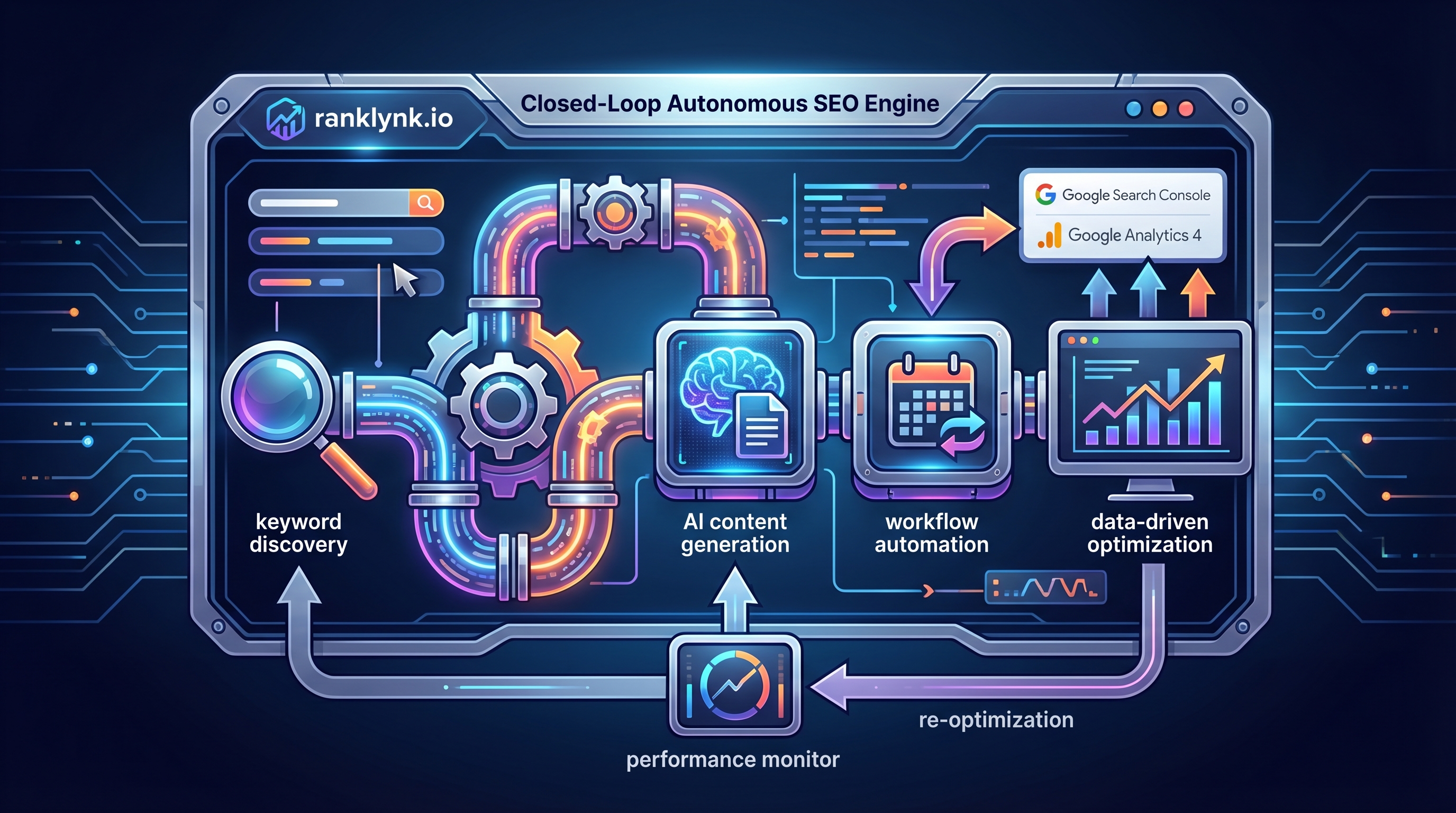
A fully autonomous SEO content system closes the loop end-to-end: keyword discovery feeds content generation, generation feeds publishing, publishing feeds performance monitoring, and monitoring triggers re-optimization when content decays — all without requiring manual intervention at each handoff. If you want to see what that operational model looks like in practice, see how it works.
Agencies and SaaS founders are already running CLG operations at scale without dedicated content teams by systematizing these handoffs. The risk of staying manual is not theoretical: competitors who systematize will outpublish and outrank you within 12 months. The content volume gap compounds the same way keyword authority does — slowly, then suddenly [1].
Distribution and Amplification: Making Sure Your Content Gets Found
Publishing without distribution is like building a product without a go-to-market motion. The asset exists. Nobody finds it. The three distribution channels that consistently move the needle for B2B SaaS CLG are organic search, LinkedIn, and email — in that order of compounding return.
Syndication and content repurposing are force multipliers. One long-form asset becomes ten distribution touchpoints: a LinkedIn thread, three short-form posts, an email newsletter excerpt, a podcast talking point, a slide deck. Build a content distribution system that runs parallel to production — not as an afterthought after the article is live.
SEO Distribution: The Channel That Compounds Without Paid Spend
Organic search is the only distribution channel where past investment continues to pay returns indefinitely. An article that ranks in position three continues generating traffic and pipeline without ongoing spend. That's the compounding mechanic that makes CLG the most capital-efficient acquisition channel for B2B SaaS [4].
Technical SEO determines whether your content gets indexed and ranked at all: site speed, crawlability, schema markup, Core Web Vitals, and mobile performance are table stakes. Backlinks remain a primary ranking signal in competitive B2B SaaS niches — earn them through content quality, original research, and targeted digital PR rather than manual link-building campaigns.
Monitor rankings continuously and trigger re-optimization when content decays. Rankings are not static. A page that ranks position four today can drop to position twelve in six months as competitors publish newer, better-optimized content. An automated decay detection and re-optimization workflow — rather than a manual quarterly audit — is what keeps your CLG investment from eroding.
LinkedIn Distribution: The B2B Amplification Engine You Can't Ignore
For B2B SaaS companies, LinkedIn operates as a direct line to the buying committee. Decision-makers — VPs of Engineering, heads of RevOps, CFOs evaluating software spend — are actively scrolling LinkedIn in ways they simply aren't on Twitter or Instagram. A content-led growth strategy that ignores LinkedIn leaves pipeline on the table.
The mechanics that consistently outperform on LinkedIn in 2026 are specific: native posts outperform link posts by a significant margin because the algorithm suppresses external URLs. Lead with insight, bury the link in the first comment. Write in short paragraphs with deliberate white space — the feed is skimmed, not read. Hook lines that open with a counterintuitive claim or a concrete number earn the "see more" click that the algorithm rewards.
Employee amplification is the distribution multiplier most B2B SaaS companies underutilize. When five subject matter experts — your head of product, a senior engineer, your VP of Customer Success — each reshare or comment on a piece of content, organic reach compounds exponentially without paid spend. Build a lightweight Slack workflow that notifies internal advocates when high-priority content goes live. Make resharing a one-tap action, not a task requiring creative effort.
Email Distribution: The Channel That Converts Readers Into Pipeline
Email remains the highest-intent distribution channel in a CLG motion because subscribers have explicitly opted into your worldview. Unlike organic search, where visitors arrive cold, your email list is a pre-warmed audience that has already expressed relevance. A 2026 benchmark from SaaS-focused content teams shows email consistently delivers 3–5x the conversion rate to trial or demo compared to social referral traffic.
Segmentation is the lever that separates high-performing email distribution from batch-and-blast newsletters. Match content to the subscriber's stage: early-funnel educational content for new list members, integration guides and advanced use cases for active trial users, ROI and competitive analysis for contacts approaching a renewal or expansion decision. A single monthly newsletter sent to your entire list is a missed opportunity — a sequenced, segment-aware distribution motion is what converts content investment into measurable revenue contribution.
Finally, treat your email list as a distribution asset that compounds the same way organic rankings do. Every new subscriber added to a well-segmented nurture sequence has a measurable expected value over a twelve-month horizon. That framing shifts email from a marketing cost to a balance-sheet asset worth systematic investment.
Measuring Content-Led Growth: The Metrics That Actually Matter
Vanity metrics kill CLG programs. Page views and social shares don't pay salaries. The metrics that map content performance to actual business outcomes are: organic-sourced pipeline, content-assisted revenue, keyword position velocity, and topic authority share — the percentage of target keywords where you rank in positions one through three [5].
Build a CLG dashboard that gives stakeholders signal, not noise. Four metrics per reporting cycle: pipeline sourced from organic, average position across target keyword set, content-to-demo conversion rate, and month-over-month organic session growth. That's enough to tell the full story without getting lost in a 47-row spreadsheet.
Timeline expectations matter for stakeholder management. Months one through three: technical foundation, keyword architecture, first content assets live, no significant ranking movement yet. Months three through six: early rankings on long-tail terms, growing impressions, first organic-sourced leads appearing in CRM. Months six through twelve: topic authority establishing, compounding traffic growth, measurable pipeline contribution [3].
Content ROI Attribution: Proving the Business Case for CLG
Content consistently gets undercounted in attribution models that credit only last-touch conversions. A buyer who read three of your articles before booking a demo gets credited to 'direct' or 'branded search' in a last-touch model — the content that educated them gets zero credit.
Multi-touch attribution that weights content-assisted touchpoints accurately reflects CLG's actual impact on pipeline. Integrate your CRM with your analytics platform so organic visitor sessions can be traced through to closed deals. Build the reporting that connects the keyword to the session to the lead to the opportunity to the closed revenue. That's the data that makes CLG defensible at the board level [2].
Beyond the core four dashboard metrics, there are several leading indicators that experienced CLG practitioners monitor closely to catch momentum shifts before they appear in pipeline data. Share of voice by topic cluster — tracking how your rankings compare to the three or four competitors dominating your category — tells you whether you're gaining or losing ground in the conversations that matter most to your buyers. Time-to-first-organic-lead for new content pieces helps you calibrate your editorial calendar based on real velocity data rather than industry benchmarks that may not reflect your specific market. Learn more about Content-Led Growth Strategy for B2B SaaS: 2026 Playbook.
For B2B SaaS companies specifically, the content-to-trial or content-to-demo conversion rate deserves more granular attention than a single blended number. Break this metric down by content type — bottom-of-funnel comparison pages typically convert at two to four times the rate of top-of-funnel educational posts. Knowing the conversion rate by content category lets you make smarter investments when headcount or budget is constrained. A company with ten engineers and a six-month runway should be producing conversion-optimized comparison and alternative pages, not thought leadership essays. Learn more about Organic Growth Strategy for Early-stage Saas: Strategies.
On attribution, the practical implementation challenge most teams face is connecting anonymous organic sessions to named CRM contacts. The cleanest approach in 2026 is using a reverse IP enrichment tool alongside your analytics platform to identify company-level engagement before a contact converts. This gives your sales team warm account intelligence — "three people from this target account have read your pricing and competitor pages this week" — and it gives marketing a more complete picture of content influence that never shows up in standard conversion tracking. Learn more about SaaS SEO Content Strategy: Zero to 10K Visitors.
One attribution framework worth adopting is the content influence window: any organic content touchpoint within ninety days of an opportunity creation date gets flagged as an assisted conversion. Report this as a distinct metric — content-influenced pipeline — alongside content-sourced pipeline. The sourced number will always look smaller and will understate CLG's contribution. The influenced number tells the real story and typically runs two to three times higher. Presenting both figures to leadership, with a clear explanation of the difference, is how you build the organizational trust that protects your CLG budget when growth slows and finance starts looking for cuts. Learn more about Organic SEO Growth Strategy for Product-Led SaaS.
Common CLG Mistakes B2B SaaS Companies Make (And How to Avoid Them)
Publishing without a keyword strategy means creating content nobody searches for. Execution effort goes in; no organic traffic comes out. Every content asset should map to a target keyword cluster before a single word is written. Learn more about SaaS Organic Traffic Growth Playbook 2026.
Targeting the wrong funnel stage is the second most common error: writing top-of-funnel awareness content when your ICP is already solution-aware and actively comparing vendors. Audit your existing content inventory against your ICP's actual buyer journey. You may discover you have 40 awareness articles and zero comparison or alternative pages. Learn more about B2B SaaS SEO Strategy on Limited Budget.
Ignoring content decay is the silent revenue leak in most CLG programs. Content that ranked well twelve months ago degrades continuously as competitors optimize and Google updates its ranking criteria. A refresh cycle — triggered by ranking drop signals, not by calendar — is what separates a maintained CLG asset from an orphaned blog post. Learn more about Early-Stage SaaS Win on Google Without SEO Teams.
Confusing content marketing with content-led growth is a framing problem with operational consequences. Brand storytelling builds affinity. Search-intent capture builds pipeline. Both have value, but they require different processes, different metrics, and different infrastructure. Running them through the same workflow produces content that does neither job well. Learn more about Build Organic Moat for SaaS Without Content Team.
Finally: treating CLG as a campaign instead of a system — starting, stopping, and restarting based on short-term results — destroys the compounding effect that makes CLG valuable. Six months of consistent, systematized execution outperforms twelve months of inconsistent bursts every time.
Two additional mistakes deserve attention because they quietly undermine CLG programs that appear to be running correctly on the surface.
Under-investing in conversion architecture is perhaps the most financially costly error. A B2B SaaS company can execute flawless keyword research, produce high-quality content, and earn first-page rankings — then convert almost none of that traffic into pipeline because the content itself lacks deliberate next steps. Every piece of content should have a mapped conversion path: a contextually relevant CTA, an inline lead magnet tied to the topic, or a product trial prompt that connects the problem the reader just learned about to the solution you offer. If your top-traffic page drives fewer than 1% of readers to a conversion action, the CLG system has a structural hole, not a traffic problem.
Neglecting internal linking as a growth lever is equally common. Many teams treat internal links as an afterthought — a technical SEO checkbox — rather than as a mechanism for pushing topical authority through the site and guiding prospects deeper into the funnel. A well-architected internal linking structure connects your awareness content to comparison pages, your comparison pages to case studies, and your case studies to free trial or demo entry points. This creates a self-reinforcing pipeline within the content system itself, reducing dependence on paid retargeting to move buyers forward.
One operational mistake worth naming explicitly: assigning CLG ownership to the wrong function. When content-led growth is treated as a marketing communications responsibility rather than a growth function, it gets evaluated on brand metrics — social shares, newsletter opens, subjective content quality — instead of pipeline metrics. CLG ownership should sit with whoever owns revenue contribution from organic channels, with clear accountability for MQL volume, trial signups, and assisted conversions attributed to content. Without that accountability structure, even technically sound CLG programs drift toward vanity metrics over time.
The corrective pattern across all of these mistakes is the same: treat your content-led growth strategy as infrastructure, not output. The goal is not to publish more; it is to build a compounding system where each asset reinforces the others, conversion paths are explicit, and performance accountability is tied to business outcomes rather than content volume.
The Bottom Line
Content-led growth is the most capital-efficient acquisition channel available to B2B SaaS companies — but only when it's built as a system, not managed as a task list. The companies winning in 2026 are not publishing more content. They are running tighter systems: keyword architecture that feeds production, production that feeds distribution, distribution that feeds conversion, and optimization that closes the loop automatically.
The gap between a CLG program that plateaus and one that compounds is almost always operational, not strategic. You likely already know what to do. The question is whether your operation can execute it at the volume and consistency that compounding requires.
Stop babysitting your content calendar. A fully autonomous SEO engine handles your entire content-led growth operation — from keyword discovery to publishing to continuous optimization — without the manual overhead. See how it works and find out what your CLG system could look like when it actually runs itself.
Frequently Asked Questions
Q: What is a content-led growth strategy for B2B SaaS companies?
A content-led growth (CLG) strategy for B2B SaaS companies is a systematic acquisition model where content assets are deliberately engineered to capture demand, educate buyers, and move prospects through a defined pipeline — without requiring manual sales intervention at every stage. It differs fundamentally from traditional content marketing, which is brand-driven and focused on awareness. CLG is intent-driven: every piece of content is mapped to what your buyers are actively searching for at each stage of their decision process. For B2B SaaS specifically, CLG works exceptionally well because purchase cycles are long (6–18 months), buyers self-educate extensively before talking to vendors, and decisions require internal justification. When done right, a CLG system compounds over time, turning every published asset into a 24/7 pipeline generator that continues working long after it's published.
Q: How is content-led growth different from traditional content marketing?
The core difference lies in intent vs. brand focus. Traditional content marketing is designed to build brand awareness, establish voice, and stay top-of-mind — it's largely untethered from measurable pipeline outcomes. A content-led growth strategy for B2B SaaS companies, by contrast, is infrastructure built around buyer intent. Every content asset is mapped to specific search queries, decision stages, and conversion paths. CLG requires a system: keyword architecture, internal linking strategies, refresh cycles, and embedded conversion infrastructure. Traditional content marketing treats a published blog post as a finished deliverable. CLG treats it as a living asset that needs to be maintained, optimized, and connected to a broader pipeline. If your content exists but your pipeline hasn't moved, the likely issue is that you're running traditional content marketing without the systems that make CLG actually compound.
Q: Why do most B2B SaaS companies fail at content-led growth?
The most common failure mode isn't a content quality problem — it's a systems problem. Most B2B SaaS teams publish content reactively and in isolation: a blog post here, a case study there, a LinkedIn post when someone has bandwidth. The content goes live, gets a brief promotional push, then sits untouched for 18+ months while the SERP landscape evolves around it. There's no refresh cycle to keep it competitive, no internal linking strategy to distribute authority, and no conversion path stitched to it to capture the visitors it does attract. The result is a blog that plateaus around 5,000 monthly sessions and never breaks through. The fix isn't publishing more — it's building the infrastructure around what you publish: intent mapping, conversion architecture, and systematic content maintenance.
Q: How does content-led growth compare to product-led and sales-led growth for SaaS?
These three growth motions serve different stages of the funnel and aren't mutually exclusive. Content-led growth (CLG) drives discovery before a prospect ever sees your product — it fills the top of the funnel with educated, high-intent visitors. Product-led growth (PLG) converts those visitors through a frictionless product experience, such as free trials or freemium tiers. Sales-led growth uses content primarily as enablement material for reps. The strongest B2B SaaS companies in 2026 run CLG and PLG in parallel. The right mix for your business depends on your average contract value (ACV) and deal complexity. High-ACV, multi-stakeholder deals still require sales involvement, but CLG handles the qualification layer — so a buyer who arrives at a demo has already self-educated through your content and is roughly 60% sold before a rep speaks to them. Low-to-mid ACV businesses can often run CLG and PLG with minimal direct sales involvement.
Q: What makes B2B SaaS uniquely suited for a content-led growth strategy?
Three structural realities make B2B SaaS an ideal fit for content-led growth. First, B2B purchase cycles are long — often six to eighteen months — which means there's an extended window during which content can build trust and educate buyers before a sales rep enters the picture. Second, B2B buyers conduct extensive online research before ever engaging a vendor. They search, compare options, and self-educate as a standard part of their buying process. Third, B2B purchases are inherently education-first: buyers need to understand the problem, validate the solution category, and build an internal business case before committing to a demo or purchase. Content that addresses each of these needs at the right moment doesn't just attract traffic — it accelerates deal velocity and improves conversion rates at every funnel stage.
Q: When should a B2B SaaS company invest in content-led growth over paid acquisition?
Content-led growth becomes the superior long-term investment when you need a compounding, always-on acquisition channel that doesn't shut off the moment you pause spend. Paid ads deliver immediate traffic but require continuous budget to sustain results. A well-built CLG system, by contrast, accumulates authority and rankings over time — each published and optimized asset continues generating qualified traffic and pipeline indefinitely. In 2026, with rising paid media costs in the B2B SaaS space, CLG offers a significantly better return on investment over a 12–24 month horizon. That said, paid and content aren't mutually exclusive. Many SaaS companies use paid to accelerate early traction while the CLG engine matures. The key signal to prioritize CLG: if your sales cycle is longer than 30 days and your buyers self-educate before engaging vendors, content-led growth should be a core strategic investment, not an afterthought.
Q: What are the core components of a content-led growth system for B2B SaaS?
A content-led growth strategy for B2B SaaS companies is built on several interconnected components, not just a publishing calendar. The foundation is keyword architecture — mapping content topics to the specific queries your buyers search at each stage of the funnel, from problem awareness to vendor comparison. On top of that sits a content production system with defined formats for each intent stage: educational pillar guides for awareness, comparison and alternative pages for consideration, and ROI calculators or case studies for decision. Equally critical is conversion infrastructure: each content asset needs embedded CTAs, lead magnets, or product trial paths that capture visitors rather than letting them leave. Finally, a refresh and maintenance cycle ensures that published content stays competitive as search landscapes evolve. Without all of these components working together, content becomes a one-time output rather than a compounding growth asset.
References
[1] https://www.insivia.com/7-key-saas-growth-strategies/. insivia.com. https://www.insivia.com/7-key-saas-growth-strategies/
[2] https://www.withdaydream.com/library/insights/content-of-strategy. withdaydream.com. https://www.withdaydream.com/library/insights/content-of-strategy
[3] https://www.marketermilk.com/blog/saas-content-marketing. marketermilk.com. https://www.marketermilk.com/blog/saas-content-marketing
[4] https://powerdigitalmarketing.com/blog/saas-marketing-strategy-align-paid-organic-plg/. powerdigitalmarketing.com. https://powerdigitalmarketing.com/blog/saas-marketing-strategy-align-paid-organic-plg/
[5] https://rightleftagency.com/saas-lead-generation-strategies-for-b2b-growth/. rightleftagency.com. https://rightleftagency.com/saas-lead-generation-strategies-for-b2b-growth/