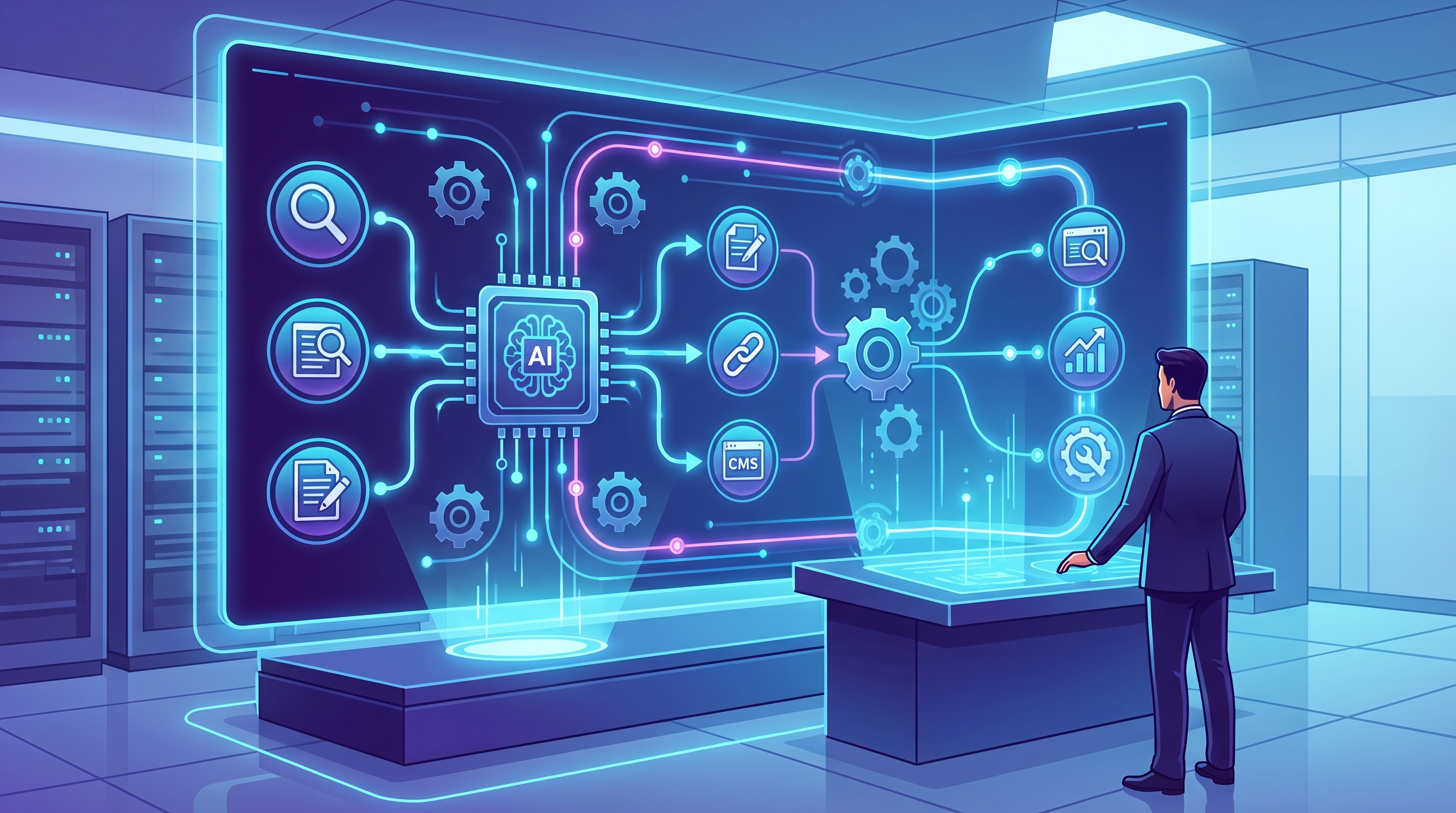
Content Marketing Automation for One-Person Marketing Teams: Build the System That Runs Without You
You're one person running what should be a five-person operation. Every hour you spend manually drafting, scheduling, and refreshing content is an hour you're not spending on strategy, growth, or sleep. The math has never worked in your favor — and yet here you are, still manually pulling keyword data, briefing articles, chasing publishing deadlines, and watching underperforming posts decay on page two without touching them.
In 2026, one-person marketing teams are no longer an anomaly — they're a deliberate operating model. Solo founders, lean SaaS builders, and bootstrapped operators are choosing speed and autonomy over headcount. But content marketing at scale was never designed for one human. It was built for teams with writers, editors, SEO managers, and coordinators. That gap is where most soloists stall.
This guide breaks down how to build a content marketing automation system that handles the full cycle — from keyword discovery to publishing to optimization — without you babysitting every step. No agency. No content team. Just a machine that works while you build.
Why One-Person Marketing Teams Break Under Manual Content Operations
The math doesn't work. One person cannot manually research, write, optimize, publish, and refresh content at the volume needed to compound organic growth. This isn't a talent problem — it's a physics problem. There are only so many hours in a week, and the content marketing lifecycle consumes them faster than any solo operator can replenish.
The bottleneck isn't intelligence or skill. It's time and repeatability. Manual workflows create single points of failure: if you stop, the entire content pipeline stops. Vacations, launches, hiring crunches, product fires — any disruption to the operator disrupts the output. That's not a system. That's a fragile dependency on a single human.
Most soloists also dramatically underestimate the maintenance load. Publishing is roughly 20% of the actual work. Optimization, refreshing, monitoring, and adjusting is the other 80% [1]. The articles you published six months ago that now sit on page two aren't generating traffic — they're generating content debt. And there's a false economy in DIY content operations: trading your highest-value hours (strategy, product, growth decisions) for tasks that a properly configured automation system could handle without you.
The Content Debt Problem Solo Operators Ignore
Content debt is the growing backlog of underperforming posts that need refreshing, re-optimizing, or pruning. Every article sitting on page two that never gets touched is a wasted asset — it cost time or money to produce, holds topical authority potential, and is simply not being used.
Without automation, content debt compounds faster than you can pay it off. You publish new articles to drive growth while the existing library quietly degrades. The net result: a growing volume of content with a shrinking percentage that actually performs. Automated refresh systems break this pattern by treating optimization as a continuous process rather than a periodic manual task.
Why Hiring Writers Doesn't Solve the System Problem
Adding writers adds output volume but not workflow intelligence. Freelancers can produce drafts — but they can't self-direct keyword research, build SEO-structured briefs, monitor performance signals, or trigger their own revisions based on ranking data. You end up managing people instead of running a system. Same bottleneck. Higher cost. More coordination overhead.
The agency alternative compounds this further: you're buying managed output, not a system you own. Agency retainers consume startup runway without building internal leverage. The operators winning on organic in 2026 aren't the ones with the biggest content teams — they're the ones who built the most efficient content engines.
What Content Marketing Automation Actually Means in 2026
Automation is not scheduling tweets or running articles through a grammar checker. Those are tools. A system is different — it operates continuously, feeds its own inputs, and doesn't require operator intervention at every stage [2].
True content marketing automation covers the full lifecycle: discovery, creation, optimization, publishing, and re-optimization. The difference between a tool stack and an autonomous system is where human input is required. Tools require it at every stage. A system requires it once — at configuration — and then executes continuously.
In 2026, AI-native platforms have collapsed what was previously a five-step workflow requiring five different operators into a single closed loop. The key capabilities to look for: keyword-to-draft pipelines that run on demand signals, auto-publishing integrations that push directly to your CMS, performance monitoring that feeds back into the engine, and automated content refresh triggers that activate on ranking drops or traffic decay.
The Five Stages of a Fully Automated Content System
Stage 1 — Discovery: Automated keyword and topic identification based on search demand, competitive gaps, and your defined content pillars. No manual research. No keyword spreadsheets. The system surfaces what to write next.
Stage 2 — Generation: Structured, SEO-optimized content creation without manual briefing. The system knows the target keyword, the competitive landscape, and the structural requirements — and it builds accordingly.
Stage 3 — Publishing: Direct CMS integration that removes the human handoff entirely. Content goes from generation to live without a manual approval step for routine execution.
Stage 4 — Monitoring: Rank tracking and performance signals that feed back into the system — not into a dashboard you have to remember to check.
Stage 5 — Optimization: Automated content refreshes triggered by ranking position drops, traffic decay thresholds, or SERP feature changes. The system detects decay and responds. You see results, not tasks.
What Automation Cannot Replace (And What It Can)
Automation handles volume, consistency, and iteration at a scale no solo operator can match manually. What it cannot replace is brand positioning, product narrative, and the strategic decisions about which markets to pursue and which angles to own.
For one-person teams, the operating principle is clear: the 95% of repetitive execution — research, drafting, structuring, publishing, monitoring, refreshing — should be automated. The 5% of strategic thinking — content pillars, positioning, audience targeting — is where human time goes. The goal is not to eliminate judgment. It's to stop spending judgment on tasks that don't require it.
The Best Content Marketing Automation Tools for One-Person Teams in 2026
Evaluation criteria for solo operators are different from enterprise procurement checklists. You need minimal setup overhead, maximum autonomy, direct ROI on time saved, and a platform that doesn't require you to manage it like a second job [3].
The market breaks into three categories: full-stack autonomous platforms, point solutions, and tool stacks. The hidden cost of assembling a tool stack is consistently underestimated — integration maintenance, prompt engineering across multiple platforms, and the workflow duct-tape required to connect them all still puts a human in the loop at every seam. Solo operators need a platform, not a collection of apps.
Full-Stack Autonomous SEO and Content Platforms
Platforms like Ranklynk operate as closed-loop systems: input your domain and niche, and the system handles discovery through optimization autonomously. No prompt writing. No manual briefing. No publish button to click for every article. The engine runs.
This is the key differentiator between a full-stack autonomous platform and an AI writing assistant: the former doesn't stop when you stop. It continues executing against your defined parameters — finding keywords, generating content, publishing, monitoring performance, and triggering refreshes — while you're focused on the work that actually requires you. If you want to see what this looks like in practice, see how it works.
Point Solutions Worth Layering In
Once your core content engine is automated, there are high-value point solutions worth connecting:
- Email automation platforms (Beehiiv, ConvertKit) — connect organic content output to your owned audience for distribution without manual curation
- Social scheduling tools — amplify published content without manual posting; set rules once, let the amplification run
- Analytics aggregators — surface content performance trends without requiring you to manually compile reports across platforms [4]
These work best as downstream layers on top of an automated content core — not as substitutes for one.
What to Avoid: Tool Stacks That Create More Work Than They Save
Platforms that require manual prompt input for every piece of content are not automation — they're acceleration. You're still in the loop for every output. Keyword tools that produce data without acting on it hand the execution problem back to you. 'AI writing assistants' that speed up drafting but leave optimization, publishing, and refreshing entirely on your plate are tools, not systems.
The test is simple: if the platform stops producing when you stop directing it, it's a tool. If it keeps running against your parameters while you focus elsewhere, it's a system.
How to Build a Content Marketing System as a Team of One
System design over task management. Stop thinking about your next blog post and start thinking about your content engine. The one-time setup investment — configuring your automation platform correctly, defining content pillars, connecting your CMS — pays compounding dividends from day one of operation.
Define your content pillars once. Let the system fill the volume. Remove yourself from the approval loop for execution-level decisions. Your operating model as a team of one: you set strategy and review outputs on a cadence. The system runs everything in between.
Mapping Your Keyword-to-Publish Workflow
Document every step from 'keyword identified' to 'article live' — then identify which steps require human judgment versus which are pure execution. Most soloists who do this exercise find that 70–80% of their content workflow is execution that can be automated.
A clean keyword-to-publish pipeline looks like this:
Demand signal → Topic brief → Content generation → SEO structuring → CMS publish → Rank monitoring → Refresh trigger
Every arrow in that chain that currently requires a human action is a candidate for automation. In a properly configured system, every arrow except the initial strategic direction is handled by the engine.
Setting Up Content Refresh Automation
Content decay is inevitable. Rankings drop. SERP competition increases. Traffic erodes. The question is whether your system detects and responds to decay automatically — or whether you catch it manually six months too late while your competitors have already taken the position.
Automated refresh triggers activate on: rank position drops below a defined threshold, traffic decay over a rolling window, or changes in SERP features that require content restructuring. Set the rules once. The system updates content without manual intervention. Your content library doesn't decay — it evolves.
Scaling Organic Traffic Without Scaling Headcount
Here's the compounding math that makes content automation asymmetric: 10 articles published per month through an automated system versus 2 articles per month through manual effort over 12 months is not a 5x difference in output. It's an asymmetric growth curve because every additional article creates new ranking surfaces, internal linking opportunities, and topical authority signals that compound backward across your existing content [5].
Organic traffic is the only acquisition channel that scales without proportional spend increases. Paid ads require proportional budget increases for proportional traffic growth. Organic content, properly automated, breaks that linear relationship. A well-optimized article from 12 months ago still drives traffic and leads today — without additional spend.
For SaaS founders and solo operators, automated organic content is the direct alternative to performance ad budgets and agency retainers. A single operator running an autonomous content system can maintain and grow a 500+ article content library without a content team. That's not a projection — that's the operating reality of platforms designed for this use case.
Why Organic Content Is the Highest-Leverage Channel for Solo Operators
Unlike paid channels, organic content compounds. The value of each piece increases over time as it accumulates backlinks, builds topical authority, and gets refreshed to maintain rankings. Content marketing automation converts organic into a near-passive acquisition channel — one that continues producing while you're building product, closing deals, or not working.
The opportunity cost of not automating is concrete: every month of manual operations is a month of compounding growth you didn't capture. That's not a metaphor — it's lost keyword rankings, missed traffic, and foregone leads that would have converted while the manual process was catching up.
Measuring ROI on Content Automation Investment
Primary metrics: organic sessions growth, keyword ranking velocity, and content output volume over time. Secondary metrics: time saved per month, content refresh cycle speed, and cost per published article compared to freelance alternatives.
For solo operators, time reclaimed is the most important ROI metric. Hours redirected from execution to strategy compound at the same rate as the content itself — because those hours go into the decisions that make the entire system more effective.
Common Mistakes One-Person Marketing Teams Make With Automation
The most common mistake: automating the wrong things first. Spending time configuring social post scheduling while the content pipeline is still entirely manual optimizes the wrong variable. The core content engine — discovery, generation, publishing — is where automation ROI is highest and should be configured first.
Second mistake: over-investing in tool configuration and under-investing in strategy definition. The system can only execute against the parameters you set. If your content pillars are vague, the output will be directionless regardless of how sophisticated the automation layer is.
Third: treating automation as a one-time setup rather than an ongoing system with a performance review cadence. And fourth: neglecting content quality signals — automation at scale can drift from brand voice if system parameters aren't reviewed and adjusted periodically.
The Set-It-and-Forget-It Trap (And How to Avoid It)
'Fully autonomous' does not mean 'never reviewed.' It means you review outcomes, not individual tasks. Build a monthly system review cadence: check ranking trends, audit a sample of content quality, adjust topic parameters based on performance signals, and update content pillars as your product or market evolves.
The difference between automation that runs itself and automation that runs itself off a cliff is a monthly 30-minute review. That's the human role in an automated content system: not execution, not approval, not briefing — just strategic steering at a cadence that matches the pace of meaningful change.
How to Choose the Right Content Marketing Automation Platform as a Solo Operator
The decision framework is straightforward: how much of the workflow does the platform own end-to-end versus how much does it hand back to you? Every handoff point is a place where the system breaks and the human becomes the bottleneck again.
Red flags: platforms that call themselves 'automated' but still require manual prompt writing, briefing, or publish approvals for routine content. Green flags: closed-loop systems with direct CMS publishing, autonomous keyword discovery, built-in performance monitoring, and automated refresh logic.
Questions to ask before committing: Does it publish automatically? Does it monitor and refresh content without manual triggers? Does it require a human in the loop for execution-level decisions? What's the total cost of ownership versus freelancer cost, agency cost, or your own time calculated at your effective hourly rate?
Ranklynk: Built for Operators Who Want the System, Not the Tool
Ranklynk operates as a fully autonomous SEO engine — not an AI writing assistant, not a keyword research dashboard, not another tool you have to manage. The system handles discovery, generation, publishing, and continuous optimization in a closed loop. It was designed specifically for the operator who has a product to build and cannot afford to also become a full-time content manager.
No prompt engineering. No brief writing. No manual publishing. The engine runs; you review results. If you're managing multiple client sites or scaling a SaaS content library and want to stop trading execution hours for growth, this is where the leverage is. Automate your SEO and redirect those hours to the work that actually requires you.
The Bottom Line
One-person marketing teams don't have a talent problem — they have a leverage problem. Manual content operations will always bottleneck at the human, and adding freelancers or agencies shifts the bottleneck without solving the system. The operators winning on organic in 2026 are the ones who stopped treating content marketing as a task list and started treating it as an engine.
Full-stack content marketing automation — from keyword discovery to publishing to continuous refresh — converts a solo operator's strategic direction into compounding organic growth without proportional time investment. The technology exists. The systems are built. The only remaining variable is whether you're still running the machine manually.
Stop building your content pipeline manually. See how Ranklynk's autonomous SEO engine handles discovery, generation, publishing, and optimization — so you can stop babysitting your content and start scaling it.
Frequently Asked Questions
Q: What is content marketing automation for one-person marketing teams and why does it matter?
Content marketing automation for one-person marketing teams refers to building systematic, tool-driven workflows that handle repetitive content tasks — like keyword research, brief creation, publishing, and performance optimization — without requiring constant manual input from a solo operator. It matters because one person simply cannot manually execute the full content marketing lifecycle at the volume needed to compound organic growth. The math doesn't work: researching, writing, optimizing, publishing, and refreshing content across an entire content library is a five-person job. Automation fills the headcount gap, allowing a solo marketer to operate at team-level output while preserving their highest-value hours for strategy, product decisions, and growth work. In 2026, this isn't a nice-to-have — it's the operating model that separates soloists who scale from those who stall.
Q: What is content debt and how does it hurt solo marketers?
Content debt is the accumulating backlog of published articles that underperform, have decayed in rankings, or need refreshing but never get touched. For one-person marketing teams, this is a silent killer. Every post sitting on page two that doesn't get re-optimized is a wasted asset — it cost time or money to produce, holds topical authority potential, and generates zero meaningful traffic. Without automation, content debt compounds faster than you can pay it off. You keep publishing new content to drive growth while your existing library quietly degrades. The net result is a growing volume of content with a shrinking percentage that actually performs. Automated refresh and optimization systems break this cycle by treating content maintenance as a continuous, system-driven process rather than a sporadic manual task.
Q: Why doesn't hiring freelance writers solve the content scaling problem for solo marketers?
Hiring freelance writers adds output volume but does not solve the underlying workflow intelligence problem. Freelancers can produce drafts, but they cannot self-direct keyword research, build SEO-structured briefs, monitor ranking performance, or trigger their own revisions based on data signals. The result is that you end up managing people instead of running a system — same bottleneck, higher cost, and more coordination overhead. The system problem remains unsolved; it's just more expensive. Similarly, agency retainers consume startup runway without building internal leverage or a system you own. The operators winning on organic search in 2026 are not those with the largest content teams — they're the ones who built the most efficient, automated content engines that run with minimal human babysitting.
Q: How much of content marketing is actually publishing versus ongoing optimization?
Publishing is roughly 20% of the actual content marketing workload. The remaining 80% consists of optimization, refreshing, performance monitoring, and strategic adjustments to existing content. Most solo marketers dramatically underestimate this ratio and focus almost exclusively on producing new articles while ignoring the maintenance load their existing library demands. This misallocation is one of the core reasons one-person marketing teams hit a ceiling — they're investing the majority of their time in the minority of the work that drives compounding results. An effective content marketing automation system for one-person teams accounts for both sides: it doesn't just automate the publishing pipeline, it also automates the signals, triggers, and workflows that keep existing content performing over time.
Q: What are the biggest risks of running a manual content operation as a solo marketer?
The biggest risk of a manual content operation is that it creates a single point of failure: you. If you stop — due to a product launch, hiring crunch, illness, vacation, or any other disruption — the entire content pipeline stops with you. That's not a system; it's a fragile dependency on one human. Manual workflows also trap your highest-value hours in low-leverage tasks. Time spent pulling keyword data, formatting posts, or chasing publishing deadlines is time not spent on strategy, growth decisions, or building the business. There's also a false economy at play: DIY content operations feel lean but are actually expensive when you factor in the opportunity cost of what you're not doing. Automation eliminates these risks by decoupling content output from your personal availability and attention.
Q: Is content marketing automation for one-person teams only relevant for tech-savvy or SaaS founders?
No. While solo SaaS builders and bootstrapped tech operators are common examples, the one-person marketing team model applies broadly — to solo founders across industries, independent consultants, small e-commerce operators, and lean startups of all types. The core challenge is universal: content marketing at scale was designed for teams with dedicated writers, editors, SEO managers, and coordinators. Any single operator trying to replicate that output manually will hit the same physics problem regardless of their industry. Content marketing automation levels the playing field by giving one person the operational infrastructure of a full team, making it relevant for any solo marketer who relies on organic content as a growth channel.
Q: What should a content marketing automation system for a solo marketer actually cover?
A comprehensive content marketing automation system for one-person marketing teams should cover the full content lifecycle — not just one stage. That means automating keyword discovery and prioritization, SEO brief generation, content drafting or outlining, publishing and scheduling workflows, and critically, ongoing performance monitoring and refresh triggers. Most partial automation solutions only address the top of the funnel (research and creation) while leaving optimization and maintenance entirely manual. The result is faster content debt accumulation, not less. The goal is to build a system where each stage feeds the next with minimal human intervention — so that strategy and oversight remain human-led, but execution and maintenance are handled by the machine. This is what allows a solo operator to run what should be a five-person content operation independently.
References
[1] https://www.forbes.com/councils/forbescommunicationscouncil/2025/01/28/19-helpful-practices-and-technologies-for-one-person-marketing-teams/. forbes.com. https://www.forbes.com/councils/forbescommunicationscouncil/2025/01/28/19-helpful-practices-and-technologies-for-one-person-marketing-teams/
[2] https://www.glean.com/perspectives/the-latest-tools-for-automating-digital-marketing-workflows. glean.com. https://www.glean.com/perspectives/the-latest-tools-for-automating-digital-marketing-workflows
[3] https://insiderone.com/best-marketing-automation-tools-smbs-enterprises/. insiderone.com. https://insiderone.com/best-marketing-automation-tools-smbs-enterprises/
[4] https://transcribe.com/blog/marketing-automation-tools. transcribe.com. https://transcribe.com/blog/marketing-automation-tools
[5] https://www.contentful.com/blog/one-to-one-marketing/. contentful.com. https://www.contentful.com/blog/one-to-one-marketing/