What Does a Digital Marketing Agency Actually Do (And When to Stop Paying for One)
Most founders hire a digital marketing agency the same way they buy a gym membership — with optimism, a vague plan, and a tendency to stop showing up after month three. The retainer gets signed, the kickoff call happens, and then somewhere around week eight, the dashboards are full of impressions and the revenue line hasn't moved.
In 2026, the digital marketing agency landscape is more crowded than ever. From legacy holding companies to boutique performance shops, the options are overwhelming — and the price tags are steep [1]. Agency fees, retainer lock-ins, and slow turnaround cycles are quietly eating into startup runway while content output stays unpredictable and attribution stays murky.
This guide breaks down exactly what a digital marketing agency does, how to evaluate one, what the real costs look like, and — critically — when it makes more sense to replace agency dependency with a system that runs itself.
What Does a Digital Marketing Agency Actually Do?
At the surface level, a digital marketing agency is a vendor that executes marketing activities on your behalf. But the category is broad enough to be almost meaningless without drilling into service lines, engagement models, and the gap between what gets promised and what gets delivered.
The 4 Types of Digital Marketing Every Agency Sells
Search (Organic SEO and Paid SEM): The engine of most B2B and SaaS growth strategies. Organic SEO includes on-page optimization, technical audits, link building, and content creation. Paid search (Google Ads, Bing) is managed separately, typically on a percentage-of-spend fee model.
Social Media Marketing and Paid Social: Organic social management — posting, community engagement, brand voice — plus paid social across Meta, LinkedIn, TikTok, and X. Organic social is low-ROI for most B2B companies but high-visibility for consumer brands.
Content Marketing and Editorial Strategy: Blog posts, long-form guides, whitepapers, video scripts, landing pages. This is the service line most agencies overpromise and underdeliver on, particularly at volume.
Email and Lifecycle Automation: The unglamorous revenue driver. Drip sequences, onboarding flows, re-engagement campaigns. Most agencies treat this as an add-on, which is a mistake — for SaaS, it's often the highest-ROI channel in the stack.
Where Agency Work Ends and Your Problem Begins
Agencies own execution. They do not own outcomes — and the distinction matters enormously when you're evaluating ROI. An agency will publish twelve blog posts per month and report on sessions and rankings. Whether those sessions convert is a product and funnel problem that most agencies aren't paid to solve.
Reporting dashboards feel busy by design. Impressions, reach, engagement rate, domain authority movement — these metrics fill slides and justify retainers. They rarely drive decisions. The handoff problem is structural: agencies don't live inside your product, they don't know your customers' objections, and they're not incentivized to understand the nuance between a lead that converts and one that churns at day thirty.
The Big Players: Who Actually Runs the Digital Marketing Industry?
The industry is shaped at the top by six holding companies: WPP, Omnicom, Publicis, IPG, Dentsu, and Havas. These conglomerates own hundreds of agency brands and serve enterprise clients with nine-figure budgets. If you're running a SaaS company or a growth-stage startup, you are not their customer — and that's fine.
The enterprise tier operates on relationship-driven procurement cycles, retainers in the hundreds of thousands, and account teams of twenty-plus people. For companies under $50M in revenue, the relevant market is mid-market agencies ($5K–$20K/month) and boutiques ($1.5K–$5K/month).
What's changed in 2026 is the rise of independent performance agencies filling the mid-market gap. These shops are leaner, more transparent, and increasingly technology-forward — but they're still operating on human labor at their core, which creates the same throughput ceilings that larger agencies have.
Top-Rated Digital Marketing Agencies in 2026
Agencies that consistently appear on ranked lists include Thrive Agency [2], VaynerMedia [3], PMG [4], and Power Digital. What separates the ranked from the noise is usually three things: documented specialization, transparent case studies with real numbers, and a clear point of view on attribution.
Be skeptical of "best agency" lists. Most are compiled through a combination of paid placement, review aggregation on platforms like Clutch and G2, and editorial discretion. The list that matters is the one you build yourself — vetted against your use case, your budget, and your internal bandwidth to manage an agency relationship.
What Does a Digital Marketing Agency Cost in 2026?
Pricing varies significantly by tier, service line, and engagement model. Here's the honest breakdown:
By Tier:
- Boutique agencies: $1,500–$5,000/month
- Mid-market agencies: $5,000–$20,000/month
- Enterprise agencies: $20,000+/month, often $50K–$200K+ for full-service engagements
By Service Line:
- SEO retainers: $1,500–$5,000/month for small-to-mid businesses; $5,000–$15,000/month for competitive verticals
- PPC management: 10–20% of ad spend, with minimums typically starting at $1,000/month in management fees
- Social media management: $1,000–$4,000/month for content creation, scheduling, and community management
- Content marketing (blog + SEO content): $2,000–$8,000/month depending on volume and research depth
- Email/lifecycle: $1,500–$5,000/month for strategy plus execution
Engagement Models:
- Retainer: Fixed monthly fee for a defined scope. Most common. Creates predictability but incentivizes agencies to protect scope rather than expand impact.
- Project-based: One-time fee for a defined deliverable — an SEO audit, a website redesign, a content sprint. Lower commitment, harder to maintain continuity.
- Performance-based: Agency fees tied to specific outcomes (leads, revenue, rankings). Rare in practice because attribution is messy and agencies resist the risk.
The Hidden Costs No One Talks About: Onboarding typically takes 30–60 days before any real work ships. Strategy delays add another 2–4 weeks. Revision cycles on content can stretch a single piece over three weeks. Reporting overhead — the time you spend reading, questioning, and re-briefing — routinely adds 8–12 hours per month to your plate. Add it up, and a $3,000/month boutique retainer has a real total cost — in time and money — that's closer to $5,000.
How to Know If Your Digital Marketing Agency Is Legit
Red Flags:
- Reporting on vanity metrics (impressions, followers) without tying them to pipeline or revenue
- Vague deliverables in the contract ("content strategy" without output counts or formats)
- No direct access to your own ad accounts, analytics, or CMS
- Long-term lock-in contracts without performance clauses
- High turnover in your account team
Green Flags:
- Transparent attribution model — they can show you how a session became a lead became a customer
- Clear KPI ownership documented in the SOW
- Proactive communication that surfaces problems before you ask
- They have their own strong organic presence — if an SEO agency doesn't rank for anything, that's a signal [5]
How to Evaluate a Digital Marketing Agency Like a Systems Thinker
The pitch deck is theater. What you want is a documented workflow. Before signing anything, demand to see how work actually flows from brief to publish, how they handle revisions, and how they escalate when performance drops.
Audit their own digital presence first. Do they rank for competitive terms in their own category? Do they publish consistently? An SEO agency that hasn't updated its own blog since 2024 is not practicing what it sells.
Ask specifically about their content-at-scale infrastructure. Are they using AI for first drafts? Freelancer networks? Templated briefs? There's no wrong answer — but if they're still managing content production on a spreadsheet and a Slack channel, you'll feel that friction in your own delivery timelines.
Finally, ask about their tech stack and automation layer. In 2026, any agency still running reporting out of manual exports is a liability. You want to see live dashboards, automated alerts on ranking drops, and a systematic approach to content refreshes — not a process that kicks in when you complain.
The 3-3-3 Rule in Marketing and Why It Applies to Agency Selection
The 3-3-3 rule is a targeting framework: reach the right audience, with the right message, at the right time. Applied to agency evaluation, it's a pressure test for whether the agency's approach is structured or reactive.
- Right audience: Can they document how they define and segment your ICP? Do they have a methodology, or are they targeting broadly and calling it "awareness"?
- Right message: Is their content strategy informed by keyword intent data, customer research, and competitive gaps — or is it based on what their writer feels like covering this month?
- Right time: Do they have a systematic trigger for when to publish, refresh, or promote? Or are they working off an editorial calendar that was built in month one and hasn't been touched since?
Agencies that can answer these with specifics are operating as systems. Agencies that answer with buzzwords are selling you vibes.
The Agency Dependency Problem: What It's Really Costing You
Here's what agency dependency actually looks like at the operator level: you're paying $4,000/month for SEO content. You're also spending 10 hours a month writing briefs, approving drafts, reviewing reports, and re-briefing when something misses the mark. Your content output is 8–10 posts/month. Your rankings move slowly because refreshes only happen when you escalate. And when your account manager leaves, you restart from scratch with someone who's never read your product docs.
The compounding cost is what kills you. Agency SEO is reactive by design — they refresh when you ask, not when ranking signals demand it. Content bottlenecks are structural: approval chains, writer availability, and editorial calendars mean the window between "this keyword is an opportunity" and "we published content targeting it" is often 6–10 weeks.
What Scaling Content Without an Agency Actually Looks Like
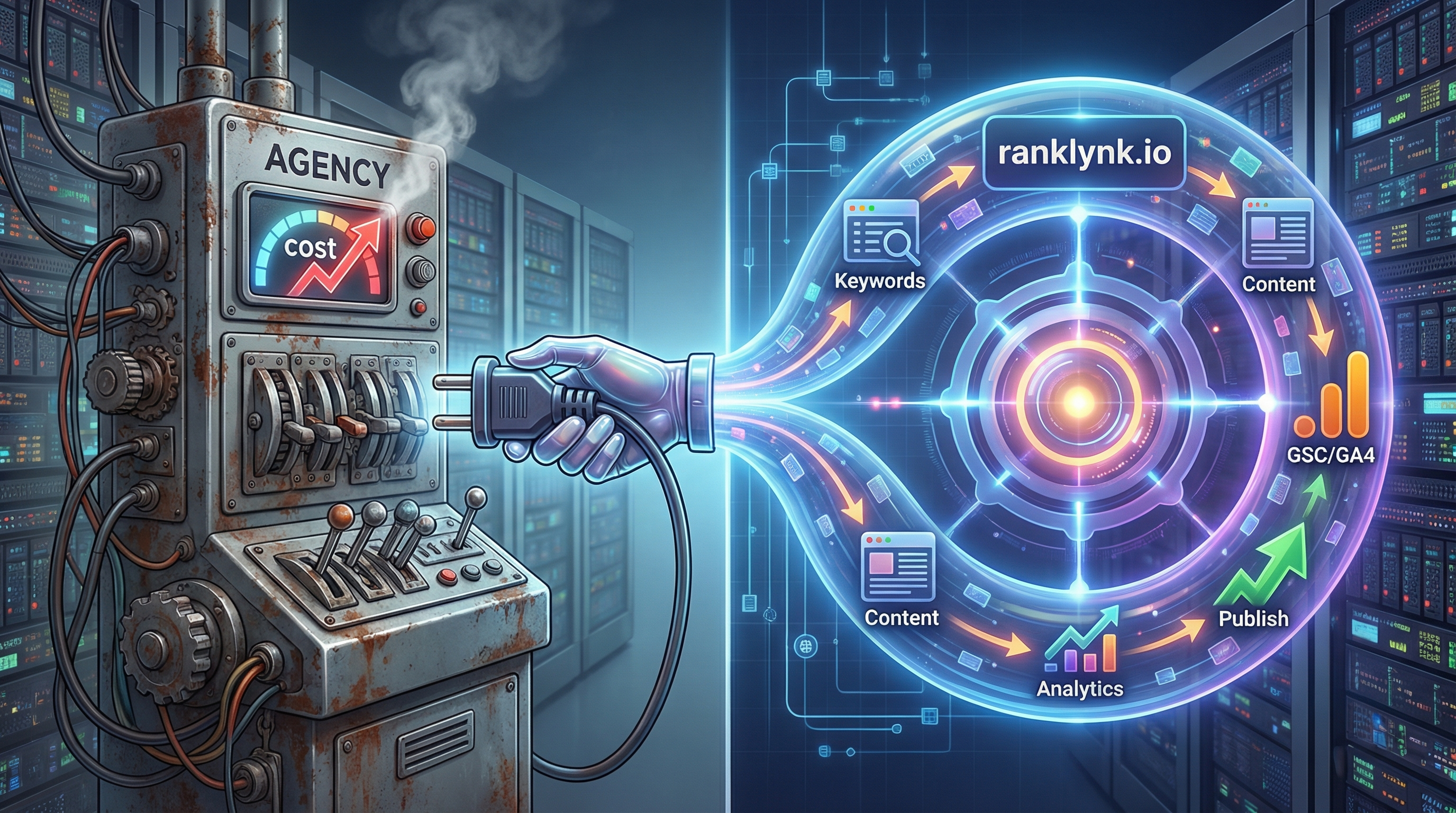
High-volume content operations are a systems design problem, not a headcount problem. The keyword-to-publish pipeline has six stages: discovery, brief, draft, optimize, publish, monitor. In an agency model, each stage involves human handoffs and wait states. In an autonomous system, the pipeline runs continuously.
The founders who stopped babysitting their content and moved to a closed-loop system aren't just saving money — they're compounding. Every published piece enters a monitoring queue. When rankings drop, a refresh is triggered automatically. When a new keyword cluster emerges, content is scoped and queued without a kickoff call.
If you're managing more than 50 pages of organic content and still routing everything through an agency workflow, you're leaving compounding returns on the table. See how it works — the execution layer most agencies are overcharging you for can run on autopilot.
When an Agency Makes Sense — And When a System Does
This isn't an argument against agencies. It's an argument for deploying each resource where it actually wins.
Agencies win on:
- Brand campaigns requiring creative production and directorial judgment
- Paid media at enterprise scale where bid strategy, creative testing, and audience segmentation require daily human attention
- PR and earned media, which is fundamentally a relationship-driven function
- High-stakes creative work: video production, brand identity, campaign strategy
Systems win on:
- Organic content at volume — blog posts, landing pages, programmatic SEO
- Continuous keyword coverage across a large topic map
- Ongoing content refreshes triggered by performance signals
- Predictable output on a cadence that doesn't depend on writer availability or approval chains
The hybrid model is the right answer for most growing companies: use agencies for high-touch strategy and creative execution. Automate the execution layer — keyword discovery, content production, optimization, publishing — with a platform built for throughput.
The decision framework is simple: are you paying for thinking or for doing? Thinking — strategic insight, creative judgment, audience intuition — is where human expertise is hard to replace. Doing — drafting, formatting, scheduling, monitoring, refreshing — is where systems beat humans on cost, speed, and consistency every time.
FAQ: Common Questions About Digital Marketing Agencies
What exactly does a digital marketing agency do? A digital marketing agency executes marketing activities on behalf of a business across one or more channels — search, social, content, paid media, email, and CRO. Engagement models include monthly retainers, project-based fees, and performance-based structures.
Who are the Big 6 digital marketing agencies? The six major holding companies are WPP, Omnicom, Publicis Groupe, IPG (Interpublic Group), Dentsu, and Havas. They collectively control hundreds of agency brands and serve primarily enterprise clients.
What is the average fee for a digital marketing agency? Boutique agencies typically charge $1,500–$5,000/month. Mid-market agencies run $5,000–$20,000/month. Enterprise engagements start at $20,000/month and can exceed $200,000/month for full-service work.
Which company is best for digital marketing? There is no universal answer. The right agency depends on your stage, budget, channel priorities, and internal capacity to manage the relationship. For early-stage startups prioritizing organic growth, an autonomous SEO platform often outperforms a boutique agency on cost per content piece and output velocity.
What are the 4 types of digital marketing? Search (organic SEO and paid SEM), social media marketing, content marketing, and email/lifecycle automation. Most agencies offer all four; few execute all four well at the same time.
How to Choose a Digital Marketing Agency: 7 Questions to Ask Before Signing a Contract
The vetting process most operators skip is the one that would save them six months and $30,000. Here are the seven questions that separate competent agencies from expensive noise:
-
Can you show me your own organic traffic and ranking history? An SEO agency that can't demonstrate results on its own domain is a red flag. Check their Ahrefs or Semrush profile before the first call.
-
What does your content workflow look like from brief to publish? You want specifics: who writes, how briefs are created, what the revision process looks like, and what the average time-to-publish is.
-
How do you handle content refreshes? If the answer is "we schedule quarterly audits" rather than "we monitor rankings continuously and trigger refreshes automatically," you're looking at a reactive agency.
-
Who owns my data and accounts if we end the engagement? This should be non-negotiable. You own your Google Ads account, your Analytics property, your CMS content. Any agency that resists this is building a hostage situation.
-
What KPIs are you accountable for, and what's in scope vs. out of scope? Get this in writing. Agencies that can't define what success looks like in measurable terms at the contract stage will use vagueness to deflect accountability later.
-
What's your tech stack? In 2026, look for agencies using AI-assisted content tools, automated rank tracking with alert thresholds, and live reporting dashboards. Manual reporting is slow and introduces interpretation lag.
-
What does the first 90 days look like, in deliverable terms? Onboarding theater — workshops, strategy documents, audits that never resolve into execution — is one of the most common agency time sinks. Demand a 90-day deliverable map before signing.
The Bottom Line
Digital marketing agencies provide real value — but only when the work matches what they're actually built to do. For brand strategy, creative campaigns, and paid media at enterprise scale, agencies are hard to replace. For organic content at volume, systematic keyword targeting, and continuous SEO optimization, you're paying agency rates for work that a closed-loop system can run without you.
The smartest operators in 2026 aren't choosing between agencies and automation — they're deploying each where it actually wins. Brand thinking and creative judgment go to the agency. Content execution — the keyword-to-publish pipeline, the refresh cycle, the ongoing optimization layer — gets automated.
If you're spending more than $2,000/month on content execution and your output is still unpredictable, that's not a budget problem. It's a systems problem. See how Ranklynk handles the content execution layer your agency is overcharging you for.
Frequently Asked Questions
Q: What exactly does a digital marketing agency do?
A digital marketing agency executes marketing activities on your behalf across multiple channels, including search (organic SEO and paid SEM), social media marketing, content creation, and email or lifecycle automation. In practice, agencies handle strategy development, campaign execution, performance reporting, and ongoing optimization. However, it's important to understand the distinction between what an agency owns — execution — and what it doesn't own — outcomes. An agency will publish content, manage ad spend, and report on metrics like impressions, sessions, and domain authority. Whether those activities actually drive revenue depends on your product, pricing, funnel, and offer clarity. Most digital marketing agencies operate on a retainer model with monthly deliverables, and the quality of work varies significantly between full-service holding companies, boutique performance shops, and channel-specific specialists. Before hiring one, define clear KPIs tied to revenue, not vanity metrics.
Q: Who are the big 6 digital marketing agencies?
The 'Big 6' typically refers to the six largest global holding companies that own networks of marketing and advertising agencies. As of 2026, these are WPP, Omnicom Group, Publicis Groupe, Interpublic Group (IPG), Dentsu, and Havas. Each of these conglomerates owns dozens of subsidiary agencies specializing in digital marketing, media buying, creative, PR, and performance marketing. For example, WPP owns agencies like Wunderman Thompson and Ogilvy, while Publicis owns Razorfish and Digitas. These holding companies primarily serve enterprise and Fortune 500 clients with large budgets. Startups and mid-market companies rarely benefit from engaging at this level due to high costs, slower execution cycles, and account structures where junior teams often manage day-to-day work. Boutique digital marketing agencies or specialized performance shops typically deliver faster turnaround and more direct access to senior talent for smaller businesses.
Q: What is the 3 3 3 rule in marketing?
The 3 3 3 rule in marketing is a framework for structuring outreach and communication, though it's applied differently depending on context. The most common interpretation breaks down as follows: reach the right audience (the first 3), with the right message (the second 3), at the right time (the third 3). In email and sales outreach, it can also refer to limiting initial contact attempts to three touchpoints over three days, focusing on three core value propositions. Some digital marketing agencies use a variation of this rule for content strategy — three content pillars, three distribution channels, and three calls to action per funnel stage. While not a universally standardized framework, the underlying principle is about focus and repetition: narrowing your marketing execution to a manageable set of channels and messages rather than spreading effort too thin. For resource-constrained teams, this kind of constraint-based thinking often outperforms broad, unfocused campaigns.
Q: What is the average fee for a digital marketing agency?
Digital marketing agency fees in 2026 vary widely based on scope, agency size, and engagement model. Here's a practical breakdown: small boutique agencies typically charge $2,500–$8,000 per month on retainer for foundational services like SEO, content, and social. Mid-market agencies with specialized teams run $8,000–$20,000 per month. Enterprise-level or full-service agencies can charge $25,000–$100,000 or more per month. For project-based work, expect $5,000–$50,000 depending on complexity. Paid media management is usually priced as a percentage of ad spend — typically 10%–20% — on top of the retainer. Many agencies also charge onboarding or setup fees ranging from $1,500 to $5,000. The real cost, however, includes time spent on internal coordination, briefing, review cycles, and reporting interpretation. Founders should evaluate total cost of engagement, not just the retainer line, when assessing whether a digital marketing agency delivers measurable ROI relative to alternatives like in-house hires or AI-assisted marketing systems.
Q: What are the 4 types of digital marketing?
The four core types of digital marketing that most agencies specialize in are: (1) Search Marketing, which includes both organic SEO — on-page optimization, technical audits, link building, and content creation — and paid search via Google Ads and Bing Ads; (2) Social Media Marketing, covering organic social management across platforms like LinkedIn, Instagram, TikTok, and X, as well as paid social campaigns; (3) Content Marketing, which spans blog posts, long-form guides, whitepapers, video scripts, and landing pages — this is often where agencies overpromise and underdeliver, especially at volume; and (4) Email and Lifecycle Automation, including drip sequences, onboarding flows, and re-engagement campaigns. While often treated as an add-on by agencies, email automation is frequently the highest-ROI channel for SaaS and e-commerce businesses. A strong digital marketing agency should be able to integrate all four types into a cohesive strategy rather than executing them in isolation.
Q: How do I know if my digital marketing agency is legit?
There are several clear signals that separate a credible digital marketing agency from one that's billing hours without delivering results. First, look for transparent, outcome-based reporting — not just impressions and engagement metrics, but pipeline influence, conversion rates, and revenue attribution. Legitimate agencies ask about your business goals before recommending channels. Second, check for verifiable case studies with specific results, not generic testimonials. Third, a reputable agency will set realistic timelines — SEO typically takes 3–6 months to show meaningful movement, and any agency promising overnight rankings is a red flag. Fourth, review their contract terms: month-to-month flexibility or reasonable exit clauses signal confidence in their work; long lock-in periods without performance benchmarks are a warning sign. Fifth, assess communication cadence and access to senior talent — if you're being handed off to junior account managers with no strategic oversight, that's a structural problem. Finally, ask how they separate vanity metrics from metrics that actually drive decisions for your business.
Q: Which company is best for digital marketing?
The best digital marketing agency for your business depends entirely on your stage, budget, industry, and growth goals — there is no single universal answer. For enterprise brands with large budgets, holding company agencies like Publicis or Ogilvy offer scale and integrated services. For B2B SaaS companies, specialized agencies focused on SEO, demand generation, and lifecycle marketing tend to outperform generalist shops. For e-commerce brands, performance-focused agencies with strong paid social and Google Shopping expertise typically drive the best ROI. In 2026, some of the most highly regarded independent digital marketing agencies include Directive Consulting for B2B SaaS, NoGood for growth-stage startups, and Tinuiti for e-commerce performance marketing. However, the most important factor isn't the agency's name — it's the quality of the team assigned to your account, the clarity of your performance benchmarks, and whether the agency is structured to drive revenue or simply to produce deliverables. Always evaluate agencies based on documented results in your specific industry and business model.
References
[1] https://vaynermedia.com/. vaynermedia.com. https://vaynermedia.com/
[2] https://www.pmg.com/. pmg.com. https://www.pmg.com/
[3] https://www.directom.com/. directom.com. https://www.directom.com/
[4] http://www.thedrum.com/. thedrum.com. http://www.thedrum.com/
[5] https://thriveagency.com/. thriveagency.com. https://thriveagency.com/