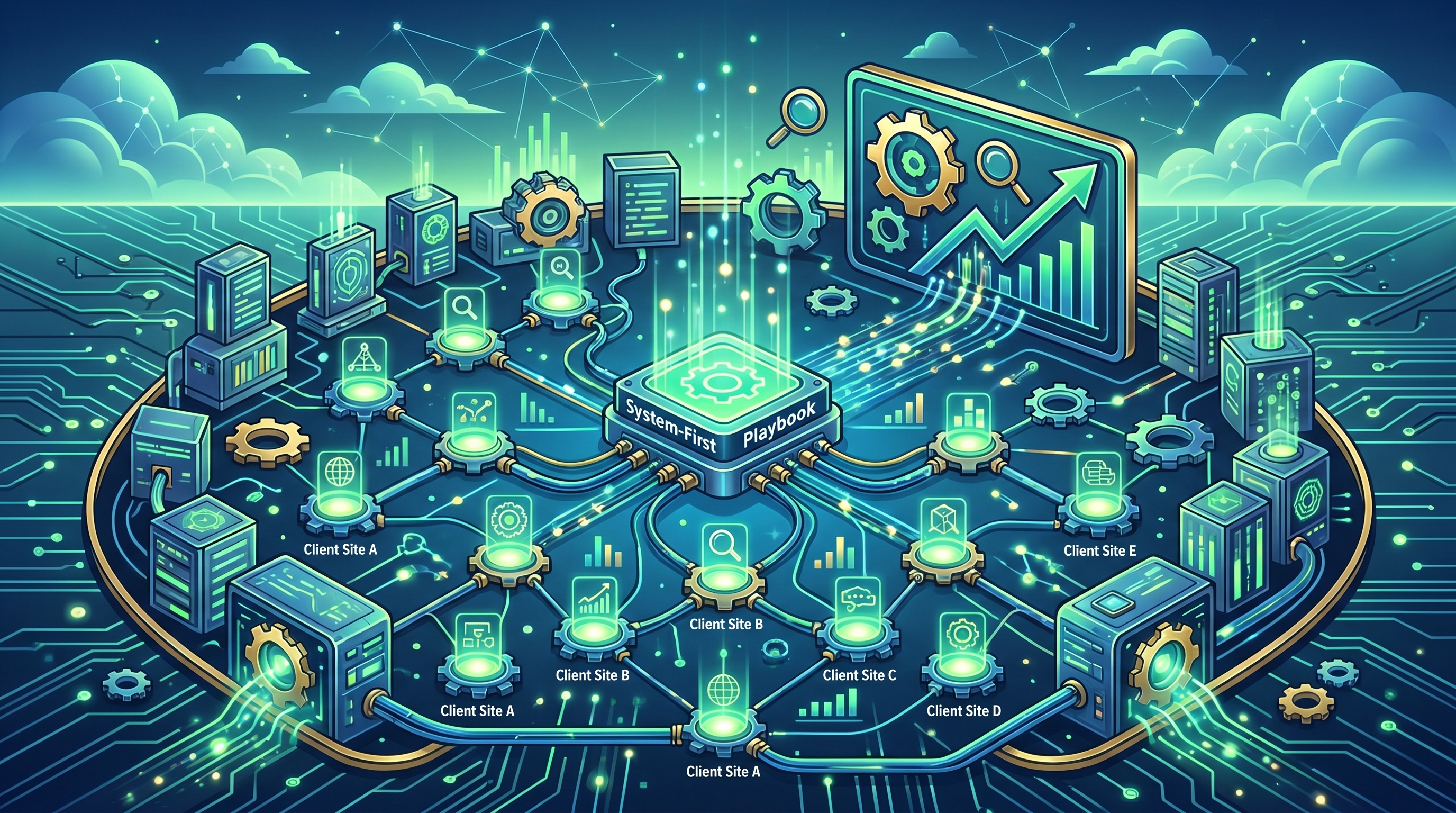
Managing SEO for Dozens of Client Sites Efficiently: The System-First Playbook
Most agency owners hit a wall around client number eight. Not because they lack talent — because they're running an SEO operation on spreadsheets, Slack threads, and sheer willpower. You've got the processes in your head, the workflows in a Google Doc nobody updates, and a team that spends more time context-switching than executing. Sound familiar?
Managing SEO for dozens of client sites isn't a staffing problem. It's a systems problem. The agencies and operators who scale past 20, 30, or 50 clients without burning out aren't working harder — they've engineered their workflows so the machine does the heavy lifting. In 2026, that machine is increasingly autonomous. AI-driven platforms now handle entire content lifecycles, rank tracking fires alerts without anyone logging in, and publishing pipelines ship optimized content without a human touching a CMS.
This guide breaks down exactly how to build an SEO operation that scales across dozens of client sites without proportionally scaling your team — from workflow architecture and tooling to automation layers that eliminate the manual tasks eating your margins.
Why Managing Multiple Client Sites Breaks Most SEO Teams
The math of manual SEO management is brutal. Add a client, add hours. Add five clients, add a hire. This is the linear scaling trap, and it's the reason most boutique SEO agencies plateau around 10–15 clients regardless of how good their work is. The bottleneck isn't talent — it's the absence of systems that decouple output from headcount.
Context-switching is the silent productivity killer. Jumping between 20 client dashboards, each with its own keyword set, CMS, reporting cadence, and stakeholder, destroys the deep work that actually moves rankings. Research consistently shows that knowledge workers lose significant cognitive load with every unplanned task switch [1]. For SEO teams, this manifests as shallow work across every account instead of meaningful momentum on any of them.
Then there's the reporting treadmill. Monthly decks that take two days to compile, present data the client won't act on, and require a fresh 45-minute call to explain. Across 25 clients, that's 50+ hours a month spent on reporting alone — hours that generate zero new rankings.
Manual keyword-to-publish workflows compound the problem. Discovery → brief → draft → edit → approve → publish → track. When each stage requires a human handoff, every article in your pipeline is a potential bottleneck. One delayed approval, one sick writer, one missed keyword research session cascades into missed publishing targets across your entire portfolio.
The Hidden Cost of Client-by-Client SEO Management
Do a real time audit across your 20-client portfolio. Most agency owners find that 60–70% of their team's hours are consumed by execution tasks — formatting content, updating trackers, pulling rank data, regenerating briefs — rather than strategy [2]. That's the compounding debt of a service model that never got systematized.
Content refresh debt is especially punishing at scale. When a 30-article piece published 18 months ago starts losing rankings, someone has to notice it, prioritize it, re-brief it, and get it updated. Multiply that across 30 client sites with 50+ published pieces each, and you're looking at a refresh backlog that manual workflows will never clear. The content decays faster than your team can respond.
Inconsistent workflows create quality variance that hurts retention. When each account manager runs their own process, client A gets proactive optimization while client B gets neglected until renewal time. That inconsistency shows up in performance gaps, which show up in churn.
Building the Architecture: Treat Your SEO Operation Like a System, Not a Service
The agencies that scale don't think of SEO as something they do for clients — they think of it as a machine they operate. The distinction matters operationally. A service is performed. A machine runs [3].
The closed loop looks like this: discovery → generation → publishing → optimization → repeat. Every step in that loop should either be automated or handled by a standardized template that removes decision-making friction. Human judgment belongs at the strategy layer — niche positioning, brand voice, competitive differentiation — not in the execution pipeline.
Standardize your inputs. Keyword taxonomy templates, content brief frameworks, site-level strategy documents — these should be reusable assets, not custom deliverables recreated from scratch for every client. Centralize reporting so performance data flows to one place automatically. Create SOPs that work whether you have 5 clients or 50. The client count should never be a variable in your operational complexity equation.
The Four Operational Layers Every Scalable SEO Agency Needs
Layer 1: Keyword and opportunity discovery (automated intake). Keyword research at scale can't rely on manual deep-dives for every client. Automated opportunity discovery — surfacing gaps, tracking competitor movements, identifying low-hanging SERP targets — should feed your pipeline without a strategist kicking it off every time.
Layer 2: Content production pipeline (templatized and scalable). Briefs, outlines, drafts, and optimization passes should follow a repeatable framework. When this layer is engineered correctly, the output is consistent regardless of which writer — or which AI — produced it.
Layer 3: Publishing and technical execution (remove human handoffs). Every manual step between content approval and live URL is a latency risk. Direct CMS integrations, scheduled publishing, and automated internal linking eliminate the last-mile drag that delays go-live dates.
Layer 4: Performance monitoring and continuous optimization (set triggers, not tasks). Don't have someone log into rank trackers every morning. Set thresholds that fire automatically — ranking drops below position 15, traffic dips of 20% week-over-week, content age triggers for refresh candidates. Let the system tell you what needs attention.
Standardizing Strategy Across Diverse Client Niches
Niche diversity is the hardest part of multi-client management to systematize, but it's not unsolvable. Build onboarding templates that capture niche-specific signals at intake — competitive density, local vs. national scope, intent distribution across the funnel — so your system can calibrate outputs without manual reconfiguration.
Reusable site audit frameworks that work across industries are the backbone of consistent quality. The technical audit checklist for an e-commerce client and a B2B SaaS client will share 80% of the same elements. Build for that 80%, then layer niche-specific modules on top.
Tagging and segmentation inside your CRM or project management system lets you manage local, national, and SaaS SEO clients under a single operational roof. Different playbooks, same machine.
Scaling Local SEO Clients Without Multiplying Effort
Local SEO is the hardest variant to scale manually, and it's where most agencies first feel the operational ceiling. NAP consistency across dozens of citation sources, Google Business Profile management for multiple clients across multiple locations, geo-variant keyword research — every one of these tasks is high-repetition and low-strategic-value, which makes them perfect automation candidates.
The citation and NAP consistency problem at volume is unsustainable by hand. A 20-location client with inconsistent addresses across 30+ directories is a rankings liability, and auditing it manually is a time sink with no leverage. Systematized citation management — automated audits, bulk correction workflows, and monitored consistency — handles this without a team member spending 8 hours in spreadsheets.
Google Business Profile management across dozens of clients requires templatized posting schedules, review response workflows, and Q&A monitoring. None of this requires human creativity. It requires reliable execution, which is exactly what systems do better than people.
Local SEO Systems That Run Across 10, 20, or 50 Markets
Template-driven local content is the scaling unlock for location-based clients. Location pages, service area pages, and proximity signal content can be generated from structured data inputs — city, service type, local identifiers — with minimal manual customization. The SEO infrastructure is the same; only the variables change.
Automated rank tracking segmented by city, region, and service type gives you a real-time picture of where each market stands without manual log-ins. When a specific service in a specific city drops, the system flags it. When rankings recover, the system confirms it.
Content refresh triggers based on local ranking drops mean you're responding to performance data, not gut feel or a client complaint. The system monitors, the system surfaces, the human decides — and that's the right division of labor [4].
The Right Tech Stack for Multi-Client SEO Management
The average SEO agency in 2026 is running six to eight tools simultaneously — a rank tracker, a site auditor, an AI writer, a reporting dashboard, a CMS integration layer, and a project management tool. The overhead of managing those tools across 30+ client sites is itself a productivity tax. Six logins, six billing cycles, six sets of context for your team to hold in their heads.
The distinction that matters in 2026 is between point tools that create more tabs and integrated systems that close the loop. A keyword tool that exports to a spreadsheet that feeds a brief template that goes to a writer who uploads to a Google Doc that gets copied into the CMS — that's not a system. That's a chain of manual steps wearing a tech costume.
When you're managing 30+ sites, the platform you choose needs to eliminate handoffs, not just accelerate individual steps. The question isn't 'does this tool save me 10 minutes?' — it's 'does this tool remove an entire step from the pipeline?'
Automation-First vs. Assistance-First Tooling
This distinction is where most agencies spend money in the wrong place. AI writing tools — even sophisticated ones — still require humans to brief, edit, approve, and publish. The human is still in the loop at every stage. That's assistance-first tooling, and while it improves quality-per-hour, it doesn't change the operational architecture.
Fully autonomous systems handle the entire lifecycle: keyword discovery fires, content is generated against a brief framework, it's optimized for on-page signals, and it's published — without a human touching each step. That's closed-loop SEO, and it's the only model that actually scales across 40-client portfolios without proportional headcount growth [5].
The evaluation question is simple: does this tool remove steps, or does it just speed up the same manual steps? If the answer is the latter, you're buying efficiency, not scale. Efficiency is a service improvement. Scale is a structural change.
If you're managing a high-volume client portfolio and want to see what closed-loop SEO infrastructure actually looks like end-to-end, see how it works.
Reporting Infrastructure That Doesn't Eat Your Fridays
Clients want to see three things: are rankings moving, is traffic growing, and is the work actually happening? Everything else is noise. Automated reporting that surfaces ranking movement, content velocity, and traffic trend data — delivered on a set cadence without someone manually pulling it — handles the client communication layer without consuming your strategists' time.
White-label dashboards beat custom decks at scale. The marginal ROI of a beautifully designed monthly deck drops sharply after client 10. Clients read the numbers, not the design. Invest the saved hours in actual optimization work.
Performance triggers that surface only the accounts needing intervention mean your team stops staring at green dashboards and starts acting on red ones. Attention goes where it's needed. That's the operational design.
Content Operations at Scale: Stopping the Babysitting
Content decay is the silent killer across large client portfolios. Published 18 months ago and never touched, those articles are bleeding rankings while your team is busy writing net-new content for clients who'd benefit more from a targeted refresh. Across 30 sites with 50+ articles each, you're looking at 1,500+ pieces of content that need attention — and a manual process that can handle maybe 20 refreshes a month.
Building a keyword-to-publish pipeline that doesn't require a writer for every article isn't a future-state vision — it's an operational necessity for any agency managing more than 15 clients. The agencies that have built this pipeline have effectively removed the content bottleneck from their growth ceiling. The ones that haven't are still hiring writers and watching margins compress.
Systematic Content Refresh Without Manual Audits
Performance thresholds that automatically flag content for refresh change the operational model entirely. Instead of a quarterly audit — which someone has to schedule, run, analyze, and prioritize — the system continuously monitors ranking position, organic traffic, and engagement signals. When a piece drops below threshold, it enters the refresh queue automatically.
Continuous optimization loops replace the audit cadence with a living system. Content gets refreshed when it needs it, not when someone remembers to check. Across a 30-client portfolio, this means hundreds of automatic optimization triggers running in parallel — the kind of coverage that a manual process simply cannot replicate.
Prioritizing refresh vs. net-new content is a strategic call that the system can also inform. If 60% of your client's top-20 rankings are decaying pieces rather than keyword gaps, the algorithm should surface that. Human strategy, machine-surfaced data.
Scaling Content Output Without Scaling Headcount
The math is unforgiving. If each client needs 8 articles per month and you have 25 clients, that's 200 articles. At a 4-hour production cycle per article (brief, write, edit, optimize, publish), that's 800 human hours per month. That's five full-time writers doing nothing but content, and zero capacity for strategy, client communication, or refresh work.
A fully automated content pipeline changes the equation. Keyword identified, brief generated, draft produced, on-page optimization applied, published — without five sequential human steps. Agencies that have removed human handoffs from the content production layer consistently report reclaiming 20+ hours per week per account manager, with content velocity increasing rather than decreasing [2].
That's not a marginal improvement. That's a structural change to what a 10-person agency can deliver.
Client Communication and SEO Reporting That Doesn't Slow You Down
Clients don't need to see everything — they need to see what matters. Ranking movement, traffic trends, content velocity, and momentum signals. Automating the performance narrative means the client receives a coherent story about their account's progress without your team spending Tuesday afternoons reformatting spreadsheets.
Positioning autonomous SEO delivery to skeptical clients comes down to outcome framing. The client doesn't care whether a human or a system wrote the content — they care whether it ranks and converts. Lead with results data, not process transparency. When the performance metrics are moving, the conversation about automation takes care of itself.
Feedback loops that improve output quality without manual review cycles are the final piece. Structured client feedback at 90-day intervals, mapped to content performance data, gives the system calibration signals without turning every client into a QA process.
How to Transition Your Agency From Manual Execution to Autonomous Operations
Start with a systems audit. Map every repeatable task your team performs across client accounts in a given month. Rank them by frequency and strategic value. The tasks that are high-frequency and low-strategic-value — rank pulling, brief formatting, report generation, citation management — are your first automation targets. The tasks requiring genuine judgment — competitive positioning, brand voice calibration, client strategy — stay human.
Phase one: automate content production and reporting. These two categories consume the most hours and require the least human creativity. Getting these off your team's plate is the fastest path to margin recovery and capacity expansion.
Change management matters. SEO team members who've been execution-focused need to shift into strategy and oversight roles. That's a meaningful identity shift, and it requires framing the transition as a capability upgrade, not a headcount reduction. The best operators become system architects — the people who configure and calibrate the machine, not the people operating it manually.
What 'Set It and Forget It' SEO Actually Looks Like in Practice
A day in the life of a manual multi-client manager: log in to 12 dashboards, export rank data, update a master spreadsheet, brief two writers, follow up on two overdue drafts, pull last month's traffic data for a client call, start building a report deck. That's before lunch.
A day in the life of an operator running an autonomous pipeline: review the system's flagged accounts — three sites need attention based on ranking triggers — make two strategic adjustments, join one client call with a pre-populated performance narrative, and spend the remaining time on new business development or high-leverage strategy work.
Operators managing 40+ client sites with autonomous platforms consistently report staying lean — 3 to 5 person teams — while delivering content velocity and reporting quality that would previously have required teams twice the size [3]. The metrics that prove it: content pieces published per month, ranking improvements within 90 days of publish, and client retention rates that trend above 85% when accounts receive consistent, system-driven optimization.
Agencies that don't systematize now will be priced out by those that do. The market rate for SEO services is being compressed by operators who've removed manual overhead from their cost structure. You can't compete on price when you're paying for 10 hours of manual work that your competitor automated.
The Bottom Line
Managing SEO for dozens of client sites efficiently isn't about hiring faster or working longer — it's about engineering a system where discovery, content, publishing, and optimization run without constant human input. The agencies and founders winning in 2026 have stopped treating SEO as a service they perform and started treating it as a machine they operate.
The framework is clear: standardize your architecture, automate execution layers, centralize reporting, and remove every human handoff that doesn't require genuine strategic judgment. Layer 1 through Layer 4 of your operational stack should be running in parallel across every client, every day, without a task assigned to a person.
The margin you recover from automation doesn't just improve profitability — it funds growth. New clients, new capabilities, deeper strategy for your highest-value accounts. That's the compounding return of a system-first operation.
Stop managing SEO one client at a time. Ranklynk's autonomous SEO engine handles the entire lifecycle — discovery through optimization — across every site in your portfolio without the manual overhead. See how it works.
Frequently Asked Questions
Q: Why do most SEO agencies struggle when managing dozens of client sites at once?
Most SEO agencies hit a scaling wall — typically around 8 to 15 clients — not because of talent gaps but because of a systems problem. When every new client added means more hours worked or a new hire made, the agency is trapped in linear scaling. Teams spend the majority of their time on execution tasks like formatting content, pulling rank data, and updating spreadsheets rather than doing high-value strategic work. Context-switching between 20+ client dashboards destroys deep focus, and inconsistent workflows across account managers create quality variance that directly leads to client churn. Managing SEO for dozens of client sites efficiently requires decoupling output from headcount — something manual, ad-hoc processes simply cannot achieve.
Q: What is the linear scaling trap and how does it prevent SEO agencies from growing?
The linear scaling trap is the pattern where adding clients directly requires adding staff or hours. If onboarding one client costs 10 hours per month, managing 30 clients costs 300 hours — math that makes growth financially unsustainable. Agencies stuck in this trap plateau around 10–15 clients regardless of the quality of their SEO work. The solution is building systems that allow output to grow without proportionally growing the team. In 2026, AI-driven platforms, automated rank tracking, and autonomous publishing pipelines make it possible to manage dozens of client sites without linear increases in headcount.
Q: How much time does manual reporting actually consume across a large SEO client portfolio?
The reporting burden is staggering at scale. A single monthly client report can take two or more days to compile, plus a 45-minute call to present findings. Across 25 clients, that amounts to over 50 hours per month spent purely on reporting — time that generates zero new rankings or SEO improvements. This is one of the biggest inefficiencies in managing SEO for dozens of client sites efficiently. Automating reporting through dashboards that pull live data eliminates the bulk of this overhead, freeing the team to focus on execution and strategy that actually drives results.
Q: What is content refresh debt and why is it a serious problem at scale?
Content refresh debt refers to the growing backlog of published content that has started losing rankings and needs to be updated but hasn't been prioritized. When an agency manages 30 client sites each with 50+ published articles, even a small percentage of decaying content creates an enormous backlog. Because manual workflows require a human to notice the drop, re-brief the piece, assign a writer, and publish the update, the content degrades faster than teams can respond. Managing SEO for dozens of client sites efficiently requires automated systems that flag ranking drops and trigger refresh workflows without relying on a team member to manually catch every issue.
Q: How does context-switching hurt SEO team performance across multiple client accounts?
Context-switching is a silent productivity killer for SEO teams managing multiple accounts. Jumping between 20 different client dashboards — each with unique keyword sets, CMS environments, reporting cadences, and stakeholder preferences — fragments attention and destroys the deep, focused work that actually moves rankings. Research consistently shows that knowledge workers lose significant cognitive capacity with each unplanned task switch. For SEO teams, this results in shallow work spread thin across every account instead of meaningful, compounding progress on any single one. Reducing context-switching through consolidated dashboards, standardized workflows, and automation is essential for managing SEO for dozens of client sites efficiently.
Q: What role does automation play in scaling an SEO operation across dozens of clients?
Automation is the backbone of any scalable multi-client SEO operation in 2026. Modern AI-driven platforms can handle entire content lifecycles — from keyword research and brief generation to drafting, optimization, and publishing — without constant human intervention. Rank tracking tools fire alerts automatically rather than requiring someone to log in and check manually. Publishing pipelines can ship optimized content without a team member touching the CMS. These automation layers eliminate the manual, low-value tasks that consume 60–70% of team hours in unoptimized agencies. By automating execution, SEO teams can redirect their energy toward strategy, client communication, and the decisions that genuinely differentiate performance.
Q: What practical steps should an SEO agency take to build a system that scales to dozens of clients?
Building a scalable SEO operation starts with treating it as an engineered machine rather than a collection of individual services. Key steps include standardizing workflows so every account follows the same process — from discovery and briefing to publishing and reporting — regardless of which team member handles it. Agencies should audit where team hours are actually going and identify which tasks can be automated or templated. Centralized dashboards that surface all client data in one view reduce context-switching. Automated reporting eliminates hours of manual deck-building. AI-powered content tools remove human bottlenecks from the brief-to-publish pipeline. Finally, building a content refresh system that proactively identifies decaying pages prevents backlog accumulation. Managing SEO for dozens of client sites efficiently is achievable when workflows are documented, automated, and consistently enforced across the entire portfolio.
References
[1] https://www.mtu.edu/umc/services/websites/seo/. mtu.edu. https://www.mtu.edu/umc/services/websites/seo/
[2] https://victorious.com/blog/seo-at-scale/. victorious.com. https://victorious.com/blog/seo-at-scale/
[3] https://www.brightedge.com/blog/seo-management. brightedge.com. https://www.brightedge.com/blog/seo-management
[4] https://chazedward.com/seo-case-studies/. chazedward.com. https://chazedward.com/seo-case-studies/
[5] https://fiftyfiveandfive.com/resources/seo-at-scale-guide/. fiftyfiveandfive.com. https://fiftyfiveandfive.com/resources/seo-at-scale-guide/