Programmatic SEO for Small Teams Without Developers: The No-Code Playbook for 2026
Most small teams assume programmatic SEO requires a developer on speed dial, a custom CMS, and three months of runway. It doesn't.
Programmatic SEO — the practice of generating hundreds or thousands of optimized pages from structured data and templates — used to be the exclusive territory of well-funded engineering teams. Zillow. Tripadvisor. NerdWallet. Companies that could afford to build the infrastructure from scratch. That gap no longer exists. The tooling has caught up, and small teams of two, five, or ten people are now running the same content systems that used to take entire dev squads to maintain [1].
This guide breaks down exactly how small teams can build, launch, and scale a programmatic SEO system in 2026 — no developers, no agency, no manual content treadmill. Just a repeatable system that compounds.
What Programmatic SEO Actually Is (And Why Small Teams Get It Wrong)
Strip away the jargon and programmatic SEO is a simple concept: structured data goes in, ranked pages come out. You build one template. You connect it to a dataset. The system produces pages at scale, each one targeting a specific keyword variation your audience is already searching for.
What it is not is bulk content generation. This distinction matters. Bulk content is volume without architecture — hundreds of posts thrown at a wall to see what sticks. Programmatic SEO is architecture without the overhead — a systematic approach where every page has a defined purpose, a data-backed keyword target, and a structural logic that scales without adding headcount.
The most common misconception small teams carry is that they need a developer to make this work. They imagine database schemas, API endpoints, custom CMS builds. They stall at the idea stage, paralyzed by complexity that no longer exists in the tooling landscape. The result: they keep grinding the old way — one keyword, one brief, one writer, repeat — while competitors with the same team size compound their organic traffic through systems [2].
The real unlock is treating SEO like infrastructure, not a campaign. Campaigns end. Infrastructure compounds.
Programmatic SEO vs. Traditional Content: What's Different?
Traditional SEO is linear. One keyword, one article, one writer, publish, repeat forever. The math never works in your favor. You're trading time for traffic, and the ratio stays roughly constant no matter how long you do it.
Programmatic SEO breaks that math. One template, one dataset, hundreds of pages — all launching in the time it used to take to publish a single blog post. The economics flip dramatically at scale. A team of three running a programmatic system can outproduce a content department of twenty running traditional workflows [1].
Small teams that keep doing it the old way aren't just slower. They're structurally outcompeted by teams that have made the shift. In 2026, that gap is widening.
When Programmatic SEO Makes Sense for a Small Team
Programmatic SEO isn't the right tool for every situation. Knowing when to deploy it is as important as knowing how.
The clearest signal: you've identified a high-volume keyword cluster where the same search pattern repeats across hundreds or thousands of variations. "[City] + [service]" pages. "[Tool A] vs [Tool B]" comparison pages. "Best [software category] for [use case]" pages. These patterns scream programmatic. They share structure. They differ in data. That's exactly what template-based systems are built for.
Use cases where pSEO consistently delivers for small teams in 2026 include SaaS comparison and alternative pages, location-based landing pages for local service businesses, tool and software directories, and listicle variants driven by taxonomy data [3].
When is pSEO the wrong move? When you don't have genuine data differentiation across your pages. Thin content — pages that swap one keyword but offer nothing unique in the body — still draws Google's penalty flag. The minimum viable dataset before you start is a structured source with enough unique field values per page to make each one genuinely useful to a searcher, not just technically distinct.
Real-World Use Cases for Small Teams in 2026
SaaS products run "[Your Tool] vs [Competitor]" pages and "[Use case] + [Software category]" landing pages to capture high-intent commercial searches at scale. A five-person SaaS team can own an entire competitive comparison landscape without a content manager.
Agencies deploy city + service landing pages for local clients — hundreds of location variants from a single template and a city database. What used to be a custom project per client becomes a repeatable system.
Media and content businesses build topic cluster architectures driven by taxonomy data — every tag, category, and subtopic becomes a structured landing page reinforcing the whole.
Founder-led startups use feature-specific landing pages at scale to capture long-tail queries without hiring a content team. The product does the work. The system does the publishing.
The No-Code Tech Stack: Tools That Do the Heavy Lifting
Every programmatic SEO stack has three layers: data, templates, and publishing. Get all three working together and you have a system. Miss one and you have a project that stalls.
In 2026, no-code and low-code tooling covers all three layers without requiring developer involvement [4]. The market has matured enough that the question isn't "can a non-technical team build this?" — it's "which combination of tools fits our workflow?"
What to look for in a pSEO tool: automation depth (not just feature count), native CMS integration, and the ability to scale page output without manual publishing steps. The difference between a tool that assists and a system that runs itself is whether you're still making decisions at the page level. If you are, it's not a system — it's a faster version of the old way.
Cost context: assembling a custom stack from Airtable, Webflow, Zapier, and a content layer typically runs $300–800/month in tooling plus ongoing time investment. Agency fees for equivalent output run $3,000–10,000/month. Autonomous platforms that handle the full lifecycle sit in between on cost and well above on efficiency [3].
Data Sources and Structuring Your Input Layer
Your data layer is the foundation. Without clean, structured input, your templates produce garbage output — and Google ranks accordingly.
Common data sources for small teams: Google Sheets or Airtable for manually curated datasets, public APIs for dynamic data (location databases, product catalogs, financial data), and lightweight scrapers for competitive intelligence. The key is normalization — every field your template references needs to be consistently formatted across every row.
The single most important data decision you'll make: investing in unique data fields. Pages that rank aren't just keyword-differentiated. They contain information that's genuinely distinct per page — specific stats, local details, feature comparisons, pricing data. That's what separates programmatic pages that perform from filtered spam that gets deindexed [5].
Template and Publishing Tools for Non-Technical Teams
On the CMS side, Webflow, WordPress (with page builder plugins and custom fields), and Framer have all developed workflows that support programmatic page creation without writing code. Webflow's CMS collections are particularly well-suited to template-driven scaling.
Template logic is where most non-technical teams underinvest. A high-performing pSEO template doesn't just swap a keyword in the H1 — it varies meaningfully across the page. Different supporting content blocks, conditional sections based on data values, dynamic internal links. The goal is pages that read as purpose-built, not generated.
Publishing automation — connecting your data layer to your CMS without touching code — typically runs through Zapier, Make, or native CMS import functions. Monitoring and indexing is the final step most teams forget: submitting updated sitemaps, validating crawl access, and checking Google Search Console for indexing status after launch.
Building Your Programmatic SEO System: A Step-by-Step Breakdown
The five-stage workflow that separates teams with a running system from teams still planning one: keyword clustering → data structuring → template creation → publishing → optimization.
Most teams skip stage one and pay for it later. They build templates around gut-feel keywords, launch pages, and wonder why nothing ranks. Keyword clustering is the architectural planning phase — it determines what you build and whether it was worth building.
Stage 1: Keyword Clustering and Opportunity Mapping
Start with tools like Ahrefs or Semrush to identify keyword clusters that follow repeatable patterns. Look for "modifier + seed" combinations: "[city] + [service]", "[brand] + vs + [competitor]", "[software] + for + [industry]". These patterns signal that the search landscape rewards template-based coverage.
Filter by intent. Informational clusters build topical authority. Commercial clusters drive conversions. For most small teams with limited runway, starting with commercial-intent clusters produces ROI faster. Both have a place in a mature pSEO system — but the sequencing matters.
Stage 2: Template Design That Scales Without Breaking
A high-performing pSEO template includes: a dynamic H1 that incorporates the primary keyword variation, a unique body content section with data-driven differentiation, structured data markup (schema), and dynamic internal links that connect related pages in your programmatic cluster [5].
Content variation is the thin-content line in practice. Pages need to differ in ways that matter to a searcher, not just in the swapped keyword. Use conditional content blocks — sections that appear or change based on specific data field values. A location page for Chicago should contain Chicago-specific information beyond just the city name in the heading.
Stage 3: Continuous Optimization Without Manual Work
Launching pages is stage one of an ongoing system, not the finish line. Underperforming pages need identification before they drop rankings, not after. The trigger metrics: declining impressions, low click-through rate relative to average position, and crawl rate reduction.
Automated refresh logic — rules that trigger a content update when pages fall below defined performance thresholds — is what separates a pSEO system from a pSEO project. A fully autonomous system handles discovery-to-optimization without requiring a human to notice the problem first. That closed loop is the compounding engine.
The Developer Bottleneck: How to Remove It Entirely
Developer dependency is the number-one reason small teams stall on programmatic SEO. Not because the work requires a developer — but because teams assume it does and never challenge that assumption.
The tasks that seem technical but aren't in 2026: schema markup (handled by plugins and no-code tools like Rank Math, Schema App, or native CMS features), URL structure planning (done in a spreadsheet before a single page is published), redirect management (handled through CMS settings in Webflow, WordPress, and most modern platforms), and canonical tag configuration (a CMS-level setting in virtually every major platform).
Crawl budget management — ensuring Google allocates crawl resources efficiently across a large page set — is handled through sitemap prioritization, robots.txt configuration, and internal linking logic. All of it is documented, learnable, and executable without writing a line of code [5].
Technical SEO Without a Dev: What's Actually Possible Now
Schema markup via plugins like Rank Math or Yoast handles structured data at scale without touching JSON-LD manually. URL structure planning in a spreadsheet — before any page is built — gives you a clean architecture that's easy to implement in any CMS. Redirects and canonical tags live in CMS settings panels, not code files. Crawl budget management is a configuration exercise, not an engineering project.
The operator's mindset shift: stop asking "how do I build this?" and start asking "how do I configure this to run itself?" Building is a one-time effort. Systems run continuously.
What a Fully Autonomous Programmatic SEO Engine Looks Like
Assembling a stack and running a closed-loop system are two different things. A stack is a collection of tools. A system is a workflow that executes without human initiation at each step.
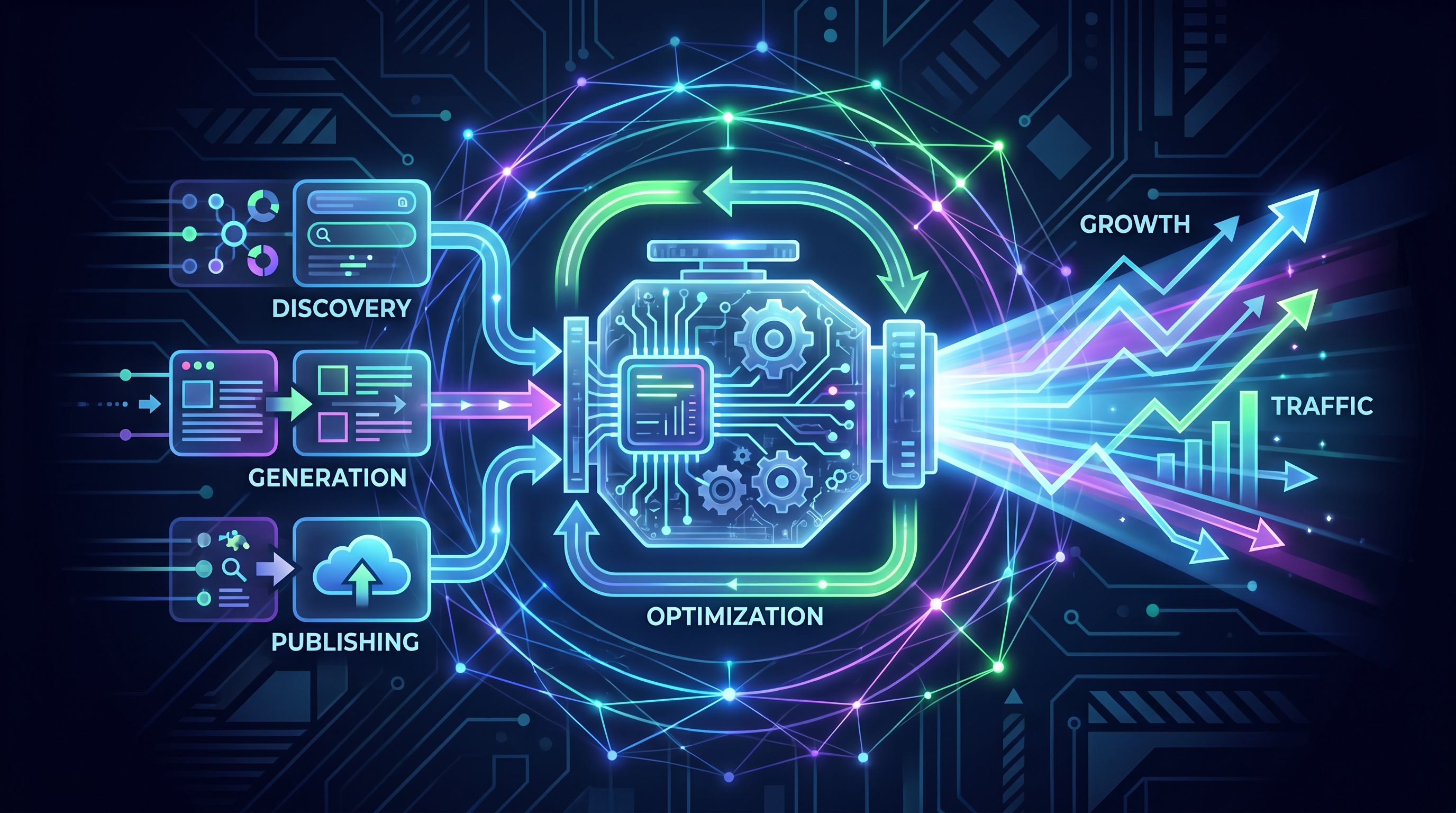
The fully autonomous model handles keyword discovery, content generation, publishing, and ongoing optimization in a single connected workflow. No manual brief writing. No publishing queues. No content calendars. The system detects opportunities, generates content against templates, publishes pages, monitors performance, and triggers refreshes when thresholds are crossed — all without a project manager in the loop.
This isn't aspirational in 2026. Platforms that deliver this workflow exist and are being used by teams of two and three people to run content operations that would have required agencies or departments five years ago [2].
The compounding effect is the real argument for making the shift. An autonomous SEO system produces returns that scale with time, not headcount. Every page published reinforces the ones around it. Every optimization run improves the baseline. Teams that have stopped babysitting their content aren't just more efficient — they're operating on a fundamentally different growth curve.
If you're ready to stop assembling tools and start running a system, see how it works — Ranklynk runs the full programmatic lifecycle from keyword discovery to published, optimized pages without developer input.
How to Evaluate Programmatic SEO Tools in 2026: The Real Criteria
Don't evaluate on feature count. A tool with fifty features that still requires manual publishing steps is not a system — it's an expensive assistant.
The five questions to ask any pSEO tool before committing:
- Does it automate publishing, or just content generation? Tools that stop at content generation leave you with the hardest part still to do manually.
- Does it require developer setup to launch? If the answer involves APIs, webhooks, or custom code, it's not built for small teams.
- Does it monitor and refresh pages automatically? One-time publishing is a project. Ongoing optimization is a system.
- Does it handle keyword discovery natively, or do you bring your own research? Integrated discovery reduces the workflow surface area you have to manage.
- What's the total cost of ownership? Include tool cost, time investment, and opportunity cost of the manual steps the tool doesn't handle [4].
Red flags: tools that require constant prompt engineering to produce usable output, platforms that need a developer for initial setup, and any solution where "publishing" is still a manual step.
Ranklynk's approach treats full-lifecycle automation — from keyword discovery through published, optimized pages — as the baseline, not a premium tier. The system handles what most stacks leave to humans: the recurring decisions that kill small-team productivity.
The Bottom Line
Programmatic SEO is no longer a developer problem. It's a systems problem. And systems problems are exactly what small, focused teams solve best — when they have the right tooling underneath them.
The teams compounding in 2026 aren't the ones with the biggest content budgets or the most writers. They're the ones that made a decision: treat SEO as infrastructure, not a content calendar. Build once, scale continuously, optimize automatically.
The tools exist. The workflows are documented. The only thing standing between your team and a self-running SEO system is the decision to stop doing it manually.
Ranklynk runs the full programmatic SEO lifecycle — keyword discovery to published, optimized pages — without a developer, a writer, or a project manager in the loop. See how it works and see what your team could be building instead.
Frequently Asked Questions
Q: What is programmatic SEO and how does it work for small teams without developers?
Programmatic SEO is the practice of generating hundreds or thousands of optimized pages from structured data and templates. Instead of writing each page individually, you build one template, connect it to a dataset, and the system produces pages at scale — each targeting a specific keyword variation your audience is already searching for. For small teams without developers, this became practical in 2026 because no-code tooling has caught up with what once required entire engineering teams. You no longer need custom CMS builds, database schemas, or API endpoints. Small teams of two to ten people can now build and run the same content systems that previously took full dev squads to maintain, using accessible no-code platforms to do the heavy lifting.
Q: How is programmatic SEO different from bulk content generation?
Programmatic SEO and bulk content generation are commonly confused but fundamentally different. Bulk content is volume without architecture — throwing hundreds of posts at a wall and hoping something ranks. Programmatic SEO is architecture without overhead. Every page in a programmatic system has a defined purpose, a data-backed keyword target, and a structural logic that scales predictably. The key distinction is intentionality. In programmatic SEO, you design a repeatable framework where structured data drives differentiated, purposeful pages. Bulk content lacks that structure, often producing thin, undifferentiated pages that provide no real value to searchers. For small teams, this distinction is critical — the goal is building a system that compounds, not just inflating page count.
Q: Do you really need a developer to run programmatic SEO in 2026?
No — and this is one of the most persistent misconceptions holding small teams back. Many assume programmatic SEO requires a developer on speed dial, a custom CMS, and significant runway. In 2026, that assumption is outdated. The no-code tooling landscape has matured to the point where small teams can build, launch, and scale programmatic SEO systems entirely without engineering support. Teams that stall waiting for developer resources are losing ground to competitors with the same team size who have already adopted no-code programmatic workflows. The real barrier today is not technical skill — it is understanding the framework and treating SEO as infrastructure rather than a one-off campaign.
Q: When does programmatic SEO make sense for a small team, and when should you avoid it?
Programmatic SEO makes the most sense when you have identified a high-volume keyword cluster where the same search pattern repeats across hundreds or thousands of variations. Classic examples include '[City] + [Service]' location pages, '[Tool A] vs [Tool B]' comparison pages, and 'Best [software] for [use case]' listicles. These patterns share structure but differ in data — which is exactly what template-based systems are designed to handle. Common use cases delivering results for small teams in 2026 include SaaS comparison and alternative pages, location-based landing pages, software directories, and taxonomy-driven listicles. Programmatic SEO is the wrong move when you lack genuine data differentiation across pages. If your pages would end up with thin, near-identical content that offers no real value, pSEO will hurt rather than help your rankings.
Q: What is the core advantage of programmatic SEO over traditional content production for small teams?
Traditional SEO is linear — one keyword, one article, one writer, repeated indefinitely. The economics never improve no matter how long you sustain the effort. Programmatic SEO breaks that math entirely. With one template and one dataset, a small team can launch hundreds of pages in the time it once took to publish a single blog post. A team of three running a programmatic system can realistically outproduce a traditional content department of twenty people. The compounding effect is the key advantage. Unlike campaigns that end when effort stops, programmatic SEO infrastructure continues generating value over time. For small teams competing against larger organizations, this structural advantage is significant — and in 2026, teams still using traditional workflows are becoming increasingly outcompeted.
Q: What types of businesses and use cases benefit most from programmatic SEO without developers?
Several business types see consistently strong results from no-code programmatic SEO in 2026. SaaS companies benefit from comparison pages, alternative pages, and integration-specific landing pages that capture high-intent searchers. Local service businesses can scale location-based landing pages targeting '[City] + [Service]' keyword patterns across dozens or hundreds of markets. Tool and software directories can programmatically generate category and comparison pages. Any business with a structured taxonomy — whether by product type, location, use case, or audience segment — can leverage programmatic templates to generate relevant, differentiated pages at scale. The common thread across all these use cases is the presence of repeatable keyword patterns and genuine data variation that allows each page to offer something distinct and useful to the searcher.
Q: What is the biggest mistake small teams make when approaching programmatic SEO?
The biggest mistake small teams make is assuming programmatic SEO is beyond their reach and stalling at the idea stage. Many teams imagine the process requires developer resources, complex infrastructure, and months of build time — so they never start. Meanwhile, competitors with identical team sizes are already running programmatic systems and compounding their organic traffic. A second major mistake is conflating programmatic SEO with bulk content. Teams sometimes launch hundreds of nearly identical pages with minimal data differentiation, which produces thin content that search engines penalize rather than reward. The right approach is to treat SEO as infrastructure — building a system with genuine structural logic, real data differentiation, and a clear keyword architecture — rather than treating it as a volume play or a short-term campaign.
References
[1] https://hashmeta.com/blog/how-programmatic-seo-helps-small-teams-scale-content-marketing-faster/. hashmeta.com. https://hashmeta.com/blog/how-programmatic-seo-helps-small-teams-scale-content-marketing-faster/
[2] https://concurate.com/programmatic-seo-tools/. concurate.com. https://concurate.com/programmatic-seo-tools/
[3] https://www.swellai.com/blog/programmatic-seo. swellai.com. https://www.swellai.com/blog/programmatic-seo
[4] https://hashmeta.com/blog/how-programmatic-seo-helps-small-teams-scale-content-marketing-faster/. hashmeta.com. https://hashmeta.com/blog/how-programmatic-seo-helps-small-teams-scale-content-marketing-faster/
[5] https://keytomic.com/blog/top-9-programmatic-seo-tools. keytomic.com. https://keytomic.com/blog/top-9-programmatic-seo-tools