Replace Your SEO Agency With Automated Tools: The 2026 Operator's Playbook
You're paying five figures a month to an SEO agency — and still manually chasing deliverables, waiting on reports, and watching rankings flatline. The system is broken. And in 2026, you don't have to tolerate it.
The SEO agency model was built for a slower internet. Monthly retainers, quarterly audits, hand-crafted content briefs — that cadence made sense when Google updated its index in weeks, not hours. Today, AI has collapsed the cost of content production, automated technical audits, and turned keyword research into a commodity. The agencies haven't caught up. The tools have [1].
This guide breaks down exactly how agency owners, SaaS founders, and growth operators are replacing traditional SEO agencies with automated tool stacks — cutting overhead, accelerating output, and building SEO systems that run without babysitting.
Why the Traditional SEO Agency Model Is Breaking Down in 2026
Agency retainers were designed around one thing: labor costs. A team of writers, strategists, and account managers bundled into a monthly invoice. That model had a logic to it — until AI made labor cheap [2].
The disconnect today isn't about talent. It's structural. Operators need speed, scale, and transparency. Agencies deliver monthly reports, revision cycles, and strategy decks. Those two operating cadences are incompatible. Google's algorithm now shifts in real time. A monthly reporting cycle doesn't catch a ranking drop until it's already compounded into a traffic crater.
Worse, agencies are structurally incentivized to optimize for client retention, not client outcomes. The longer you stay confused about SEO, the longer you stay on retainer. That's not a conspiracy — it's just how the economics work.
And the content math has become impossible to ignore. The average agency markup on AI-assisted content is now 60–80%, producing output you could automate directly for a fraction of the cost [3].
The Real Cost of an SEO Agency in 2026
Break down a $5K–$15K/month agency retainer and here's what you're actually funding: account management overhead, internal QA processes, project coordination, and a margin layer on top of tools you could license yourself. The content production line — which AI now handles in minutes — is often the smallest actual cost on their side, but the largest line item on your invoice.
Then there are the hidden costs: onboarding delays that eat your first 60 days, revision cycles that stall publishing momentum, strategy drift as account managers rotate, and the churn tax when you eventually leave and take nothing proprietary with you.
Opportunity cost is the number nobody talks about. Every week you spend waiting on an agency deliverable is a week your competitors are publishing, indexing, and compounding organic equity.
What Has Actually Changed with AI and SEO Automation
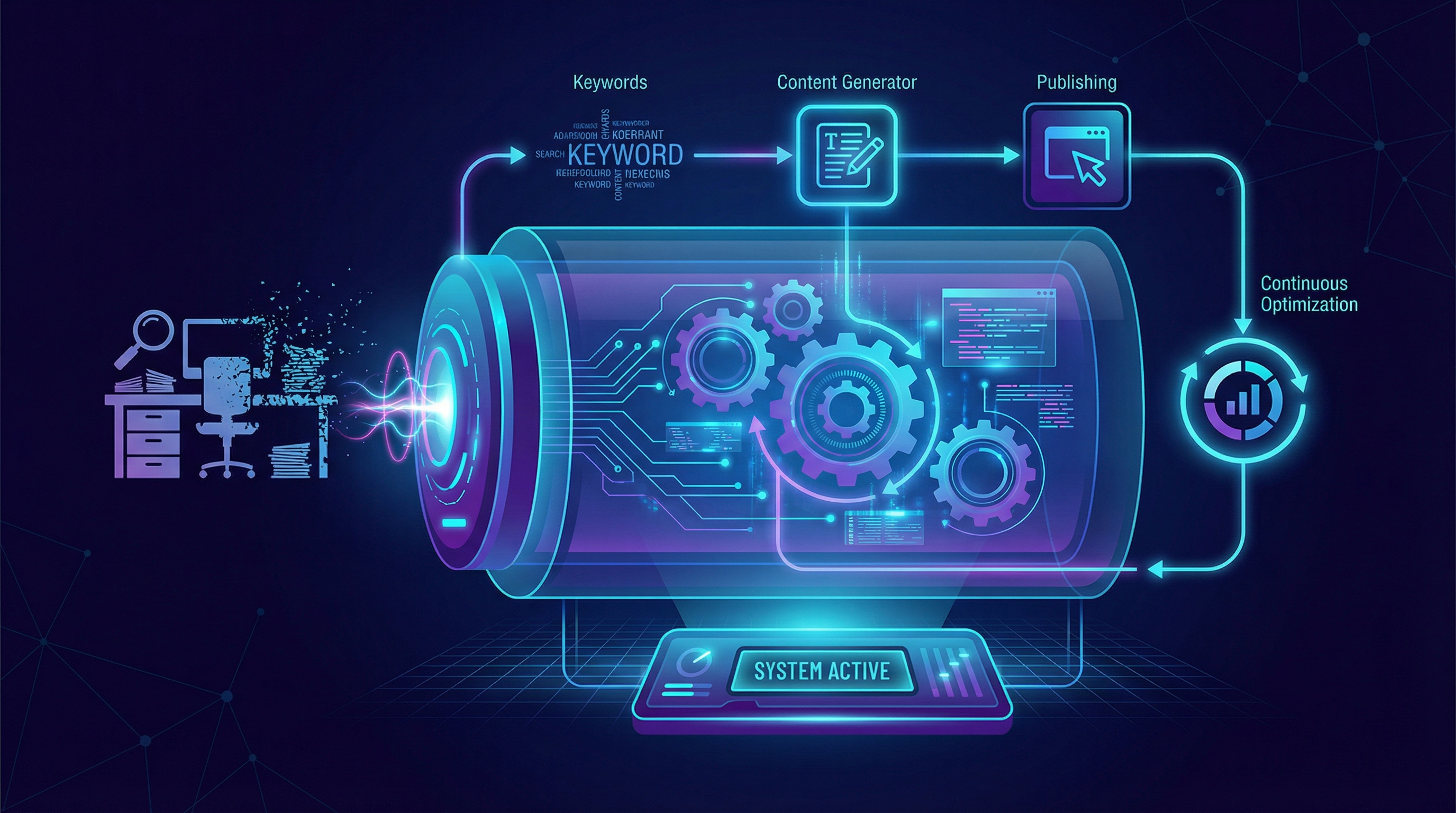
AI didn't just speed up content writing. It automated the entire keyword-to-publish pipeline [4]. Technical SEO auditing, internal linking analysis, on-page scoring, meta optimization — all of it can now run programmatically, without a human in the loop.
The new competitive moat in organic search isn't content quality alone. It's publishing velocity combined with continuous optimization. The operators winning in 2026 aren't publishing better essays. They're publishing faster, indexing more surface area, and running feedback loops that keep content from decaying.
What 'Replacing Your SEO Agency' Actually Means
This isn't about firing humans and hoping for the best. It's about replacing manual processes with systems. There are five core functions every SEO agency performs. All five are now automatable.
Keyword discovery. Content creation. On-page optimization. Publishing. Performance monitoring.
The problem most operators hit isn't that tools don't exist — it's that they swap their agency for 12 disconnected point tools and end up with more overhead, not less. You didn't replace the agency. You became your own agency, manually stitching together Ahrefs exports, Surfer audits, Google Docs drafts, and WordPress logins.
The distinction that matters is between point tools and closed-loop systems. Point tools replace one task. Closed-loop systems replace the entire workflow.
The Five SEO Functions You Need to Automate
Keyword discovery and intent mapping. Automated SERP analysis and topical clustering — the system surfaces opportunities and organizes them by priority without a human running searches.
Content generation. From brief creation through to publish-ready drafts. Not content that requires a human editor to clean up before it goes live — output that's already optimized for structure, intent, and on-page signals.
On-page optimization. Title tags, meta descriptions, heading hierarchy, internal linking — executed at publish time, not retrofitted manually three months later.
Publishing and CMS integration. Zero-touch deployment to WordPress, Webflow, or custom stacks. The content moves from generation to live URL without a human touching it.
Performance tracking and content refresh triggers. The loop closes when rank tracking connects back to refresh logic — so content that starts decaying gets flagged and updated automatically, before traffic drops.
The 2026 SEO Automation Tool Landscape: What to Know Before You Build a Stack
There are three categories of SEO tools in 2026: research and audit tools, AI writing tools, and full-lifecycle automation platforms. Most operators have heard of the first two. The third category is where the leverage actually lives [5].
The trap is thinking that assembling category-leading point tools equals a system. It doesn't. It equals a stack of dashboards that still requires a human to interpret outputs, make decisions, and execute the next step. The hidden costs add up fast: API integrations that break, prompt engineering that drifts, manual QA that consumes hours, and version fragmentation across tools that update on different schedules.
Point Tools vs. Closed-Loop Automation Platforms
Point tools — Ahrefs, Semrush, Surfer, Jasper — solve individual problems well. They're genuinely excellent at what they do. But they require a competent operator to connect the dots between them. That operator is your labor cost.
Closed-loop platforms handle discovery through optimization in a single automated pipeline. The input is a domain or a topic cluster. The output is published, optimized content and a performance feedback loop. The human role shifts from executor to supervisor.
Point tools make sense when you have specialized tasks and existing operator expertise — competitive link analysis, technical crawl debugging, content gap audits at the strategic level. Closed-loop platforms win when you're running high-volume operations, managing multiple sites, or operating a lean team without a dedicated SEO staff member.
Key Features That Separate Real Automation From AI Gimmicks
Not every tool with 'AI' in the marketing copy delivers automation. Here's what actually matters:
Autonomous keyword discovery. Not a dashboard that surfaces data for a human to interpret — a system that identifies opportunities and queues them for action without manual input.
Publish-ready output. Drafts that require substantive human editing before going live aren't automation. They're outsourced drafting. The bar is content that deploys without a revision cycle.
Continuous re-optimization. The system monitors performance and triggers content updates without a scheduled human review. This is the function most point tools completely skip.
Multi-site and multi-client capability. Non-negotiable for agencies and portfolio operators. If the tool can't manage multiple properties at scale without multiplying your management overhead, it's a solo-user product, not an operations platform.
How to Replace Your SEO Agency: A System-First Approach
Start with your current agency deliverables and map each one to an automatable function. Be specific. 'Content creation' isn't a deliverable — '8 blog posts per month targeting mapped keywords with on-page optimization' is a deliverable. That specificity tells you exactly what the system needs to produce.
Audit your existing tech stack for redundancy before adding tools. Most operators already have overlapping capabilities across tools they're underusing.
Build the pipeline in the right sequence: keyword intelligence first, content engine second, publishing layer third, optimization loop fourth. Skipping steps or building out of order creates bottlenecks that defeat the automation.
Define KPIs before you flip the switch. What does 'working' look like at 30, 60, and 90 days? Crawl coverage growth. Indexed page count. Keyword footprint expansion. Organic sessions by cohort. Without pre-defined benchmarks, you'll be flying blind and second-guessing the system at the first sign of normal SEO latency.
The cleanest transition playbook: run automated tools in parallel with your agency for 30–60 days before cutting the cord. Use the agency outputs as a benchmark. When the automated pipeline matches or exceeds deliverable quality at lower cost, the decision makes itself.
Building the Automated SEO Pipeline Step by Step
Step 1 — Keyword intelligence layer. Automated discovery, clustering, and prioritization. The system crawls SERPs, identifies gaps in your topical coverage, and outputs a prioritized content queue. No human keyword research session required.
Step 2 — Content engine. Brief generation and draft production with on-page optimization already embedded. Headings, internal linking targets, semantic coverage, and meta elements are built into the output — not added as a post-production step.
Step 3 — Publishing automation. CMS integration handles URL structure, schema markup, and internal link insertion at deploy time. Content goes live correctly, the first time.
Step 4 — Performance loop. Rank tracking connects to refresh triggers. Pages that drop below a rank threshold or show declining click-through rates enter a re-optimization queue automatically. Nothing decays silently.
Common Mistakes Operators Make When Switching from Agencies to Tools
The most common failure mode: rebuilding the agency model manually inside a tool. You're still writing briefs, editing drafts, approving pages, and reviewing reports — you just fired the people who were doing it before. You didn't escape the process.
The second mistake: over-indexing on content volume before locking in keyword strategy. Publishing at speed with poor keyword targeting just indexes a large amount of irrelevant content faster.
Third: skipping the performance feedback loop. SEO automation is not 'set and forget.' It's 'set and supervise.' The system runs itself, but you need to be watching output quality, indexation rates, and ranking movement — especially in the first 90 days.
Fourth: choosing tools optimized for demos, not production workloads. Every AI SEO tool looks impressive in a controlled demonstration. Stress-test for multi-site volume, CMS reliability, and output consistency before you commit.
Who Should (and Shouldn't) Replace Their SEO Agency With Automation
Best fit: content-heavy SaaS businesses, digital agencies managing five or more client sites, media and publishing operations, and solo founders who need to scale organic traffic while staying heads-down on product.
Strong fit: operators who already understand SEO fundamentals and are ready to own their stack rather than outsource the thinking.
Weaker fit: businesses with no existing content foundation, or those requiring heavy brand voice customization across every single piece of content. Automation handles scale and structure; it's less suited for brand storytelling that requires deep editorial judgment.
The pragmatic hybrid model: use automation for volume and velocity, retain strategic consulting for positioning, digital PR, and link acquisition. Those latter functions still benefit from human relationship networks and creative judgment.
The Solo Founder and Lean Startup Use Case
Building a product while scaling organic simultaneously — this used to require either an agency budget or a content hire. In 2026, it requires neither. Autonomous SEO functions as a growth channel that compounds while you stay focused on the product.
For a new domain, realistic expectations in the first 90 days look like: crawl coverage expanding across topically clustered content, initial keyword footprint establishing, and early long-tail rankings beginning to appear in months two and three. For an established site with existing domain authority, the timeline compresses — ranking movement can show up meaningfully within 30–45 days of new content publishing at volume.
The Agency Owner Use Case
For agency owners, automation is a margin play. You deliver more output at a lower cost of goods — without increasing headcount. The economics flip: instead of labor costs scaling linearly with client count, your platform cost scales fractionally.
The white-label angle is real. Automated SEO output can be productized as a core service offering — packaged as a content velocity tier, a technical optimization retainer, or an ongoing organic growth engine — with your agency's strategy layer sitting on top. If you're running an agency and haven't modeled the margin impact of replacing content production labor with an automated platform, see how it works before your next client proposal.
What Results Look Like: Benchmarks for Automated SEO in 2026
Best-in-class automated SEO operations are publishing 20–50 optimized pieces per week per domain — a cadence that no traditional agency model matches at equivalent cost. Monthly agency retainers at the $5K–$10K range typically deliver 8–16 content pieces. The output gap is structural, not marginal.
Ranking timelines for automated content vary by domain authority tier. New domains with DA below 20 typically see initial long-tail rankings in 60–90 days. Established domains with DA 40+ can see meaningful ranking movement within 30 days of publishing velocity increases.
Cost comparison: an automation platform handling equivalent output to a $10K/month agency retainer typically runs at $500–$2,000/month in platform costs. The delta doesn't shrink as you scale — it widens. Agency costs are fixed per deliverable. Automation costs are fixed per platform seat.
The compounding effect is the real argument. Every piece of automated content that ranks becomes cheaper to maintain over time — the system refreshes it automatically. Agency content, once delivered, either decays silently or requires a paid refresh cycle. Automated SEO gets cheaper per ranking over time. Agency costs stay fixed [4].
Leading indicators to track in the first 60 days: crawl coverage (is Google finding your new content?), indexed page growth (is it getting into the index?), keyword footprint expansion (are you appearing for net new queries?), and organic click growth by content cohort.
Frequently Asked Questions: Replacing Your SEO Agency With Automated Tools
Can automated tools fully replace an SEO agency for a small business? For the core execution functions — content creation, on-page optimization, publishing, and performance monitoring — yes. Where small businesses may still benefit from human input is in positioning strategy and link acquisition outreach.
What SEO tasks are hardest to automate in 2026? Digital PR and link acquisition remain the most human-dependent functions. High-quality editorial relationships, podcast placements, and journalist outreach still require human judgment and network capital [1].
How long does it take to see results after switching from an agency to automation tools? For established sites, expect measurable keyword footprint growth within 30–45 days of publishing at automated velocity. For new domains, first meaningful organic traffic typically appears in months two through four.
Will AI-generated SEO content rank on Google in 2026? Yes — when it's built around genuine search intent, structured correctly, and optimized for on-page signals. Google evaluates quality and relevance, not the production method. The operators publishing AI-generated content that doesn't rank are usually failing on intent targeting and topical depth, not on the fact that AI wrote it [2].
What is the minimum budget to replace an SEO agency with tools? A functional automation stack — covering keyword intelligence, content generation, and publishing automation — can be assembled for $300–$1,500/month depending on output volume requirements. That compares against a minimum viable agency retainer of $3,000–$5,000/month for equivalent output.
How do I know if my automated SEO system is actually working? Track four metrics weekly in the first 90 days: indexed page count, total keyword footprint, organic sessions by new content cohort, and average ranking position for target keywords. If all four trend upward by day 60, the system is functioning.
The Bottom Line
The SEO agency model made sense when content production required human labor at every step. That constraint is gone. In 2026, the operators winning organic search aren't the ones with the biggest agency retainers — they're the ones who built systems.
Keyword discovery, content generation, publishing, and continuous optimization are all automatable. Not theoretically — operationally, today, at scale. The five-figure monthly retainer you're paying for account management overhead, revision cycles, and an AI markup is a choice, not a necessity.
The question isn't whether to replace your SEO agency with tools. The question is how fast you can build the pipeline.
Stop paying for overhead. See how Ranklynk's closed-loop SEO engine handles the entire pipeline — from keyword discovery to published, optimized content — without a single manual step.
Frequently Asked Questions
Q: Can you really replace an SEO agency with automated tools in 2026?
Yes, and many operators are already doing it successfully. The five core functions a traditional SEO agency performs — keyword discovery, content creation, on-page optimization, publishing, and performance monitoring — can all be automated with modern tools. AI has collapsed the cost of content production, turned technical auditing into a programmatic process, and made keyword research a commodity. The key distinction is that replacing your SEO agency with automated tools is not about firing humans and hoping for the best. It is about replacing slow, manual processes with faster, scalable systems. Operators who execute this transition correctly report lower overhead, higher publishing velocity, and more transparent performance data than they ever got from a traditional retainer model.
Q: What are the biggest hidden costs of keeping an SEO agency on retainer?
Most operators focus on the monthly retainer fee, but the real costs go much deeper. A $5K–$15K per month agency retainer typically funds account management overhead, internal QA cycles, project coordination, and a significant margin layer on tools you could license directly yourself. The actual content production — which AI now handles in minutes — is often the agency's smallest cost but your largest invoice line item. Beyond the invoice, hidden costs include 60-day onboarding delays, revision cycles that stall publishing momentum, strategy drift as account managers rotate, and a churn tax when you eventually leave with no proprietary assets. Opportunity cost is the number agencies never surface: every week waiting on a deliverable is a week competitors are publishing, indexing, and compounding organic equity.
Q: Why is the traditional SEO agency model breaking down in 2026?
The traditional agency model was built around labor costs bundled into a monthly retainer. That structure made sense when Google's index updated slowly and content production was expensive. In 2026, both of those conditions have reversed. AI has made content production cheap and fast, and Google's algorithm now shifts in near real time. A monthly reporting cycle cannot catch a ranking drop before it compounds into a serious traffic loss. Structurally, agencies are also incentivized to optimize for client retention rather than client outcomes — the longer you stay confused about SEO, the longer you stay on retainer. The average agency markup on AI-assisted content is now 60–80%, meaning you are paying premium rates for output you could automate directly at a fraction of the cost.
Q: What SEO tasks can actually be automated with tools today?
In 2026, the full keyword-to-publish pipeline can run programmatically. Automated tools now handle technical SEO auditing, internal linking analysis, on-page scoring, meta optimization, keyword research, and content brief generation. AI writing tools can produce optimized drafts in minutes rather than days. Performance monitoring and alerting can run continuously in the background without a human reviewing a monthly report. The critical difference between success and failure when you replace an SEO agency with automated tools is avoiding the trap of stitching together 12 disconnected point solutions. The operators winning are building integrated stacks where data flows between tools, creating feedback loops that keep content from decaying and rankings from drifting without intervention.
Q: What is the new competitive moat in SEO now that AI has commoditized content?
The new competitive moat is not content quality alone — it is publishing velocity combined with continuous optimization. The operators outperforming their competitors in 2026 are not necessarily publishing better essays. They are publishing faster, indexing more surface area, and running automated feedback loops that identify and fix content decay before it erodes rankings. Traditional agency cadences — monthly reports, quarterly audits, scheduled strategy sessions — are fundamentally incompatible with this operating model. When you replace your SEO agency with automated tools and build systems that run continuously, you gain the compounding advantage that slow retainer models structurally cannot deliver.
Q: What is the biggest mistake operators make when switching from an agency to automated SEO tools?
The most common mistake is swapping one agency for a dozen disconnected point solutions. Operators cancel their retainer, subscribe to separate tools for keyword research, content writing, technical auditing, and rank tracking, and end up spending more time managing tools than they ever spent managing the agency. The result is fragmentation without a feedback loop, which is actually worse than the agency model it replaced. A successful transition requires building an integrated stack where outputs from one tool feed inputs to the next — keyword data informs content briefs, on-page scores trigger optimization tasks, and rank changes surface automatically without manual reporting. The goal is a system that runs without constant babysitting, not a collection of dashboards you check manually.
Q: How much can you realistically save by replacing your SEO agency with automated tools?
The savings depend on your current retainer size and which tool stack you build, but the math is consistently favorable. A $10,000 per month agency retainer funding AI-assisted content with a 60–80% markup means you may be paying $6,000–$8,000 for output a well-configured automated stack could produce for under $1,000 per month in tool costs. Beyond direct savings, you also eliminate onboarding fees, revision cycle delays, and the churn tax of transitioning between agencies. The more important metric, however, is ROI speed. Automated systems can publish and index content in days rather than the weeks a typical agency revision cycle requires, meaning organic equity starts compounding faster and the breakeven on your tool investment arrives much sooner.
References
[1] https://www.elsner.com/can-ai-replace-seo-experts/. elsner.com. https://www.elsner.com/can-ai-replace-seo-experts/
[2] https://www.analyticsvidhya.com/blog/2024/07/ai-tools-to-replace-seo-agencies/. analyticsvidhya.com. https://www.analyticsvidhya.com/blog/2024/07/ai-tools-to-replace-seo-agencies/
[3] https://www.jpost.com/consumerism/article-890561. jpost.com. https://www.jpost.com/consumerism/article-890561
[4] https://www.eesel.ai/blog/ai-driven-seo-tools-for-agencies. eesel.ai. https://www.eesel.ai/blog/ai-driven-seo-tools-for-agencies
[5] https://www.marketermilk.com/blog/best-seo-automation-tools. marketermilk.com. https://www.marketermilk.com/blog/best-seo-automation-tools