Retrieval-Augmented Generation (RAG) Explained: How It Works and Why It Matters
LLMs are powerful — until they hallucinate facts, cite outdated data, or confidently answer questions they have no business answering. You've seen it: a model that invents a court case, fabricates an API endpoint, or describes a product feature that doesn't exist. The confidence is flawless. The answer is wrong. That's the fundamental failure mode of language models operating without grounding — and RAG is the fix.
Retrieval-Augmented Generation (RAG) is the architectural pattern that turns a generic language model into a knowledge-grounded system. Instead of relying solely on what a model memorized during training, RAG pulls live, relevant information from external sources at inference time — then uses that context to generate accurate, citation-backed responses. It's the difference between a model that guesses and one that knows [1].
This guide breaks down exactly how RAG works, why it outperforms standalone LLMs for knowledge-intensive tasks, and how teams are using it to build AI systems that don't go off-script — complete with real-world examples, architectural breakdowns, and the tradeoffs you need to know before building.
What Is Retrieval-Augmented Generation (RAG)?
RAG is an AI framework that combines information retrieval with language model generation. The core premise: instead of answering purely from memorized training data, the model first retrieves relevant, up-to-date information from an external knowledge source, then generates a response grounded in that retrieved context [2].
Important distinction: RAG is an architectural pattern, not a standalone model or product. You don't download RAG — you build it. It's a system design decision that connects a retrieval engine to a generative model.
To understand why this matters, you need to understand two types of knowledge:
- Parametric knowledge: Information baked into model weights during training. Fixed. Static. Frozen at the training cutoff.
- Non-parametric knowledge: Information retrieved at runtime from external sources. Dynamic. Updatable. As current as your data pipeline allows.
RAG combines both. The LLM brings its parametric reasoning and language capabilities. The retrieval layer brings fresh, domain-specific, or proprietary knowledge that was never in the training data [3].
The term was formalized in the 2020 Lewis et al. paper from Facebook AI Research, which demonstrated that augmenting language models with a retrieval component dramatically improved performance on knowledge-intensive NLP tasks — without retraining the model [3].
The Problem RAG Solves
Standalone LLMs have three structural problems that RAG systematically addresses:
Knowledge cutoff: Every LLM has a training cutoff date. Ask GPT-4 about something that happened last month and you'll get a guess at best, a fabrication at worst. RAG bypasses this by retrieving current information at query time — your knowledge base is as fresh as you keep it.
Hallucination: When a model lacks grounding, it doesn't say "I don't know." It generates plausible-sounding output that may be completely wrong. Hallucination isn't a bug you can patch — it's a structural property of probabilistic text generation. RAG treats retrieval as a real-time grounding mechanism that gives the model actual facts to work with instead of forcing it to confabulate.
No access to proprietary data: A public LLM knows nothing about your internal documentation, your product specs, your customer history, or your company policies. It can't. That data was never in training. RAG is how you connect your private knowledge to the model's reasoning capabilities — without exposing your data to model training pipelines.
These aren't edge cases. They're the core reasons why most enterprise AI deployments fail when built on vanilla LLMs [4].
How RAG Works: The System Architecture
RAG is a two-stage pipeline: retrieval, then generation. The user never sees the machinery — they get a response. But under the hood, the system is doing significant work before the LLM generates a single token.
The full flow: user query → retrieval → context injection → LLM generation → response. The LLM never operates in isolation. It always works with retrieved context as part of its input.
Stage 1: The Retrieval Pipeline
When a user submits a query, the first thing that happens is not generation — it's search.
The user's query is converted into a vector embedding using an embedding model (e.g., OpenAI's text-embedding-3, Cohere Embed, or open-source alternatives like BGE). This embedding is a dense numerical representation that encodes the semantic meaning of the query — not just keywords, but conceptual intent.
That embedding is then used to search a vector database — Pinecone, Weaviate, Qdrant, pgvector, or similar — for document chunks with the highest semantic similarity. The database returns the top-k most relevant chunks based on approximate nearest-neighbor search [5].
Here's the critical truth about Stage 1: retrieval quality determines generation quality. Garbage in, garbage out. If your retrieval pipeline surfaces irrelevant or low-quality chunks, no amount of prompt engineering will save the response. The retrieval layer isn't infrastructure — it's the foundation of the entire system.
Stage 2: Context Injection and Generation
Once the top-k relevant chunks are retrieved, they're injected into the LLM prompt as context. This is the augmentation step that gives RAG its name.
The LLM now receives two things: the original user query and the retrieved context. It generates a response conditioned on both. Well-designed system prompts instruct the model to stay within the retrieved context — to cite what it was given rather than reach into parametric memory for facts that may be stale or fabricated.
The result is a response that's grounded in actual source material, optionally attributed to specific documents, and far less likely to hallucinate — because the model has real information to work with instead of relying on statistical patterns from training.
RAG vs. LLM: What's the Actual Difference?
A standalone LLM generates responses purely from parametric memory. It knows what it learned during training and nothing more. Ask it about your company's Q3 2026 roadmap and it will either refuse or invent something convincing.
A RAG-augmented LLM combines parametric knowledge with dynamically retrieved, non-parametric knowledge. The difference shows up in three specific dimensions:
- Accuracy on recent or domain-specific information: RAG wins. It can retrieve yesterday's data. A standalone LLM is stuck at its training cutoff.
- Hallucination rate: RAG significantly reduces hallucination on factual questions by giving the model grounded source material.
- Updateability without retraining: Update your vector database, and your RAG system immediately knows the new information. Updating a standalone LLM requires a full retraining or fine-tuning run — expensive and slow.
RAG is not a replacement for a well-trained LLM. The base model still needs strong reasoning, language, and instruction-following capabilities. RAG is the system layer that makes LLMs operationally reliable for real-world, knowledge-intensive tasks [1].
When to Use RAG vs. Fine-Tuning
This is where most teams get confused. Fine-tuning bakes knowledge into model weights — you're literally modifying the model's parameters to encode new information or behavior. RAG retrieves knowledge at runtime from an external store. They solve different problems.
Use RAG when:
- Your knowledge changes frequently (pricing, policies, product docs)
- Data is proprietary and can't be included in training
- You need source attribution and auditability
- You want to avoid the cost and lead time of retraining
Use fine-tuning when:
- You need the model to adopt a specific output format, tone, or behavioral pattern consistently
- You want to compress task-specific reasoning into the model weights
- Latency matters and you need fewer prompt tokens at inference
Many production systems use both: a fine-tuned base model optimized for style and format, with RAG layered on top for knowledge grounding. That's not overhead — that's the architecture that actually works in enterprise deployments. For most startups and agencies, RAG is the lower-cost, higher-flexibility default that gets you 80% of the benefit without a retraining budget.
RAG With a Real Example
Abstract architecture is easy to nod along to. Here's what RAG actually looks like in operation.
Scenario: A SaaS company builds a customer support chatbot that answers questions using internal product documentation.
Step 1 — Indexing: The engineering team takes all internal docs — help articles, API references, changelog entries — and runs them through a chunking and embedding pipeline. Each chunk is stored in a vector database with metadata (source URL, last updated date, product area).
Step 2 — Query: A user asks: *"How do I reset my API key?"
Step 3 — Retrieval: The query is embedded and run against the vector database. The top 3 matching chunks are retrieved — an article on API key management, a step-by-step reset guide, and a security policy note.
Step 4 — Generation: The LLM receives the original query plus the three retrieved chunks as context. The system prompt instructs it to answer based on the provided documentation and cite the source article.
Result: The user receives a precise, step-by-step answer tied directly to actual documentation — not a hallucinated guess, not a generic response, not yesterday's workflow for an API that's been redesigned. The system scales to thousands of concurrent queries without a support agent in the loop.
That's RAG as operational infrastructure.
The RAG Knowledge Base: Vectors, Embeddings, and Chunking
The quality of a RAG system lives or dies in how the knowledge base is built. The LLM is the easy part. The hard part is turning your raw data into a retrieval-ready knowledge store.
Document chunking is the process of splitting source documents into segments that can be independently embedded and retrieved. Three primary strategies:
- Fixed-size chunking: Split by token count (e.g., 512 tokens per chunk) with overlap. Simple. Works reasonably well for uniform content.
- Semantic chunking: Split at natural boundaries — paragraphs, sections, topics. Better for preserving context but more complex to implement.
- Hierarchical chunking: Index documents at multiple granularities (section summaries + individual paragraphs). Enables coarse-to-fine retrieval.
Embeddings are dense vector representations that encode semantic meaning. Similar concepts end up near each other in vector space. This is what makes semantic search possible — you're not matching keywords, you're matching meaning [5].
Vector stores enable fast approximate nearest-neighbor search across millions of chunks. The speed comes from indexing algorithms like HNSW or IVF that trade exact accuracy for retrieval speed at scale.
Metadata filtering lets you scope retrieval before semantic search — filter by date, category, product line, or user permission level. This turns a general knowledge base into a precise, context-aware retrieval system.
Chunk size and overlap are tunable parameters with real tradeoffs: smaller chunks improve retrieval precision, larger chunks preserve more context. Most production systems iterate on this rather than getting it right on the first pass.
Advanced RAG Patterns and Architectures
Naive RAG — retrieve the top-k chunks and inject them into the prompt — works, but it has known failure modes. Poor retrieval surfaces irrelevant chunks. Long context windows get overwhelmed. Useful information gets buried. Advanced RAG introduces pre-retrieval and post-retrieval optimization steps to address each of these systematically.
Pre-Retrieval Optimization
Query rewriting: Ambiguous or short queries often fail to match relevant content. Query rewriting expands or rephrases the query before retrieval using another LLM call — turning "reset key" into a well-formed question that retrieves better matches.
HyDE (Hypothetical Document Embeddings): Instead of embedding the user query directly, generate a hypothetical answer to the query, embed that, and use it for retrieval. The reasoning: a hypothetical answer is semantically closer to relevant documents than the original question.
Query decomposition: Complex multi-part questions get broken into sub-queries that run in parallel. Each sub-query retrieves independently; results are merged before generation. More compute, significantly better coverage.
Post-Retrieval Optimization
Reranking: After initial retrieval, a cross-encoder reranker model re-scores each chunk against the original query for relevance. The reranker is slower than vector search but far more accurate — it sees the full query-chunk pair, not just embeddings. Reranking is one of the highest-leverage improvements in production RAG systems.
Context compression: Retrieved chunks often contain irrelevant sentences surrounding the relevant passage. Compression models filter out the noise before injection, reducing token count and improving signal-to-noise ratio in the prompt.
Lost-in-the-middle problem: Research has shown that LLMs systematically underweight context positioned in the middle of long prompts [4]. The fix: put the most relevant chunks at the beginning or end of the context window. Ordering your retrieved context is not optional — it materially affects response quality.
Is ChatGPT a RAG System?
It depends on how you're using it — and the distinction matters more than most people realize.
Base ChatGPT (GPT-4 without plugins or tools) is not a RAG system. It generates entirely from parametric memory. Whatever it says came from training data, not live retrieval. If you're trusting it for factual, current, or proprietary information, you're trusting a model that's guessing from memory.
ChatGPT with web browsing enabled does implement a form of RAG at inference time — it retrieves live web content and injects it as context before generating. Custom GPTs with file search and the Assistants API with vector stores also implement RAG under the hood, against your uploaded documents.
Enterprise deployments — Azure OpenAI with Azure AI Search, for example — implement full production RAG pipelines against proprietary data at scale. That's a different system entirely from the consumer ChatGPT interface.
The distinction matters operationally: knowing whether your AI system is retrieval-grounded is the difference between trusting it with customer-facing responses and using it only for tasks where hallucination is acceptable. Build like there's a difference, because there is.
RAG in Production: Use Cases and Real-World Applications
RAG isn't a research curiosity. It's the architecture powering production AI systems across every major vertical [2]:
Enterprise knowledge management: Internal Q&A systems over company wikis, HR docs, and legal policies. Employees ask natural language questions and get answers grounded in actual company documentation — not hallucinated HR policies.
Customer support automation: Chatbots grounded in product documentation and support ticket history. Deflects Tier 1 support volume without sacrificing accuracy.
Legal and compliance research: Lawyers retrieve and synthesize regulatory documents, case law, and internal compliance policies in seconds rather than hours.
Medical and clinical decision support: Clinical tools that ground responses in up-to-date clinical guidelines and medical literature — where a hallucination isn't just wrong, it's dangerous.
Developer tooling: Code assistants that retrieve relevant API documentation, repository context, and technical references before generating suggestions — grounded in your actual codebase, not generic training data.
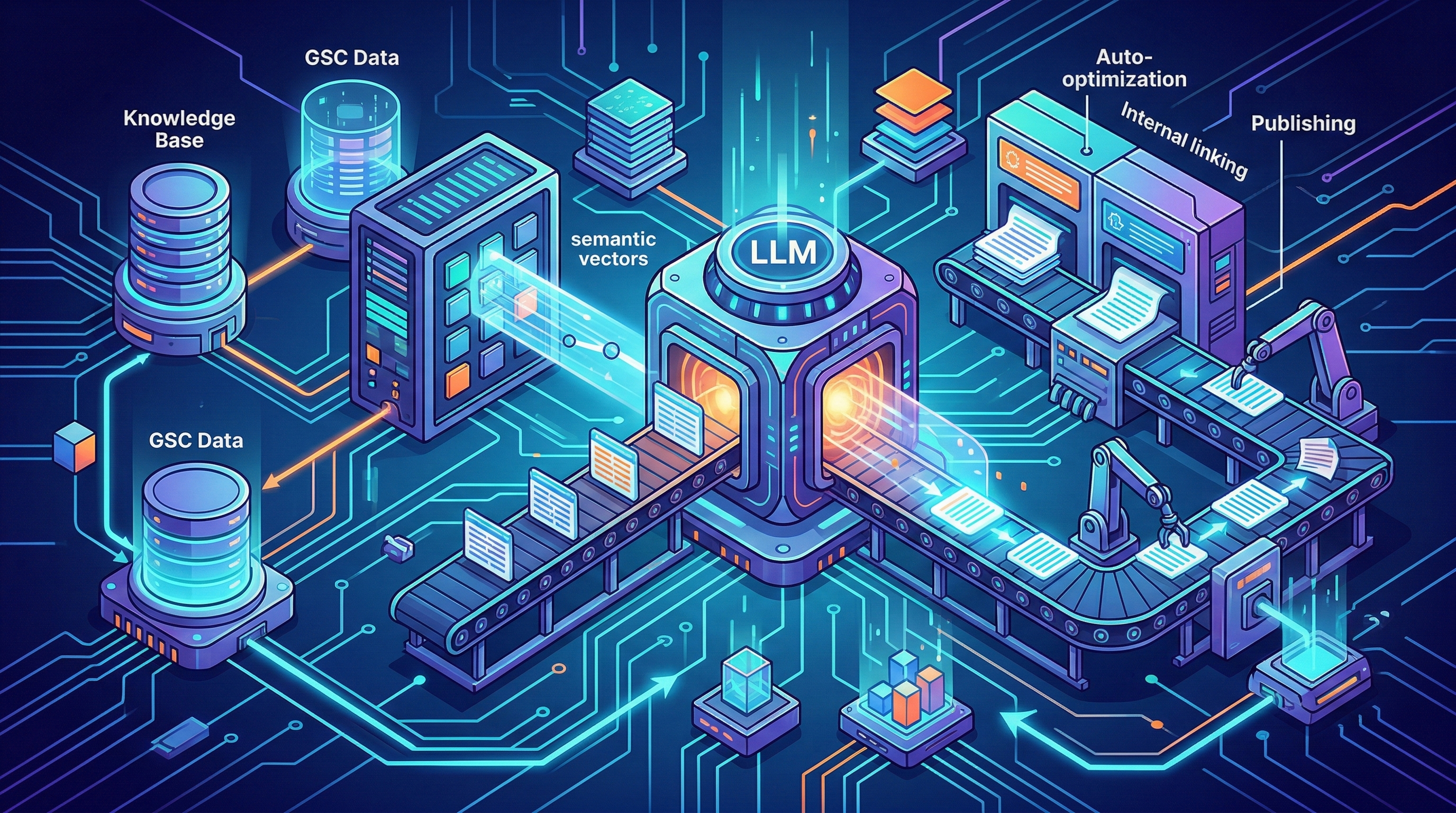
Content operations: SEO content systems that retrieve live SERP data, competitor signals, and keyword context before generating — turning content production into a closed-loop, automated pipeline. The same retrieve-and-generate architecture that powers enterprise RAG is what makes it possible to see how it works — a system that discovers keywords, retrieves what's ranking, generates optimized content, and publishes without a human in the loop.
Every one of these use cases shares the same core pattern: don't let the model guess. Retrieve the relevant facts. Augment the prompt. Generate a grounded response.
The Bottom Line
RAG is not a feature — it's a systems architecture decision. It takes an LLM from a confident guesser to a grounded, reliable reasoning engine by injecting real knowledge at inference time.
The pattern is clear: embed your knowledge base, retrieve what's relevant, augment the prompt, generate the answer. Master the pipeline — chunking strategy, retrieval quality, reranking, context injection — and you have a system that scales without degrading. That's the difference between AI that surprises you and AI that runs like infrastructure.
For teams building knowledge-intensive AI products, RAG isn't optional. It's the architecture that makes your system trustworthy. Standalone LLMs are powerful. Retrieval-grounded systems are reliable. There's a significant difference between the two when the output is customer-facing, compliance-critical, or driving business decisions.
The same retrieval-and-generate logic powering enterprise RAG systems is what Ranklynk uses to automate SEO content at scale — discovering keywords, retrieving SERP signals, generating optimized content, and publishing without a human in the loop. If you're still manually refreshing underperforming articles or babysitting content workflows, see how it works and watch the pipeline do the heavy lifting.
Frequently Asked Questions
Q: What is retrieval-augmented generation?
Retrieval-Augmented Generation (RAG) is an AI architectural framework that enhances large language models (LLMs) by combining real-time information retrieval with AI-generated responses. Instead of relying solely on knowledge memorized during training, a RAG system first retrieves relevant, up-to-date information from an external knowledge source — such as a database, document store, or search index — and then uses that retrieved context to generate accurate, grounded responses. The concept was formalized in a 2020 paper by Lewis et al. at Facebook AI Research, which showed that augmenting LLMs with retrieval dramatically improved performance on knowledge-intensive tasks without requiring full model retraining. RAG effectively solves three core weaknesses of standalone LLMs: knowledge cutoffs (models only know what was in their training data), hallucination (models confidently fabricating facts), and lack of domain-specific or proprietary knowledge. By pulling live context at inference time, RAG systems can deliver current, citation-backed answers that standalone models simply cannot provide reliably.
Q: Is ChatGPT a RAG?
By default, the base version of ChatGPT is not a RAG system — it is a standalone large language model that generates responses purely from knowledge encoded in its weights during training. However, ChatGPT does incorporate retrieval-augmented features in certain configurations. For example, when the web browsing tool or file upload features are enabled, ChatGPT can retrieve information from external sources before generating a response, which mirrors the core RAG pattern. Additionally, OpenAI's GPT-based APIs can be integrated into custom RAG pipelines by developers who connect them to vector databases or document stores. So the accurate answer is: ChatGPT itself is an LLM, but it can function as part of a RAG architecture depending on how it is configured and what tools are enabled. Many enterprise deployments of ChatGPT-style models are explicitly built as RAG systems to ensure responses are grounded in company-specific, current, or proprietary data.
Q: What is RAG with example?
A practical example of retrieval-augmented generation helps illustrate how the system works end-to-end. Imagine a company builds a customer support chatbot powered by RAG. When a user asks, 'What is your return policy for electronics purchased in 2026?' the system does not rely on the LLM's training data to answer. Instead, it follows three steps: First, the retrieval layer converts the user's question into a vector embedding and searches a knowledge base containing the company's current policy documents. Second, the most relevant policy sections are retrieved and injected into the prompt as context. Third, the LLM reads that retrieved context and generates a precise, accurate answer — citing the actual policy. Without RAG, the model might hallucinate a plausible-sounding but incorrect policy. With RAG, it answers from verified, current source material. Other common real-world RAG examples include legal research tools that retrieve case law, medical assistants that pull from clinical guidelines, and enterprise search platforms that surface answers from internal documentation.
Q: What is the difference between RAG and LLM?
An LLM (Large Language Model) is a neural network trained on massive text datasets to understand and generate human language. It stores knowledge parametrically — meaning everything it knows is encoded in its model weights at training time and cannot be updated without retraining. A RAG system, by contrast, is an architectural pattern that wraps retrieval capabilities around an LLM. The key differences are: Knowledge freshness — LLMs have a fixed training cutoff, while RAG systems can access live or continuously updated data sources. Accuracy — standalone LLMs can hallucinate facts confidently, while RAG grounds responses in retrieved evidence. Customization — RAG allows organizations to connect LLMs to proprietary or domain-specific knowledge without expensive fine-tuning. Transparency — RAG systems can cite their sources, making responses auditable. Think of it this way: an LLM is the reasoning engine, and RAG is the system design that gives that engine access to an up-to-date, relevant library before it answers. RAG does not replace the LLM — it makes the LLM significantly more reliable and useful for knowledge-intensive applications.
Q: What are the 4 generations of AI?
The four commonly referenced generations of AI describe the field's evolution from narrow rule-based systems to increasingly autonomous and general intelligence. The first generation covers rule-based or symbolic AI, which relied on hand-coded logic and expert systems (1950s–1980s). The second generation introduced machine learning, where systems learned patterns from data rather than explicit rules (1980s–2000s). The third generation is characterized by deep learning and neural networks, enabling breakthroughs in image recognition, natural language processing, and speech (2010s). The fourth generation represents the current era of large-scale foundation models and generative AI — including LLMs, multimodal models, and architectures like retrieval-augmented generation — where models can reason, generate, and adapt across broad domains. Some researchers and frameworks add a fifth emerging generation focused on autonomous AI agents. Retrieval-augmented generation sits firmly within the fourth generation, representing a key innovation for making generative AI systems more reliable, grounded, and enterprise-ready.
Q: What are the 4 models of AI?
The four primary AI model types commonly referenced in the field are: Reactive machines — the most basic form, which respond to inputs without memory or learning (e.g., IBM's Deep Blue chess engine). Limited memory models — AI that uses past experiences or data to inform decisions, which includes most modern machine learning systems and LLMs. Theory of mind AI — a theoretical category where machines understand human emotions, intentions, and social cues; not yet fully realized in 2026. Self-aware AI — a hypothetical future stage where machines have genuine consciousness and self-understanding. In practical industry usage, AI models are also categorized by function: discriminative models (classifying data), generative models (creating new content), retrieval-augmented models (combining retrieval with generation), and agentic models (autonomous task execution). Retrieval-augmented generation represents an important hybrid model type that enhances generative AI with real-time knowledge access, making it one of the most practically valuable AI architectures deployed in enterprise applications today.
Q: What does it mean if a girl is on her RAG?
This is an informal British slang expression meaning a woman is menstruating or on her period. The phrase is entirely unrelated to the AI term RAG, which stands for Retrieval-Augmented Generation. In the context of artificial intelligence and machine learning, RAG refers exclusively to the architectural pattern that combines information retrieval with language model generation to produce accurate, knowledge-grounded AI responses. If you arrived here looking for information about retrieval-augmented generation in AI, RAG describes a system where a language model retrieves relevant documents or data at inference time before generating a response — dramatically reducing hallucinations and keeping AI outputs current and accurate.
Q: What are the 7 types of rags?
In the context of music, 'rags' refers to ragtime compositions — a genre popularized in the late 19th and early 20th centuries. Common categories include classic rags, novelty rags, folk rags, syncopated rags, instrumental rags, vocal rags, and orchestrated rags. However, if you are researching RAG in the context of artificial intelligence, the term stands for Retrieval-Augmented Generation — a framework with its own architectural variations. Common RAG system types in AI include: Naive RAG (basic retrieve-then-generate pipeline), Advanced RAG (with re-ranking, query rewriting, or hybrid search), Modular RAG (flexible, composable retrieval pipelines), Graph RAG (retrieval from knowledge graphs), Multi-modal RAG (retrieving images, audio, or structured data), Agentic RAG (where AI agents dynamically decide when and what to retrieve), and Self-RAG (where the model evaluates whether to retrieve at all). Each RAG variant offers different tradeoffs in accuracy, latency, and complexity depending on the use case.
References
[1] https://aws.amazon.com/what-is/retrieval-augmented-generation/. aws.amazon.com. https://aws.amazon.com/what-is/retrieval-augmented-generation/
[2] https://www.salesforce.com/agentforce/what-is-rag/. salesforce.com. https://www.salesforce.com/agentforce/what-is-rag/
[3] https://arxiv.org/abs/2005.11401. arxiv.org. https://arxiv.org/abs/2005.11401
[4] https://en.wikipedia.org/wiki/Retrieval-augmented_generation. en.wikipedia.org. https://en.wikipedia.org/wiki/Retrieval-augmented_generation
[5] https://cloud.google.com/use-cases/retrieval-augmented-generation. cloud.google.com. https://cloud.google.com/use-cases/retrieval-augmented-generation