How to Scale Organic Traffic Without Hiring Writers (Build the System, Skip the Headcount)
Most founders and agency operators hit the same wall. Organic traffic is flat. The content backlog is growing. And hiring more writers feels like throwing money at a symptom instead of fixing the machine.
In 2026, the businesses winning at SEO aren't the ones with the biggest content teams — they're the ones running the tightest systems. The 80/20 rule in SEO is brutally real: a small percentage of pages drive the overwhelming majority of your organic traffic [1]. The question isn't how to produce more content — it's how to build a workflow that produces the right content, continuously, without you babysitting every step.
This article breaks down exactly how to scale organic traffic without adding headcount — from systematizing keyword-to-publish workflows to automating content refresh cycles — so your SEO compounds while your team stays focused on everything else.
Why Hiring More Writers Doesn't Scale SEO
There's a seductive logic to the content volume play: publish more, rank more, traffic grows. It doesn't work that way. The false assumption is that more content output equals more organic traffic. In practice, writers introduce bottlenecks at every stage — briefs, editing, QA, publishing cycles all require human coordination. High output without a system creates content sprawl: dozens of posts that generate zero traffic, indexed pages diluting your authority, and a backlog that grows faster than you can clear it [2].
The real leverage point is workflow architecture, not headcount. And the numbers make this obvious fast. Agency costs and freelancer management eat into startup runway faster than most founders expect, often before the first piece of content starts generating measurable returns.
The Real Cost of Content-Team Dependency
When you factor in briefs, writer fees, editorial review, SEO QA, and publishing overhead, the fully loaded cost of a single article sits between $300 and $800 for most small agencies and startups. That's before accounting for the management time required to keep the pipeline moving. Time-to-publish cycles when humans are in the loop often stretch to two to four weeks per piece. An automated pipeline compresses that to hours.
The opportunity cost is where it gets painful. While you're managing writers, your competitors are indexing new pages, accumulating internal link equity, and compounding keyword coverage. Every week you spend in coordination mode is a week your SEO system isn't running.
What 'Scaling Content' Actually Means in SEO Terms
Scaling content isn't about word count — it's about systematically expanding keyword coverage across topical clusters where you already have domain authority. Volume without targeting is noise. Scaling organic traffic means compounding indexed pages that each capture intent-matched queries, not flooding a CMS with generic articles that compete with themselves.
The distinction matters: scaling content creation is a production problem. Scaling SEO output is a systems problem. The operators who conflate the two keep hiring. The ones who understand the difference build pipelines.
The 80/20 Rule in SEO: Work the System, Not the Volume
In most content libraries, 20% of pages generate 80% of organic traffic [1]. This isn't a content quality argument — it's a targeting argument. Before producing a single new word, the highest-leverage move is identifying which keyword clusters your existing authority can win, then building systematic coverage around them.
The 3 C's of SEO — Content, Code, and Credibility — all matter, but in a resource-constrained environment, Content and Code move fastest without additional writers. Credibility (authority and links) builds compoundingly when your content system is running correctly.
Finding Your High-Leverage Keyword Clusters
High-leverage keyword research isn't about chasing volume — it's about filtering for the intersection of search volume, keyword difficulty below your current domain authority threshold, and business relevance. Start with seed terms already driving conversions. Expand programmatically from those seeds into related queries, long-tail variants, and topically adjacent clusters.
Avoid the trap of high-volume vanity keywords with no conversion intent. A keyword driving 50,000 searches per month with zero purchase signal generates traffic that doesn't convert. A cluster of 500-search-per-month keywords with high commercial intent can outperform it by an order of magnitude in revenue terms.
Fixing What's Broken Before Building New
Underperforming existing pages are almost always a faster win than new content [3]. Content decay — the process by which pages lose rankings over time without refresh cycles — is silent and expensive. Most teams don't detect it until traffic has already dropped sharply.
Optimizing the bottom 50% of your indexed pages — updating statistics, improving semantic depth, fixing heading structures — often unlocks more organic traffic in 30 days than three months of net-new content production. Fix the floor before you raise the ceiling.
Build a Keyword-to-Publish Pipeline That Runs Without You
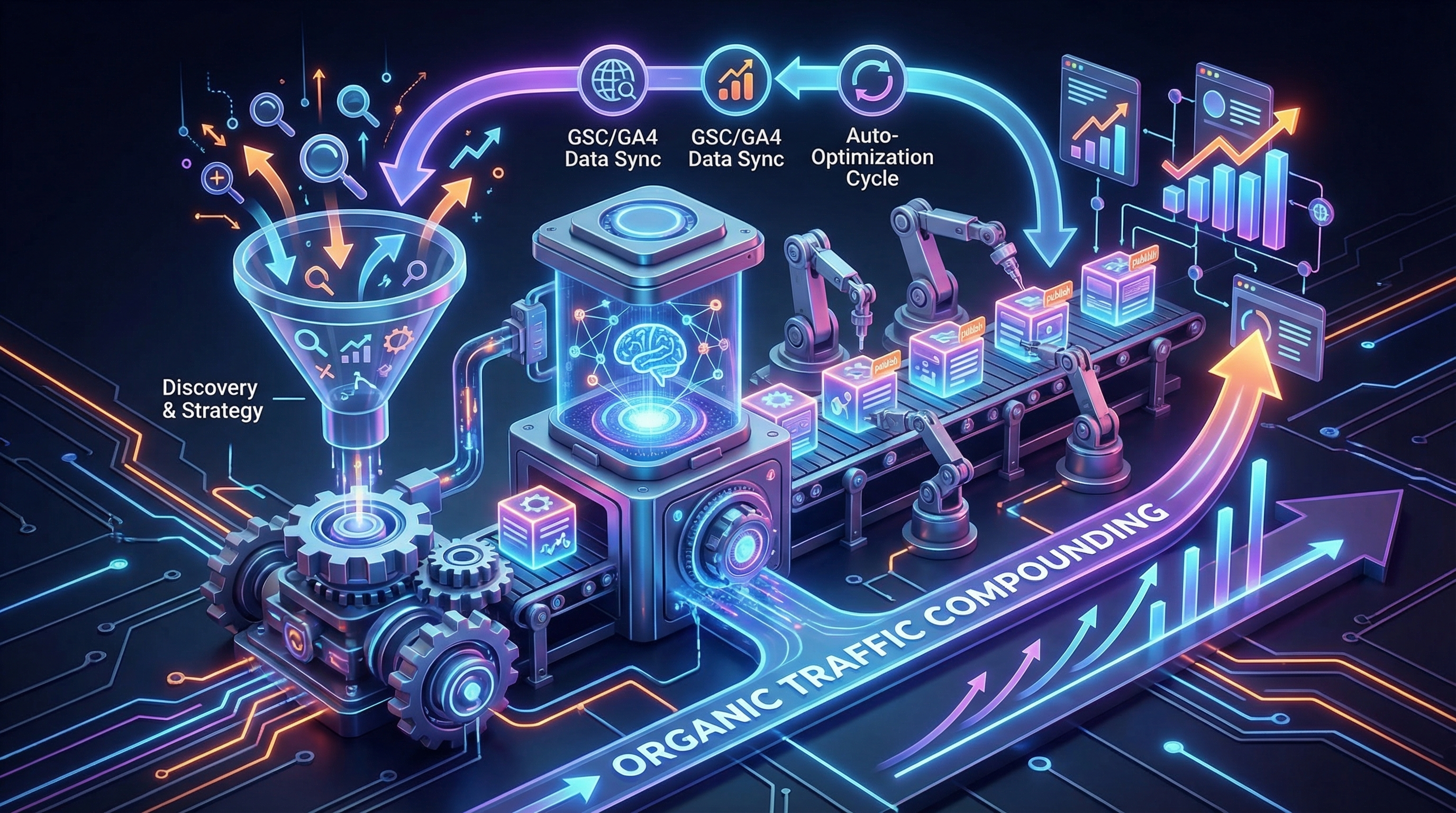
A systematic keyword-to-publish workflow removes human decision-making from every repeatable step. The goal is a four-stage autonomous pipeline: discovery, briefing, generation, and publishing. Each stage runs on rules, not judgment calls. Define the logic once. Deploy it repeatedly. This is the architecture that separates SEO systems from SEO tasks [4].
The difference between an AI writing assistant and a closed-loop SEO system is the human driver. An AI writing assistant still requires someone to prompt it, review output, paste it into a CMS, add metadata, and hit publish. A closed-loop system handles all of that — from keyword signal to indexed page — without a human in the loop on every cycle.
Stage 1: Automated Keyword Discovery
Keyword discovery runs on data, not intuition. Pull opportunities continuously from search data APIs, competitor gap analysis, and internal site signals like crawl frequency and ranking position trends. Set rules-based filters: difficulty thresholds calibrated to your domain authority, volume floors that exclude near-zero-traffic queries, and intent classification that sorts informational from commercial from navigational.
When this stage is automated, keyword research disappears from your weekly workflow entirely. The pipeline surfaces the next target. You don't have to look for it.
Stage 2: Brief Generation and Content Templating
SEO requirements — heading structures, semantic keyword coverage, internal link targets, word count ranges, schema types — encode into reusable templates. Structured briefs replace editorial oversight at scale. Instead of a managing editor deciding what each article needs to cover, the template encodes that logic once and applies it across every piece in a topic cluster.
This is how you maintain consistency across 100 pages without a coordinating human. The template is the editor. Run it systematically and the output is predictable [2].
Stage 3: Publishing and Technical SEO Automation
Auto-publishing pipelines handle metadata generation, schema markup injection, canonical tag assignment, and internal link insertion without manual intervention. From generated content to indexed page without touching the CMS manually. This removes the final bottleneck in most content operations — the gap between "content is ready" and "content is live and crawlable."
The 4 pillars of SEO are content, technical, authority, and user experience. Three of the four — content, technical, and significant components of user experience — are fully automatable with the right system architecture in place. Authority is the one pillar that still benefits from strategic input, though even link acquisition can be systematized.
If you want to see what a fully closed-loop pipeline looks like in practice, see how it works.
Automate Content Refresh Cycles Instead of Producing Net-New
Refreshing existing content often delivers faster ranking gains than publishing new articles. The reason is straightforward: existing pages already have indexed history, accumulated internal link equity, and in many cases, existing backlinks. Refreshing that content is a multiplier on assets you already own, not a bet on new pages that have yet to prove themselves [3].
Content decay is the silent killer of organic traffic programs. Most teams don't detect it until traffic drops sharply — and by that point, the recovery window is longer than it needed to be. The fix is automated performance monitoring that flags underperforming pages before they become crises.
How to Detect Content Decay Before It Costs You Rankings
Monitor four signals continuously: ranking position trends (not just snapshots), impression volume in Google Search Console, click-through rate against the expected rate for a given position, and crawl frequency as a proxy for perceived freshness. When any of these drop outside defined thresholds, trigger an automated alert — not a manual GSC review.
Setting automated alerts is the operational difference between proactive and reactive SEO. Organic traffic drops suddenly because algorithm updates, competitor content improvements, or content staleness compound faster than most manual audit cycles can catch. Build the detection layer so the system catches decay before you notice it in your dashboard.
The Refresh Workflow: What Changes and What Stays
A refresh workflow isn't a rewrite. It's a targeted intervention: update statistical claims with current data, add semantic depth to sections that are thin relative to current SERP competition, adjust heading structures to match the format dominant pages are using in the current results landscape, and re-optimize internal links from refreshed pages toward higher-priority conversion targets.
Test title tag and meta description variants to recover lost CTR. A ranking position 4 article getting a 3% CTR should be getting 8%. Fixing the title tag can recover that traffic without moving the ranking at all. These are mechanical improvements — systematic, repeatable, and fully automatable.
Scale Link Building as a System, Not a Campaign
Link building at scale requires the same systematization that content does. One-off outreach campaigns don't compound. A link-building system — with defined prospecting rules, templated outreach sequences, and CRM integration — runs continuously in the background the same way a content pipeline does [5].
Programmatic approaches to identifying link opportunities include broken link target analysis, unlinked brand mention monitoring, and competitor backlink gap analysis. High-volume content operations create natural link surface area — when you're publishing consistently across a topical cluster, external sites looking for reference material find your pages without active outreach.
Internal Linking as a Scalable Authority Engine
A large indexed content library creates compounding internal link equity. Every new page is an opportunity to pass PageRank toward your highest-priority conversion targets. Automate internal link insertion based on topical relevance rules — when a new page covers a topic cluster that overlaps with a cornerstone conversion page, the link inserts automatically.
This moves PageRank intentionally and continuously without manual link audits. The larger your content library grows, the more powerful the internal linking system becomes. It's a self-reinforcing mechanism that rewards scale.
Building External Link Pipelines That Don't Require Your Time
Systematize outreach with templates, sequencing rules, and CRM integration for link prospecting. Leverage content assets — data studies, free tools, programmatic comparison pages — as passive link magnets that attract inbound links without active outreach effort. Studies show that 77% or more of indexed pages with real topical authority can generate organic traffic when the content and link architecture are built systematically.
Guest post services and automated outreach sequences function as repeatable pipeline components, not one-time efforts [5]. Build the system once, run it continuously, and let the link acquisition compound.
The Metrics That Tell You If Your SEO System Is Working
Organic traffic is a KPI — but only when paired with conversion-correlated metrics. Session counts alone tell you almost nothing about whether your SEO system is healthy. The metrics that actually indicate system performance are indexed page growth rate, keyword coverage breadth across your target clusters, crawl frequency trends, and internal link density across the content library.
The compounding curve of healthy autonomous SEO growth is nonlinear. Month one and two look flat. Month four and five, the curve starts to bend. By month eight, you're looking at a traffic asset that grows without proportional effort input. Set up dashboards that report on system health — indexed pages, keyword coverage, crawl rate, refresh cycles triggered — not just traffic snapshots.
Leading vs. Lagging Indicators in Autonomous SEO
Leading indicators tell you the system is working before the traffic proves it: indexed pages growing, keyword coverage expanding, crawl frequency increasing, internal link density rising. Lagging indicators — organic sessions, keyword rankings, organic-attributed conversions — confirm the system worked, but they lag by weeks or months.
Optimize for leading indicators and the lagging results arrive predictably. Chase lagging indicators and you're always reacting to something that happened six weeks ago. Build the dashboard around leading signals. Let the lagging metrics validate the system quarterly.
When to Intervene and When to Let the System Run
Define exception thresholds that trigger human review — a ranking position drop exceeding 15 positions over 30 days, a crawl frequency drop below baseline, an indexed page count declining. Below those thresholds, let the system self-correct. Above them, trigger a structured audit, not an ad hoc investigation.
Audit your autonomous SEO system quarterly. Review the exception log, validate that automated refresh cycles fired on schedule, check that the publishing pipeline hasn't accumulated a backlog. This is the difference between a system that needs babysitting and one that self-corrects: a babysitting system pulls you into daily management. A self-correcting system surfaces exceptions and handles the rest.
FAQ: Scaling Organic Traffic Without a Content Team
Does SEO drive significantly more traffic than organic social media? Consistently, yes. Studies show search traffic volume dwarfs social — and unlike social, it compounds over time without ongoing promotion spend. Every indexed page you publish today is still driving traffic in three years. A social post has a 24-48 hour window.
What is the fastest way to start getting organic traffic without hiring? Fix existing underperforming pages first. The fastest wins are in the content you already have — update statistics, improve semantic depth, fix title tags. Once the existing library is performing, build a systematic pipeline for net-new keyword coverage.
Why is my organic traffic suddenly dropping? Content decay, algorithm updates, and technical issues are the primary culprits — all three are detectable and correctable with automated monitoring in place. The sudden drop usually reflects a problem that's been developing for weeks or months without detection. The fix is the monitoring layer, not the reaction to the drop.
How do you calculate organic traffic value? Multiply your estimated monthly organic sessions by the CPC equivalent of the keywords driving that traffic. If you're generating 10,000 sessions per month from keywords averaging $3 CPC, your SEO asset is worth $30,000 per month in equivalent paid traffic spend. This frames SEO as an asset on your balance sheet, not a cost center.
What are the 4 pillars of SEO and which ones can be automated? Content, technical SEO, authority and links, and user experience. Three of the four are fully automatable with the right system architecture. Authority still benefits from strategic input — but even link acquisition can be systematized with the right outreach and content asset infrastructure in place.
The Bottom Line
Scaling organic traffic without hiring writers isn't a content volume problem — it's a systems problem. The operators winning in 2026 built keyword-to-publish pipelines that run continuously, automated refresh cycles that prevent content decay, and link-building processes that compound without campaign management overhead. They stopped treating SEO as a series of manual tasks and started treating it as an engine.
The 80/20 rule applies here too: fix your workflow architecture once, and it pays dividends across every piece of content you've ever published and every page you'll publish next. The system is the leverage. The headcount was never the answer.
Ranklynk's closed-loop SEO engine handles discovery, generation, publishing, and optimization — without a writer, an editor, or a daily check-in. See how it works.
Frequently Asked Questions
Q: What is the 80/20 rule in SEO?
The 80/20 rule in SEO means that roughly 20% of your pages drive approximately 80% of your organic traffic. In practice, most websites have a small cluster of high-performing pages that generate the bulk of their search visibility, while the remaining content sits largely dormant. For businesses trying to scale organic traffic without hiring writers, this principle is critical. Instead of publishing more content indiscriminately, you should identify which existing pages are already gaining traction, double down on those topical clusters, and systematically expand keyword coverage around proven winners. Auditing your analytics to find your top 20% of pages — then building supporting content around them — compounds your SEO gains far faster than producing random new articles. The 80/20 rule also highlights the danger of content sprawl: publishing dozens of low-intent pieces that dilute your domain authority and waste crawl budget without contributing meaningfully to organic growth.
Q: How to scale organic traffic?
Scaling organic traffic requires building a repeatable system, not just producing more content. The most effective approach in 2026 involves four key steps: First, identify topical clusters where your domain already has authority and expand keyword coverage within those clusters systematically. Second, automate or templatize your keyword-to-publish workflow so new content can move from research to indexed page in hours rather than weeks. Third, implement a content refresh cycle to update high-potential pages that are ranking on page two or three — these often deliver faster traffic gains than brand-new articles. Fourth, optimize internal linking so new pages inherit authority from your existing top performers. You can scale organic traffic without hiring writers by using AI-assisted drafting tools, structured content briefs, and programmatic SEO where appropriate. The goal is compounding indexed pages that each capture specific search intent, turning your content operation into a self-reinforcing system rather than a manual, headcount-dependent process.
Q: Does SEO drive 1000%+ more traffic than organic social media?
Yes, multiple industry studies confirm that SEO consistently drives significantly more traffic than organic social media — with some research suggesting SEO can deliver over 1,000% more traffic than organic social channels. The core reason is intent and longevity. A social media post has a lifespan measured in hours or days, while a well-optimized page can generate traffic for months or years after publication. Search traffic is also pull-based: users are actively searching for answers, making them far more likely to engage, convert, or take action. Organic social reach has declined sharply across major platforms as algorithms increasingly favor paid promotion. For founders and agencies trying to scale organic traffic without hiring writers, this comparison underscores why investing in a systematic SEO workflow delivers compounding returns that social media simply cannot match. Every indexed, intent-matched page you publish keeps working around the clock, while social posts fade almost immediately after posting.
Q: How do you calculate organic traffic?
Organic traffic is calculated by measuring the number of sessions or users that arrive at your website through unpaid search engine results, excluding paid ads, social referrals, direct visits, and email clicks. The most common tools for calculating organic traffic are Google Analytics 4 (GA4) and Google Search Console. In GA4, navigate to the Acquisition report and filter by the 'Organic Search' channel to see session volume, user counts, engagement rates, and conversions attributed to SEO. Google Search Console provides complementary data including total clicks, impressions, average click-through rate, and average ranking position for specific queries. To get a complete picture, track organic traffic trends over rolling 30, 90, and 365-day windows to account for seasonality. When scaling organic traffic without hiring writers, monitoring these metrics consistently helps you identify which content clusters are gaining momentum, which pages need refreshing, and where to focus your next round of content production for maximum compounding impact.
Q: What is the 3-3-3 rule in sales?
The 3-3-3 rule in sales is a prospecting framework suggesting you spend three hours researching prospects, send three targeted outreach messages, and follow up three times before moving on. While this rule originates in direct sales rather than SEO, it has a useful parallel for content strategy. When scaling organic traffic without hiring writers, a similar structured cadence applies: identify three priority topical clusters, produce three pieces of content per cluster to establish authority, and revisit each cluster three months later to refresh and expand based on performance data. Applying disciplined, repeatable rules to your content workflow — much like the 3-3-3 rule does for sales prospecting — prevents the common mistake of scattered publishing. It keeps your SEO efforts concentrated in areas where you can realistically compete and compound authority, rather than spreading thin across dozens of unrelated topics that never gain enough traction to rank.
Q: What are the 4 pillars of SEO?
The four pillars of SEO are technical SEO, on-page optimization, content, and off-page authority (primarily backlinks). Technical SEO ensures your site is crawlable, fast, mobile-friendly, and properly indexed — without this foundation, even great content won't rank. On-page optimization covers proper use of target keywords in titles, headers, meta descriptions, and body copy, along with strong internal linking structures. Content is the substance that matches user search intent — the right topics, depth, and format for the queries you're targeting. Off-page authority refers to the backlinks and external signals that indicate your site is trustworthy and relevant. For those looking to scale organic traffic without hiring writers, the most actionable focus is the intersection of content and on-page optimization: building systematized workflows to produce intent-matched content efficiently while ensuring every published page is technically sound and properly interlinked to pass authority throughout your site.
Q: Why is my organic traffic suddenly dropping?
Sudden drops in organic traffic typically stem from one of several causes: a Google algorithm update, a technical issue such as accidental noindex tags or crawl errors, loss of backlinks to key pages, increased competition outranking your content, or cannibalization where multiple pages compete for the same keyword. In 2026, core algorithm updates continue to reward content that demonstrates genuine expertise and penalize thin, low-value pages. Start diagnosing by checking Google Search Console for manual actions, coverage errors, and ranking position changes around the date the drop began. Cross-reference with known algorithm update timelines. If your drop coincides with a content volume push without corresponding quality controls, content sprawl may be diluting your overall site authority. This is one reason why scaling organic traffic without hiring writers through systematic, high-quality workflows outperforms a high-volume, low-oversight approach — tighter systems produce fewer low-quality indexed pages that can drag down your overall SEO performance.
Q: Is organic traffic a KPI?
Yes, organic traffic is a widely used KPI (Key Performance Indicator) in digital marketing and SEO strategy. It measures the volume of visitors arriving from unpaid search results and serves as a direct indicator of your content and SEO performance over time. However, organic traffic alone is a leading metric — it should always be paired with downstream KPIs like organic conversion rate, revenue attributed to organic sessions, keyword ranking positions, and pages indexed. Tracking organic traffic as a standalone number can be misleading if your traffic grows but conversions don't follow, which often signals intent mismatch in your content strategy. For teams working to scale organic traffic without hiring writers, tracking organic traffic as a KPI helps validate whether your content system is compounding correctly — are more pages getting indexed, are rankings improving, and is the traffic volume trend moving upward quarter over quarter? Setting clear organic traffic benchmarks aligned to business goals makes it a powerful and actionable KPI rather than just a vanity metric.
References
[1] https://cxl.com/blog/scale-organic-traffic/. cxl.com. https://cxl.com/blog/scale-organic-traffic/
[2] https://almcorp.com/blog/guest-post-services-for-agencies/. almcorp.com. https://almcorp.com/blog/guest-post-services-for-agencies/
[3] https://kontra.agency/increase-organic-traffic-without-link-building/. kontra.agency. https://kontra.agency/increase-organic-traffic-without-link-building/
[4] https://www.seoxport.com/what-is-the-80-20-rule-of-seo/. seoxport.com. https://www.seoxport.com/what-is-the-80-20-rule-of-seo/
[5] https://seositecheckup.com/articles/how-to-scale-content-creation-without-sacrificing-quality. seositecheckup.com. https://seositecheckup.com/articles/how-to-scale-content-creation-without-sacrificing-quality