SEO Automation for Bootstrapped SaaS Startups: Build the System That Scales Without You
You built a SaaS product. You didn't sign up to become an SEO agency for yourself — but here you are, manually updating meta descriptions at midnight while your MRR flatlines.
This is the bootstrapped founder's paradox: organic search delivers the highest ROI of any acquisition channel available to you, yet executing SEO at scale demands either a dedicated team you can't afford or an agency eating runway you don't have. Agency retainers average $3K–$10K/month [1]. For a bootstrapped founder watching every dollar, that's not a marketing expense — that's three months of infrastructure costs.
In 2026, that tradeoff is no longer inevitable. SEO automation has matured to the point where a solo founder can run a content operation that rivals a 10-person team — without writing a single word manually or babysitting a single keyword rank. The technology exists. The architecture is proven. What's missing for most founders is the blueprint.
This guide breaks down exactly how bootstrapped SaaS startups can replace the manual SEO grind with a closed-loop automation system — covering the right tools, the right workflows, and the strategic decisions that separate founders who compound organic traffic from those who stay stuck publishing one blog post a month and hoping for the best.
Why Manual SEO Is a Startup Killer (And Why Bootstrapped Founders Feel It Most)
Manual SEO doesn't just cost time — it costs compounding time. Every hour you spend briefing a writer, editing a draft, updating an internal link, or manually checking keyword rankings is an hour that doesn't scale. You do it once this week. You do it again next week. And the output? A single published post that may take six months to rank.
The math is brutal. A competitive SaaS niche requires consistent content volume to build topical authority — typically 10–20 well-optimized pieces per month to move the needle [2]. One founder, one blog post per week: you're already invisible before you start.
The opportunity cost compounds. Every hour you spend on low-leverage SEO tasks is an hour not spent on product development, customer conversations, or the work that actually builds your business. For a bootstrapped founder without a co-founder or team to absorb this overhead, the opportunity cost isn't abstract — it's your product roadmap slipping.
The Bootstrapped SEO Trap: Doing More With Less and Still Losing
The typical bootstrapped founder's SEO journey follows a predictable failure arc. You start with DIY — writing your own posts, updating your own meta tags, manually building internal links. You're doing the right things. You're just doing them at a tenth of the speed required to compete.
So you hire freelance writers. Now you've traded a time problem for a management problem. Every piece requires a detailed brief. Every brief requires research. Every draft requires editing. Every edit cycle burns another two to three hours. You've added overhead without adding velocity.
The result is what it always is: inconsistent output, missed keyword windows as competitors publish faster, and a content calendar that looks productive on paper but generates zero compounding growth in organic traffic.
What Bootstrapped SaaS Needs Instead: A System, Not a Strategy
The founders who win at SEO without a team aren't working harder — they've made a fundamentally different architectural decision. They stopped treating SEO as a campaign and started treating it as a pipeline.
SEO that runs itself isn't a fantasy. It's an infrastructure choice. A continuous, autonomous content pipeline — one that discovers keywords, generates content, publishes, monitors, and re-optimizes without requiring your hands on the keyboard — is an engineering problem, and in 2026, it's already been solved. The question is whether you're running that system or still manually executing tasks that should have been automated 18 months ago.
What SEO Automation Actually Means in 2026 (Not What You Think)
Most founders think they're doing SEO automation when they're scheduling posts in advance or using ChatGPT to draft outlines. They're not. That's task assistance. Real SEO automation is architecturally different.
A true closed-loop SEO system executes five functions without human intervention: keyword discovery, content generation, on-page optimization, publishing, and continuous re-ranking. Remove any one of those functions from the automation layer and you've reintroduced a bottleneck. The weakest manual link still breaks the chain [3].
What is NOT automation: AI writing assistants that require you to write prompts, review briefs, trigger generation manually, copy-paste output into your CMS, and then manually monitor what happens after. That's a tool. Tools still require operators.
The Automation Stack Myth: Why Stitching Together 6 Tools Still Requires You
The common bootstrapped SEO stack looks something like this: Ahrefs for keyword research, SurferSEO for optimization scoring, ChatGPT for drafting, WordPress for publishing, Zapier for connecting the pieces. On paper, this looks like automation. In practice, it's a fragile Rube Goldberg machine that requires you to operate it.
Every integration point is a failure point. Every tool handoff requires a decision. Zapier breaks. API limits get hit. Output quality degrades and no one catches it until you check manually. The hidden overhead of maintaining a multi-tool SEO workflow solo often exceeds the time cost of just doing it manually — but with worse output consistency.
Closed-Loop SEO: The Architecture That Actually Scales
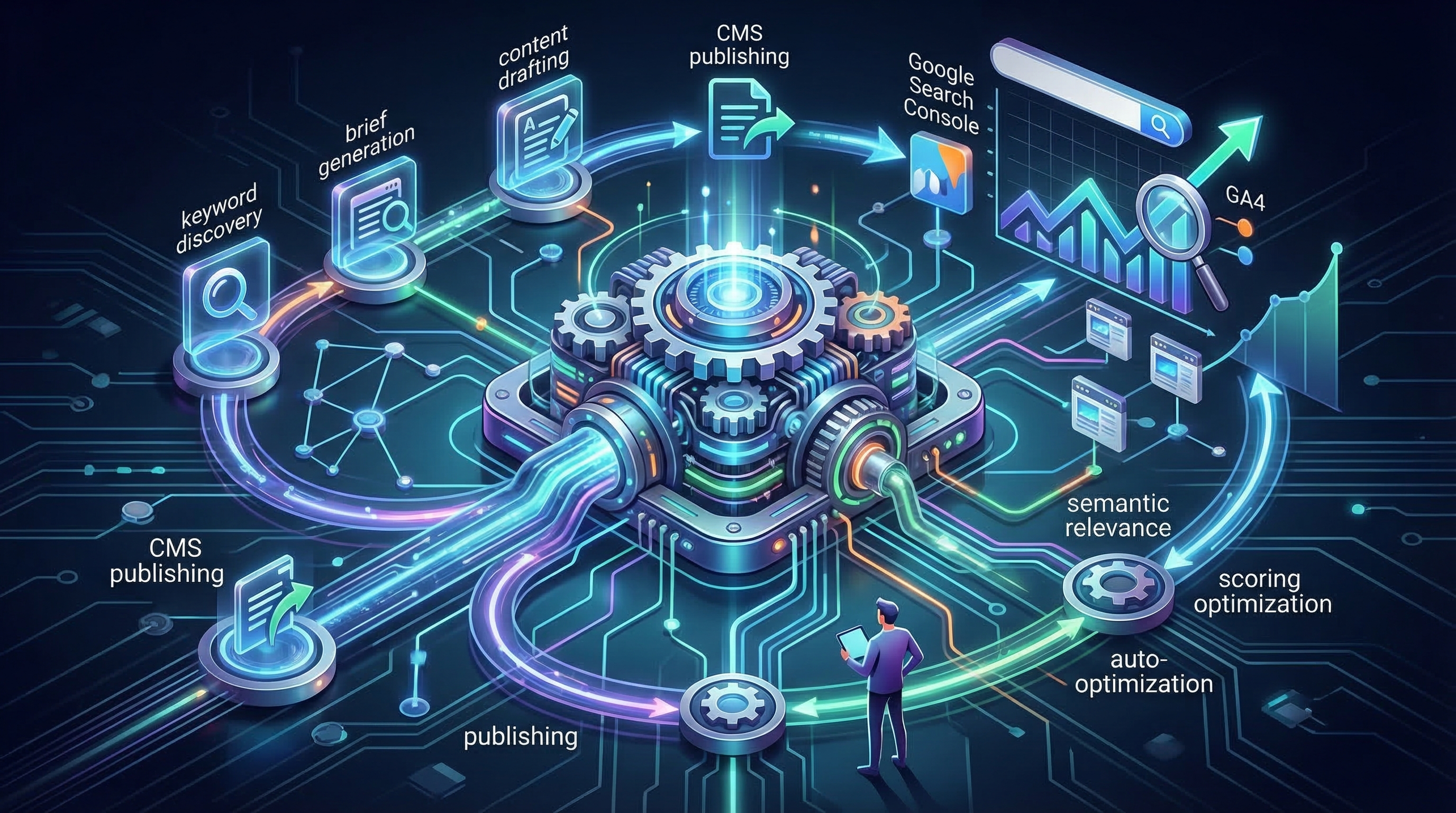
The architecture that actually scales looks like a single pipeline: Discovery → Generation → Publishing → Monitoring → Optimization, with each stage feeding automatically into the next.
Autonomous SEO engines detect when content drops below a rank threshold, pull updated SERP data, trigger a content refresh, and re-submit for indexing — all without a human in the loop. This isn't theoretical. This is how the category of autonomous SEO platforms works in 2026 [4].
The compounding advantage is real: a system that monitors and improves itself gets better over time while requiring less of your attention. Your competitors are still manually refreshing posts. Your system already did it while you slept.
The Best SEO Automation Tools for Bootstrapped SaaS Startups in 2026
Evaluating tools as a bootstrapped founder requires different criteria than evaluating them as an enterprise buyer. The metrics that matter: price-to-automation ratio, setup time, ongoing manual effort required, and integration depth. A tool that automates 40% of the workflow at $99/month beats a tool that automates 80% at $800/month if the delta in manual effort doesn't justify the cost.
Tool categories span a wide spectrum: keyword research automation (SEMrush, Ahrefs, Surfer), AI content generation (Jasper, Copy.ai), technical SEO crawlers (Screaming Frog, Sitebulb), programmatic SEO platforms, and full-lifecycle autonomous engines. For bootstrapped SaaS, only the last category eliminates the coordination overhead that kills solo founders [2].
Point Solutions vs. Autonomous Platforms: A Direct Comparison
Point solutions are excellent at one thing. Ahrefs is world-class at keyword data. SurferSEO produces reliable optimization scores. But neither publishes content. Neither monitors rankings and triggers re-optimization. Neither generates topically consistent content at volume. You still need a human to coordinate between them — and that human is you.
Autonomous SEO platforms eliminate the coordination layer entirely. One system ingests your keyword universe, generates content, publishes to your CMS, tracks ranks, and re-optimizes on a schedule. The manual effort gap that remains with point solutions — briefing, editing, publishing, monitoring, refreshing — disappears.
What to Look For: Autonomous SEO Criteria Checklist
Before committing to any SEO automation platform, run it through this filter:
- Does it discover and prioritize keywords without manual input? If you're still manually building keyword lists, you're still in the loop.
- Does it generate, optimize, and publish content end-to-end? Generation without publishing is a draft tool, not an automation platform.
- Does it monitor rankings and trigger re-optimization automatically? This is the function that separates systems from tools.
- Does it require ongoing human prompting or babysitting? If you're configuring prompts weekly, it's not automated.
- Is the pricing model compatible with bootstrapped runway constraints? Avoid platforms with enterprise pricing minimums that assume you have a team to justify the cost.
The Bootstrapped SEO Automation Stack Under $300/Month
Here's the practical reality most content about SEO automation ignores: budget constraints are real, and the right stack depends on your tier.
| Tier | Tools | What's Automated | What's Still Manual |
|---|---|---|---|
| Free | Google Search Console, Ubersuggest (free), WordPress | Basic rank monitoring | Everything else |
| $0–$100/mo | LowFruits ($29), RankMath Pro ($59), Writesonic ($19) | Keyword clustering, on-page scoring, AI drafting | Publishing, monitoring, re-optimization |
| $100–$300/mo | Ahrefs Starter ($29), SurferSEO ($89), Zapier ($49), ChatGPT Plus ($20) | Research, optimization scoring, basic workflow triggers | Coordination between tools, quality control, re-optimization |
| Full Autonomous (<$300/mo) | Dedicated autonomous SEO platforms (e.g., Ranklynk) | Full pipeline: discovery → generation → publishing → monitoring → re-optimization | Monthly strategic review only |
The critical insight: stacking point solutions at the $100–$300 tier gives you more automation surface area but doesn't eliminate the coordination tax. You're still the integration layer. A dedicated autonomous platform at a comparable price point eliminates that tax entirely — which for a solo founder is the only math that matters.
For founders serious about getting off the manual SEO treadmill without hiring, see how it works before committing to a stack that still requires you to run it.
Programmatic SEO for SaaS Startups: How to Build Pages at Scale Without a Dev Team
Programmatic SEO is the highest-leverage content strategy available to SaaS startups — and the most underutilized by bootstrapped founders who assume it requires engineering resources they don't have.
The concept: identify templatable keyword patterns in your niche, build structured data inputs, and generate hundreds or thousands of pages at scale from those templates. For SaaS products, the keyword surface area is naturally large: comparison pages ('[your tool] vs [competitor]'), use-case pages ('[feature] software for [industry]'), integration pages ('[your tool] + [integration] setup'), and location-based landing pages [5].
The traditional barrier — developers, designers, data pipelines — has been largely eliminated by modern autonomous platforms that handle slug generation, internal linking, metadata, and CMS publishing from structured inputs alone.
Mapping Your SaaS Keyword Universe to a Programmatic Architecture
Start with your templatable keyword patterns. For a project management SaaS, that might be 'project management software for [industry]' across 50 verticals, or '[your brand] vs [competitor]' across every credible alternative in your space. For a CRM tool, it's 'CRM for [company size]' or '[your tool] integration with [software]'.
Structure your data inputs: a spreadsheet of variables (industries, competitors, use cases, locations) maps directly to a programmatic page generator. The content system fills the template with topically relevant, differentiated content for each combination.
What separates programmatic SEO that ranks from programmatic SEO that gets filtered: depth, differentiation, and original insight per page. Thin pages with swapped variables and identical body copy get filtered fast. Pages with legitimately unique content per variation — different statistics, different use-case specifics, different competitive angles — build topical authority.
Publishing at Scale Without Engineering Resources
Modern autonomous SEO platforms integrate directly with WordPress, Webflow, Framer, and custom stacks via API — no developer required. Slug generation, canonical tags, internal linking structures, and metadata are handled at the platform level before content ever touches your CMS.
The zero-dev-intervention publishing pipeline looks like this: structured inputs go in, optimized pages come out, published directly to your live domain. For a bootstrapped founder, this is the difference between a 100-page programmatic content strategy being a six-month dev project and a one-week configuration exercise.
Continuous Optimization: The Function Most SaaS Founders Skip (And Why It's Costing Them)
Publish and pray is a failure mode, not a strategy. The average piece of SaaS content peaks within six to twelve months of publication and then decays — rankings slip, click-through rates fall, and the page stops contributing meaningful organic traffic [1]. Most bootstrapped founders never get to content refresh because new content always feels more urgent. The result is an archive full of decaying assets that used to drive traffic and now don't.
Automated re-optimization changes this equation entirely. Rank monitoring detects when a page drops below a threshold. The system pulls fresh SERP data, identifies content gaps, updates the page, and triggers re-indexing — all without you touching it.
What Automated Content Refresh Actually Looks Like
The mechanics: you set rank thresholds (e.g., any keyword dropping from position 1–5 to position 6–15 triggers a review). The system detects the drop, analyzes the current top-ranking pages for that keyword, identifies what your content is missing, generates updated content, and republishes — preserving the original URL, internal link equity, and page authority.
Frequency calibration matters. For competitive SaaS keywords with high search volume and active competitor publishing, monthly refresh cycles are appropriate. For lower-competition long-tail terms, quarterly is sufficient. The system should calibrate this automatically based on rank volatility data.
Turning Your Content Archive Into a Continuous Growth Asset
If you've been publishing for more than a year, you already have an asset base — it's just decaying. An autonomous platform can audit your existing archive, score each piece for refresh urgency based on current rank, traffic trend, and keyword opportunity, and process them in priority order without manual intervention.
The revenue impact of ranking recovery on transactional SaaS keywords is non-trivial. A single comparison page or use-case landing page recovering from position 8 to position 2 for a high-intent keyword can represent hundreds of additional trial signups per month.
Is SEO Automation Safe? Addressing the Risk Concerns Bootstrapped Founders Have
The concern is legitimate: Google has been vocal about AI-generated content, thin content penalties, and manipulative automation. Founders worry that automating content production puts their domain at risk. Here's what the actual guidelines say.
Google's position in 2026 is consistent with what it's said for years: the standard is quality and helpfulness, not the method of production. Content that is helpful, accurate, and demonstrates genuine expertise and authority is rewarded — regardless of how it was created [3]. Content that is thin, duplicative, or exists primarily to manipulate rankings is penalized — regardless of whether a human or an algorithm wrote it.
The risk calculus has shifted. Under-investing in SEO automation now means ceding ground to competitors who are already running autonomous systems. The risk of over-automating with low-quality output is real. The risk of staying manual while competitors automate is existential.
What Makes Automated SaaS SEO Content Google-Safe
Quality-first autonomous SEO platforms are engineered around E-E-A-T signals: content depth, topical authority, original insight, and consistency of expertise across a domain. Platforms trained on SaaS-specific signals produce content that reflects genuine product context, competitive differentiation, and vertical-specific nuance — not generic AI output.
Brand signal integration is critical: voice consistency, product-specific context, ICP-aligned language. An autonomous system ingests these parameters once and applies them at scale, producing content that reads as distinctly yours — not generic, not thin, not templated in the ways Google filters.
How to Launch Your SEO Automation System in Under a Week
The bootstrapped founder's setup playbook runs five steps from zero to autonomous pipeline — with the majority of configuration happening in the first 48 hours.
Step 1: Define your keyword universe (Day 1 — 2–3 hours). Identify your core keyword clusters: transactional terms (high intent, product-adjacent), informational terms (topical authority builders), and programmatic patterns (comparison, use-case, integration templates). This is your one-time strategic input. Everything else the system discovers autonomously from here.
Step 2: Select and configure your autonomous SEO platform (Day 1–2). Choose a platform based on the criteria checklist above. Configuration involves brand inputs, target ICP, competitor set, and publishing parameters. This is a one-time setup, not an ongoing workflow.
Step 3: Set publishing parameters and CMS integrations (Day 2–3). Connect your CMS (WordPress, Webflow, or API endpoint), configure slug structures, internal linking rules, and metadata templates. Most modern platforms handle this via no-code connectors — no developer required.
Step 4: Activate discovery and generation — let the system run its first cycle (Day 3–4). The system processes your keyword universe, generates its first content batch, and queues for publishing. Review the first five to ten pieces for quality calibration. Adjust brand voice parameters if needed. This is your one editorial checkpoint.
Step 5: Set re-optimization thresholds and disengage (Day 5). Configure rank monitoring thresholds, set refresh frequency, and activate the continuous optimization loop. Your ongoing involvement from here: a monthly 30-minute strategic review. That's it.
The Inputs You Need to Provide Once (And Then Never Again)
Brand voice parameters, target ICP description, core product context, competitor set, and CMS credentials. An autonomous platform uses these inputs to generate topically consistent content indefinitely — without re-prompting, without re-briefing, without quality control cycles.
Before you step away: run the configuration audit. Confirm brand voice is captured accurately in the first content batch. Confirm CMS integration is publishing correctly. Confirm rank monitoring is tracking the right keyword set. Once confirmed, the system runs without you.
Measuring ROI Without Drowning in Analytics
Three metrics. That's all a bootstrapped founder needs to monitor: organic sessions (are more people finding you?), keyword rank velocity (are you moving up or down?), and trial/signup attribution (is organic traffic converting?). Set up automated weekly rank and traffic reports — your autonomous platform should generate these natively. Check them once a week. Intervene only when the data signals a systematic issue, not a normal fluctuation.
Week 1 SEO Automation Setup: Realistic Time-to-Value by Automation Type
| Automation Type | Setup Time | Time to First Value |
|---|---|---|
| Rank tracking | 30 minutes | Immediate (Day 1) |
| Keyword discovery | 1–2 hours | 24–48 hours |
| Content generation pipeline | 2–4 hours | 3–5 days |
| CMS publishing integration | 1–3 hours | Day 2–3 |
| Re-optimization triggers | 30 minutes | 30–90 days (rank data needed) |
| Programmatic page set | 3–6 hours | 4–8 weeks (indexing cycle) |
Prioritize in this order: rank tracking first (you need baseline data before anything else makes sense), then keyword discovery, then content generation, then publishing integration, then re-optimization. Don't configure re-optimization before you have rank data to trigger it.
The Bottom Line
Bootstrapped SaaS founders don't have the luxury of throwing headcount at SEO. But in 2026, they don't need to. The tools exist to run a full-lifecycle SEO operation — keyword discovery, content generation, publishing, and continuous optimization — without a writer, without an agency, and without the founder's time being the bottleneck.
The competitive advantage now belongs to founders who stop treating SEO as a manual task and start treating it as an automated system. The ones who set it up once and let it compound while they build their product. Your competitors are still manually refreshing posts, briefing writers, and checking ranks by hand. Your system can be running all of that — autonomously — by the end of next week.
See how Ranklynk's autonomous SEO engine runs the entire pipeline for bootstrapped SaaS founders — from first keyword to published, optimized content — without manual intervention. See how it works.
Frequently Asked Questions
Q: What is SEO automation for bootstrapped SaaS startups and why does it matter?
SEO automation for bootstrapped SaaS startups refers to building a system of tools and workflows that handle keyword research, content creation, publishing, monitoring, and re-optimization without requiring constant manual input from the founder. It matters because bootstrapped founders face a brutal paradox: organic search delivers some of the highest ROI of any acquisition channel, yet executing SEO at scale traditionally demands either a dedicated team or an agency retainer costing $3,000–$10,000 per month. For a solo founder watching every dollar of runway, that's simply not viable. Automation closes this gap by replacing manual, non-scalable tasks with a continuous pipeline that operates without your hands on the keyboard — letting you compete with well-funded competitors even when you're building alone.
Q: How much does it typically cost to hire an SEO agency, and is it worth it for bootstrapped founders?
SEO agency retainers average $3,000–$10,000 per month in 2026, which for a bootstrapped founder represents a significant burn on limited runway. Beyond the cost, agencies often lack the deep product context needed to create truly differentiated SaaS content, and they still require significant founder time for briefings, approvals, and direction. For most bootstrapped founders, the smarter investment is building an SEO automation stack that costs a fraction of agency fees while delivering consistent, scalable output. The key is making an architectural decision upfront — treating SEO as a pipeline to engineer rather than a service to outsource — so you compound organic traffic gains without compounding your personal workload.
Q: How many blog posts does a bootstrapped SaaS startup need to publish per month to compete?
Competitive SaaS niches typically require 10–20 well-optimized pieces of content per month to build meaningful topical authority and move the needle in organic search rankings. This volume is what separates startups that compound organic traffic from those that stay invisible. For a solo founder publishing one blog post per week, that's roughly four posts per month — far short of what's needed to compete. This is precisely why manual content production is unsustainable for bootstrapped teams. SEO automation solves this volume problem by enabling a solo founder to run a content operation that rivals a 10-person team, generating consistent output at the cadence the algorithm actually rewards without sacrificing quality or burning out.
Q: What are the biggest mistakes bootstrapped founders make when trying to do SEO manually?
The most common mistake is treating SEO as a series of one-off tasks rather than a scalable system. Founders typically follow a predictable failure arc: they start writing their own posts, then hire freelance writers to save time, only to find they've traded a time problem for a management problem. Each piece requires detailed briefs, research, editing rounds, and approval cycles — adding overhead without adding velocity. The result is inconsistent publishing, missed keyword windows as faster-moving competitors dominate the SERPs, and a content calendar that looks productive but generates little compounding organic growth. The fix isn't working harder at manual execution — it's making a fundamentally different architectural decision to build a closed-loop automation pipeline from the start.
Q: What does a closed-loop SEO automation system actually do for a SaaS startup?
A closed-loop SEO automation system handles every stage of the SEO workflow without requiring constant founder involvement. At minimum, a well-designed system covers keyword discovery, content briefing, content generation, publishing, internal linking, rank monitoring, and re-optimization of underperforming pages. The 'closed-loop' aspect means insights from monitoring feed back into the system to continuously improve output — for example, triggering content updates when a post drops in rankings or when a competitor publishes on the same topic. For a bootstrapped SaaS startup, this means organic traffic compounds over time without proportional increases in founder time. The goal is to make SEO behave like infrastructure: something you build once, configure correctly, and trust to run reliably in the background while you focus on product and customers.
Q: Can a solo bootstrapped founder realistically compete with funded SaaS companies using SEO automation?
Yes — and this is one of the most significant competitive advantages available to bootstrapped founders in 2026. Funded companies spend heavily on SEO agencies and in-house teams, but they're also slower to move, burdened by approval processes, and often lack the product specificity that makes content truly convert. A bootstrapped founder who deploys a well-architected SEO automation system can publish at competitive volume, build topical authority in a defined niche, and iterate faster than a 10-person team constrained by committee decisions. The technology to do this exists today. The edge goes to founders who treat SEO as an engineering problem to solve once rather than a manual grind to maintain forever — and who start building that system earlier in their growth stage rather than waiting until they can afford to hire.
Q: When should a bootstrapped SaaS startup invest in SEO automation versus other acquisition channels?
SEO automation makes sense as a primary investment when your product has a defined target audience searching for solutions your category solves, and when you're playing a long-term acquisition game rather than needing immediate revenue in days. Organic search delivers some of the highest long-term ROI of any channel because traffic compounds over time — a post that ranks well in month six continues delivering leads in month 36 with no additional spend. Paid ads stop the moment your budget does. For bootstrapped founders with limited runway, the calculus favors building an SEO automation system early — ideally in the first six to twelve months — so the compounding effect has time to work before you need it most. Waiting until you can 'afford to focus on SEO' is typically too late to catch competitors who started earlier.
References
[1] https://www.usegrowthos.com/blog/best-ai-seo-tools-b2b-saas. usegrowthos.com. https://www.usegrowthos.com/blog/best-ai-seo-tools-b2b-saas
[2] https://www.saffronedge.com/blog/saas-seo-tools/. saffronedge.com. https://www.saffronedge.com/blog/saas-seo-tools/
[3] https://relixir.ai/blog/top-answer-engine-optimization-platforms-for-saas-startups. relixir.ai. https://relixir.ai/blog/top-answer-engine-optimization-platforms-for-saas-startups
[4] https://aeoengine.ai/blog/best-saas-seo-tools. aeoengine.ai. https://aeoengine.ai/blog/best-saas-seo-tools
[5] https://dev.to/deepakgupta/automating-growth-building-programmatic-seo-for-b2b-saas-531c. dev.to. https://dev.to/deepakgupta/automating-growth-building-programmatic-seo-for-b2b-saas-531c