SEO Workflow Automation for Digital Agency Clients: Build a System That Runs Without You
Most agencies are still running SEO like it's 2018 — manually pulling reports, briefing writers, chasing approvals, and refreshing content that decays faster than they can fix it. The result? Burned-out teams, inconsistent client results, and a hard ceiling on how many accounts you can actually scale.
Digital agencies managing multiple client sites face a compounding problem: SEO is high-value but labor-intensive, and every manual touchpoint — from keyword research to content publishing to performance tracking — multiplies across every client you add. In 2026, the agencies winning aren't hiring more people. They're building systems [1].
This guide breaks down exactly how to automate your SEO workflow for digital agency clients — from the tools and frameworks to the specific processes you can remove from your plate entirely — so your agency can scale output, deliver consistent results, and stop trading hours for rankings.
Why Manual SEO Workflows Are Killing Agency Scalability
The per-client labor cost of manual SEO adds up faster than most agency owners want to admit. Keyword research, content briefs, writing, QA, publishing, and reporting: every one of those steps compounds across every account you run. Agencies with 10+ clients are executing the same repetitive workflows dozens of times per month with almost zero leverage from one cycle to the next.
Manual workflows also introduce inconsistency. Different team members follow different processes, cut different corners, and apply different standards — which means client results are only as good as whoever handled the account that week. That's not a people problem. It's a systems problem.
The default response is to hire. But adding headcount to solve a systems problem is expensive, slow, and doesn't scale. Every new hire multiplies your management overhead and your payroll — but doesn't fundamentally change how much each client costs to service [2].
The hidden cost most agencies ignore: context-switching. When your team is bouncing between 15 client accounts, 6 tools, and 3 project management systems, cognitive overhead fragments focus and drives error rates up. The real drag on agency productivity isn't any single task — it's the switching cost between all of them.
The Breaking Point: What Manual SEO Looks Like at Scale
A typical agency SEO workflow involves 15–20 manual steps per client per month. Run the time audit: keyword research (3 hrs) + brief writing (2 hrs) + content creation (5 hrs) + on-page optimization (2 hrs) + reporting (2 hrs) = 14+ hours per client, per month. Multiply that across 20 clients and you're running a 280-hour monthly operation that physically cannot grow without adding staff [3].
This is the ceiling most agencies hit somewhere between 15 and 25 clients. Growth stops being a revenue opportunity and starts being an operational crisis.
The System Mindset Shift Agencies Need
The shift that changes everything: treat SEO as a repeatable production system, not a creative service delivered from scratch each time. Once you map your workflow, you realize that most of what your team does is execution — not strategy. Keyword research logic is rule-based. Brief structures are templated. Publishing is mechanical. Reporting is just data formatting.
Identify which steps require decisions and which require execution. Automation targets execution. Your team owns strategy and client relationships — the two things that actually require human judgment. Agencies that made this mindset shift report 60–70% reduction in time-per-client deliverables, freeing capacity to take on more accounts without adding headcount [4].
The Core Components of an Automated SEO Workflow
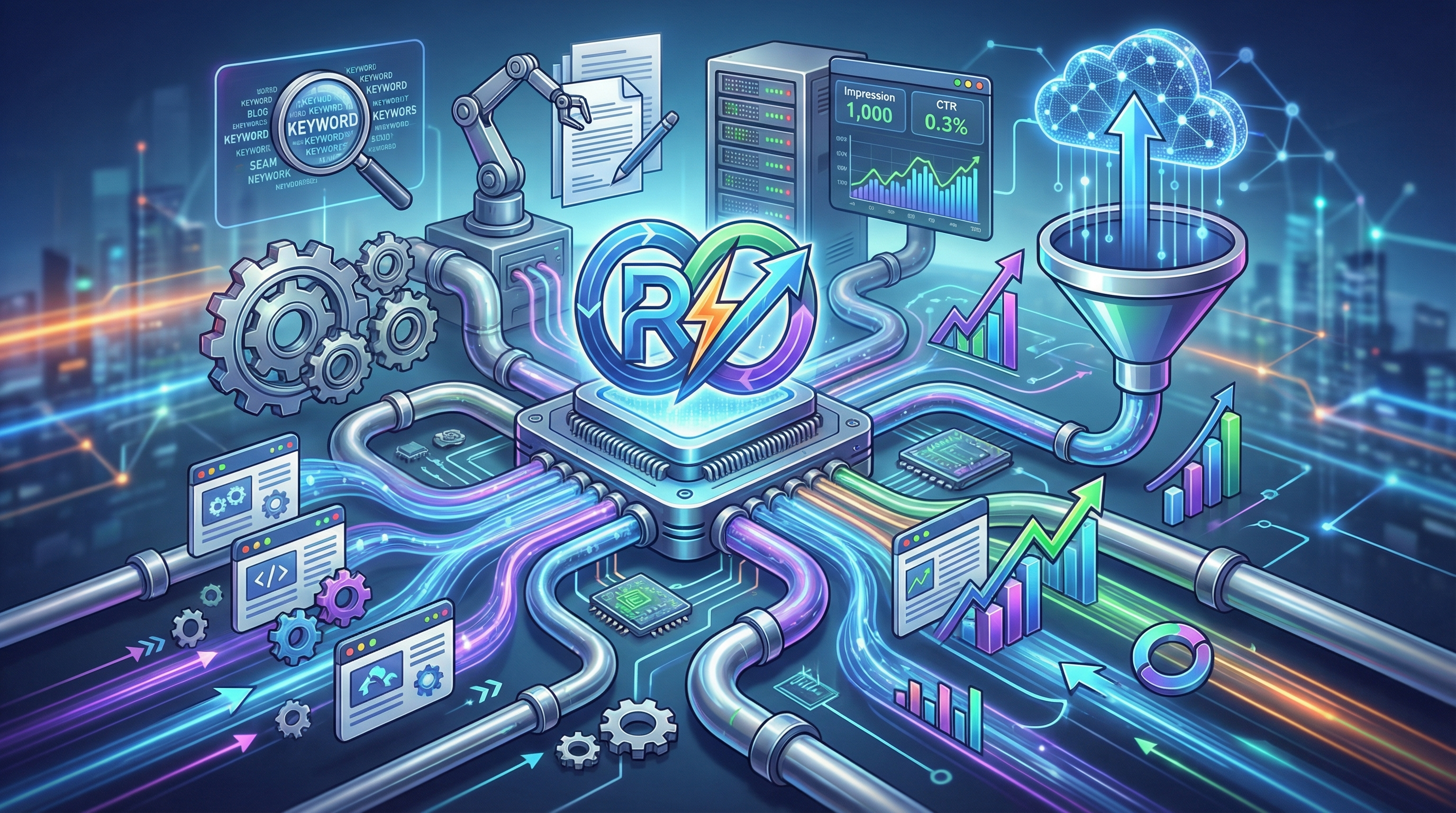
A fully automated SEO workflow operates in five stages: discovery, prioritization, content generation, publishing, and performance optimization. Each stage can be partially or fully automated. The goal is a closed-loop system where output from one stage feeds the next automatically — no manual handoffs, no spreadsheets passed between tools, no status update emails.
Stage 1: Automated Keyword Discovery and Opportunity Mapping
Automated crawling surfaces competitor gaps, SERP shifts, and search trend changes across all client accounts simultaneously. Keyword clustering and intent classification happen programmatically — no manual spreadsheet work. Opportunities are prioritized by traffic potential, keyword difficulty, and client business objectives, and surfaced on a scheduled basis without requiring analyst input.
The output isn't a raw data dump. It's a ranked, actionable opportunity list per client — automatically generated and ready to feed the next stage.
Stage 2: Automated Content Brief and Generation Pipeline
Structured content briefs are generated directly from keyword and SERP data: target keyword, semantic terms, suggested structure, recommended word count, competitor coverage gaps. No brief-writer required. AI-driven content generation then incorporates those inputs, applying client-specific brand voice rules consistently at scale.
The brief-to-writer handoff — a perennial source of delays and miscommunication in agency workflows — disappears entirely. The pipeline moves from keyword to draft without a human in the loop [5].
Stage 3: Automated Publishing and On-Page Optimization
Direct CMS integrations — WordPress, Webflow, Shopify — publish content without manual upload. Meta tags are generated automatically. Internal links are inserted based on topical relevance. Schema markup is applied by content type at publish time. Scheduling logic spaces content deployment for crawl efficiency.
Zero manual QA steps for standard content types. The content goes from generation to live without touching a human queue.
Stage 4: Continuous Performance Monitoring and Re-Optimization
Automated rank tracking connects to content performance data across all client sites. When a page drops below a rank threshold or loses a defined percentage of traffic, a re-optimization job is triggered automatically. Updated content is republished without analyst involvement.
Performance reports are generated and distributed to clients on schedule. And critically, performance data feeds back into the discovery stage — surfacing new opportunities based on what's working and what's slipping. The loop closes. SEO that runs itself.
Best SEO Workflow Automation Tools for Digital Agencies in 2026
The tool stack for agency SEO automation spans four categories: research, content, technical, and reporting. No single tool covers the full lifecycle — most agencies need a connected stack or an all-in-one automation engine. The key evaluation criteria for agency use: multi-site support, API access, CMS integrations, white-label reporting, and the degree of autonomous vs. assisted operation.
Cost-per-client economics matter at scale. Tools that charge per seat or per site eat margin fast when you're running 20+ accounts.
Research and Discovery Automation Tools
Semrush, Ahrefs, and Moz all offer API access for automated keyword and competitor data pulls — usable as data sources in a broader automation pipeline. Programmatic keyword clustering tools reduce manual spreadsheet work significantly. SERP monitoring tools alert on ranking changes and new featured snippet opportunities. Workflow automation platforms like n8n and Zapier can connect research tools to content pipelines, though they require technical setup and ongoing maintenance.
Content Generation and Publishing Automation Tools
AI content platforms with direct CMS publishing integrations eliminate the copy-paste step that wastes more agency time than most teams track. Tools with built-in SEO scoring reduce manual editing loops.
For agencies that want to go beyond assisted workflows, Ranklynk operates as a fully autonomous system — handling discovery through publishing and re-optimization in a single closed-loop pipeline with no human steps required between stages. The distinction matters: assisted tools still require a human to initiate, review, and approve at each stage. Autonomous systems execute the full workflow without handoffs. For agencies managing 10+ clients, that's the difference between marginal efficiency gains and a fundamentally different operating model.
Reporting and Client Communication Automation
Automated white-label reporting tools like AgencyAnalytics and DashThis reduce monthly reporting time significantly — from hours to minutes. Scheduled report delivery removes the manual step of compiling and sending performance updates. Automated anomaly detection keeps clients informed without analyst involvement. Real-time client-facing dashboards reduce ad hoc reporting requests and the inbox noise that comes with them.
6 SEO Workflows Every Digital Agency Should Automate First
Prioritize automation by highest time-cost and highest repetition frequency across client accounts. Start with workflows that don't require creative judgment — these have the lowest automation barrier and the highest immediate ROI. Build automations that work across all clients, not just one. Agency-level leverage is the goal [3].
1. Monthly Keyword Opportunity Identification
Automated weekly scans of ranking gaps, competitor content changes, and new search demand signals. Output: a prioritized keyword list per client, delivered to a shared workspace or project management tool. Eliminates 3–5 hours of manual research per client per month. At 20 clients, that's 60–100 hours returned to your team every month from a single automation.
2. Content Brief Generation from Keyword Data
Automated brief creation using SERP analysis, competitor coverage, and keyword intent data. The brief includes target keyword, semantic keywords, suggested structure, word count, and competitor references — everything a writer or AI system needs to produce on-target content. Eliminates brief-writing entirely for standard informational and commercial content types.
3. On-Page SEO Optimization at Publish
Automated meta title and description generation based on keyword targets and CTR optimization rules. Internal linking suggestions — or automatic insertion — based on topical relevance. Schema markup applied by content type: article, FAQ, product, local business. Post-publish optimization stops being a separate workflow step and becomes part of the publish event.
4. Rank Drop Detection and Content Refresh Triggers
This is where most agencies leak the most value. Content decays. Rankings slip. And without an automated detection system, pages sit underperforming for months before anyone notices. Automated rank monitoring with threshold-based triggers queues re-optimization jobs automatically when a page drops below defined thresholds. Re-optimization updates content, refreshes on-page elements, and republishes — without analyst involvement. Stops the decay loop before it becomes a client conversation you don't want to have.
5. Competitor Content Gap Monitoring
Scheduled crawls of competitor domains detect new content published in target topic clusters. Automated alerts fire when competitors publish content that could threaten existing rankings. New keyword opportunities surfaced from competitor gap analysis feed directly into the content pipeline. Your agency stays ahead of competitive shifts without anyone manually monitoring competitor sites.
6. Client Performance Reporting
Automated monthly report generation pulls rank data, traffic changes, and content published — then formats it with client branding and delivers it on schedule. The last manual step in the monthly client cycle removed. Your team stops spending time on report formatting and starts spending it on strategy conversations that actually strengthen client relationships.
How to Build an SEO Workflow Automation System for Your Agency
Building an automated SEO system is a one-time investment that pays back across every client you add. The build process has three phases: audit, architect, automate. Most agencies can deploy a functional automation stack in 2–4 weeks with the right tools [1].
Phase 1: Audit Your Current Workflow
Document every step in your current SEO delivery process for one client — from onboarding to monthly reporting. Assign time estimates to each step and identify who performs it. Flag every step that is repetitive, rule-based, or doesn't require strategic judgment. These are your automation targets.
Calculate your current hours-per-client-per-month baseline. You need this number to measure the actual impact of automation and to make the ROI case internally.
Phase 2: Architect the Automated System
Map your target automated workflow against the five-stage model: discovery, brief, generation, publish, optimize. Select tools that integrate with each other via API or native connection — avoid tools that require manual data export/import, because that's just outsourcing the manual step to a different format.
Decide between a fully autonomous platform and a connected stack of point solutions based on your agency's technical capacity and margin requirements. Define quality control checkpoints — even in automated workflows, strategic oversight touchpoints matter for high-stakes client accounts where brand sensitivity is high.
Phase 3: Deploy, Test, and Scale
Start with one client account as a pilot. Validate the automated workflow end-to-end. Measure time savings and output quality against your manual baseline. Identify any steps that still require human intervention and systematize or automate them.
Once validated, roll out to all client accounts. The marginal cost of adding clients to an automated system approaches zero. That's the compounding return that manual workflows can never deliver.
What to Look for in an SEO Automation Platform for Agency Use
Most SEO tools are designed for single-site use. Agency requirements are different: multi-site dashboard, client-level reporting, white-label options, scalable pricing, and full-lifecycle workflow coverage. Evaluate tools on workflow coverage — how many steps does it automate? — not just feature count [5].
Assisted Automation vs. Fully Autonomous SEO Systems
Assisted tools accelerate human work. They still require a human to initiate, review, and publish at each stage. For smaller operations, that's fine. For agencies managing 10+ clients, assisted automation delivers marginal gains — you're still in every loop, just moving slightly faster.
Autonomous systems execute the full workflow without human handoffs. Discovery triggers content generation. Content generation triggers publishing. Publishing feeds back into optimization. No one babysitting the pipeline between stages.
Ranklynk is built as an autonomous system — not a tool you use, but a system you deploy. See how it works if you're ready to stop running SEO manually across a growing client roster.
Evaluating ROI: Time Saved vs. Tool Cost
Calculate your current cost-per-client using fully-loaded hourly rates for your team. Compare against the tool cost per client account at your current and projected client volume. Factor in opportunity cost: every hour freed by automation is an hour your team can redirect toward new client acquisition or higher-margin strategic services.
Most agencies see positive ROI on automation platforms within the first 60–90 days. The compounding effect — each new client added at near-zero marginal labor cost — accelerates the return beyond year one.
The Bottom Line
Manual SEO workflows are a growth ceiling — and in 2026, there's no excuse for running into it. Every hour your team spends on repetitive research, brief writing, content production, and reporting is an hour that doesn't scale. The agencies and founders winning right now have replaced those manual loops with systems: automated pipelines that run discovery, generate content, publish, and re-optimize without needing a human in the loop for every step.
The five-stage automation framework gives you the architecture. The right tool stack gives you the execution layer. A one-time workflow build transforms your agency's SEO delivery from a labor-intensive service into a compound machine — one that gets more efficient with every client account you add, not less.
Stop adding headcount to a systems problem. Build the system once, and let it run.
Frequently Asked Questions
Q: What is SEO workflow automation for digital agency clients and why does it matter?
SEO workflow automation for digital agency clients refers to using tools, frameworks, and systems to replace manual, repetitive SEO tasks — like keyword research, content briefs, publishing, and reporting — with automated processes. Instead of executing each step from scratch for every client, agencies build repeatable production systems that run with minimal human intervention. It matters because manual SEO workflows don't scale. A typical agency spends 14+ hours per client per month on SEO tasks. Multiply that across 20 clients and you're managing a 280-hour monthly operation that can only grow by hiring more staff. Automation breaks that ceiling, allowing agencies to deliver consistent, high-quality results across more accounts without proportionally increasing headcount or overhead.
Q: What are the biggest signs that your agency needs SEO workflow automation?
The clearest signs your agency needs SEO workflow automation include hitting a growth ceiling between 15–25 clients, where adding accounts feels like an operational crisis rather than a revenue opportunity. Other warning signs include burned-out team members bouncing between multiple tools and client accounts, inconsistent client results depending on who handled the account that week, repetitive manual tasks like report pulling and brief writing consuming most of your team's time, and a default instinct to hire new staff every time workload increases. If your team is spending more time on execution than strategy, that's a systems problem — and automation is the fix, not more headcount.
Q: How much time can SEO workflow automation actually save a digital agency?
Agencies that implement SEO workflow automation for digital agency clients report a 60–70% reduction in time spent per client deliverable. To put that in concrete terms: a manual SEO workflow typically involves 14+ hours per client per month — covering keyword research, brief writing, content creation, on-page optimization, and reporting. Across 20 clients, that's roughly 280 hours monthly. Automating execution-heavy steps like data collection, reporting, and content briefing can cut that significantly, freeing your team to focus on strategy, client relationships, and account growth — the high-value work that actually requires human judgment.
Q: What are the core stages of a fully automated SEO workflow for agencies?
According to the framework outlined in this approach, a fully automated SEO workflow operates across five core stages: discovery, prioritization, content generation, publishing, and performance optimization. Discovery covers automated keyword research and competitive analysis. Prioritization uses rule-based logic to determine which opportunities to act on first. Content generation involves templated briefs and AI-assisted writing workflows. Publishing automates the mechanical steps of getting content live on client sites. Performance optimization closes the loop by automatically tracking rankings, traffic, and conversions and flagging what needs attention. Each stage removes manual touchpoints while keeping human oversight focused on strategic decisions rather than repetitive execution.
Q: Why is hiring more staff not the right solution to scaling agency SEO?
Hiring more staff to solve a scalability problem is expensive, slow, and doesn't address the root issue. Every new hire multiplies management overhead and payroll costs, but doesn't fundamentally reduce how much each client costs to service. If your workflows are inefficient and manual, adding people just means more people doing inefficient, manual work. The real problem is a systems problem — inconsistent processes, excessive context-switching between tools and accounts, and execution tasks that could be automated. Agencies that build automated SEO systems scale output without scaling headcount proportionally, which dramatically improves profit margins and makes growth sustainable rather than operationally exhausting.
Q: What types of SEO tasks should be automated versus handled by humans?
The key distinction in SEO workflow automation for digital agency clients is separating execution from strategy. Execution-heavy tasks are ideal for automation: keyword data collection, brief templating, performance reporting, rank tracking, content publishing workflows, and approval notifications. These are rule-based, repeatable, and don't require creative or strategic judgment. Human oversight should be reserved for tasks that genuinely require judgment: overall SEO strategy for a client, relationship management, interpreting complex performance data, making nuanced editorial decisions, and handling client communications. When agencies make this distinction clearly, they stop wasting senior team members' time on mechanical tasks and direct human effort where it creates the most value.
Q: What is context-switching and how does it hurt agency SEO productivity?
Context-switching refers to the cognitive cost of constantly shifting focus between different clients, tools, and tasks throughout the workday. In a typical digital agency, team members might jump between 15 client accounts, 6 different SEO tools, and multiple project management platforms in a single day. Each switch fragments attention, increases error rates, and consumes mental bandwidth that could otherwise go toward high-quality strategic work. This switching cost is often the hidden drag on agency productivity — not any single task, but the accumulated friction of constantly reorienting. SEO workflow automation reduces context-switching by centralizing processes, standardizing how tasks are triggered and completed, and minimizing the number of manual handoffs required across a client's monthly deliverables.
Q: How does SEO workflow automation improve consistency of client results?
Manual SEO workflows are only as consistent as the individual team member running them. When different people follow different processes, cut different corners, or apply different quality standards, client results become unpredictable — a serious problem for agency retention and reputation. Automated SEO workflows enforce a standardized process every time, regardless of who is involved. Templates, triggers, and automated checks ensure that keyword research follows the same logic, briefs include the same components, and reports surface the same metrics across every client account. This consistency doesn't just protect quality — it builds the kind of reliable, repeatable results that clients notice, trust, and renew contracts for.
References
[1] https://monday.com/blog/marketing/seo-workflow/. monday.com. https://monday.com/blog/marketing/seo-workflow/
[2] https://seobotai.com/blog/seo-workflow-automation-7-best-practices/. seobotai.com. https://seobotai.com/blog/seo-workflow-automation-7-best-practices/
[3] https://www.glean.com/perspectives/the-latest-tools-for-automating-digital-marketing-workflows. glean.com. https://www.glean.com/perspectives/the-latest-tools-for-automating-digital-marketing-workflows
[4] https://www.moxo.com/blog/digital-marketing-workflow-process. moxo.com. https://www.moxo.com/blog/digital-marketing-workflow-process
[5] https://seobotai.com/blog/seo-workflow-automation-7-best-practices/. seobotai.com. https://seobotai.com/blog/seo-workflow-automation-7-best-practices/