How Solo Founders Use AI to Compete on Organic Search (Without a Marketing Team)
Solo founders are outranking funded startups with full marketing teams — not by working harder, but by wiring AI directly into their SEO stack and letting the system run. No content managers. No agency retainers. No weekly editorial meetings. Just a closed-loop pipeline that discovers keywords, generates content, publishes, and re-optimizes on its own schedule.
A few years ago, organic search was a resource game. Big teams, big budgets, big content calendars. Solo founders were locked out by default — competing against companies with five-person SEO teams and six-figure agency contracts was simply not a rational use of time. In 2026, that equation has flipped. AI has collapsed the unit cost of content production, keyword research, and on-page optimization to near-zero. The founders who figured this out early are now compounding organic traffic while their competitors are still writing briefs manually and waiting for freelancers to deliver drafts [1].
This article breaks down exactly how solo founders are using AI to build autonomous SEO systems that generate, publish, and optimize content at scale — without hiring writers, agencies, or babysitting a content calendar. The playbook is systematic, the math is compounding, and the window to build this advantage is still open — but not for much longer.
Why Organic Search Is Now a Level Playing Field for Solo Founders
The old SEO moat was headcount and budget. You needed people to do keyword research, people to write content, people to handle publishing and technical SEO, and a project manager to coordinate all of it. That moat has been systematically filled in by AI. Keyword research that took a specialist two days now runs automatically. Content that required a writer and an editor can be generated, structured, and optimized by a system in minutes. On-page optimization that demanded a dedicated SEO lead is now a configuration decision made once.
Solo founders have a structural advantage that agencies and large teams don't: zero approval chains. No account managers. No lag between insight and execution. When a keyword opportunity surfaces, a solo founder running an autonomous system acts on it immediately. A funded startup with a marketing team routes it through a brief, a writer assignment, an editorial review, and a publishing queue that takes weeks.
Search engines in 2026 reward topical authority and freshness — both of which a well-configured AI system can maintain at scale without any human involvement. The risk isn't that solo founders can't compete in organic search anymore. The risk is that most still haven't made the switch from manual SEO workflows to a system-first model [2].
The Old SEO Stack vs. the AI-Powered Solo Founder Stack
The old stack looked like this: SEO agency or in-house specialist handling strategy, manual keyword research in a spreadsheet, freelance writers delivering drafts on two-week timelines, an editor cleaning up the output, and monthly reporting cycles that showed you what happened 30 days ago. Every stage required a human handoff. Every handoff introduced latency and error.
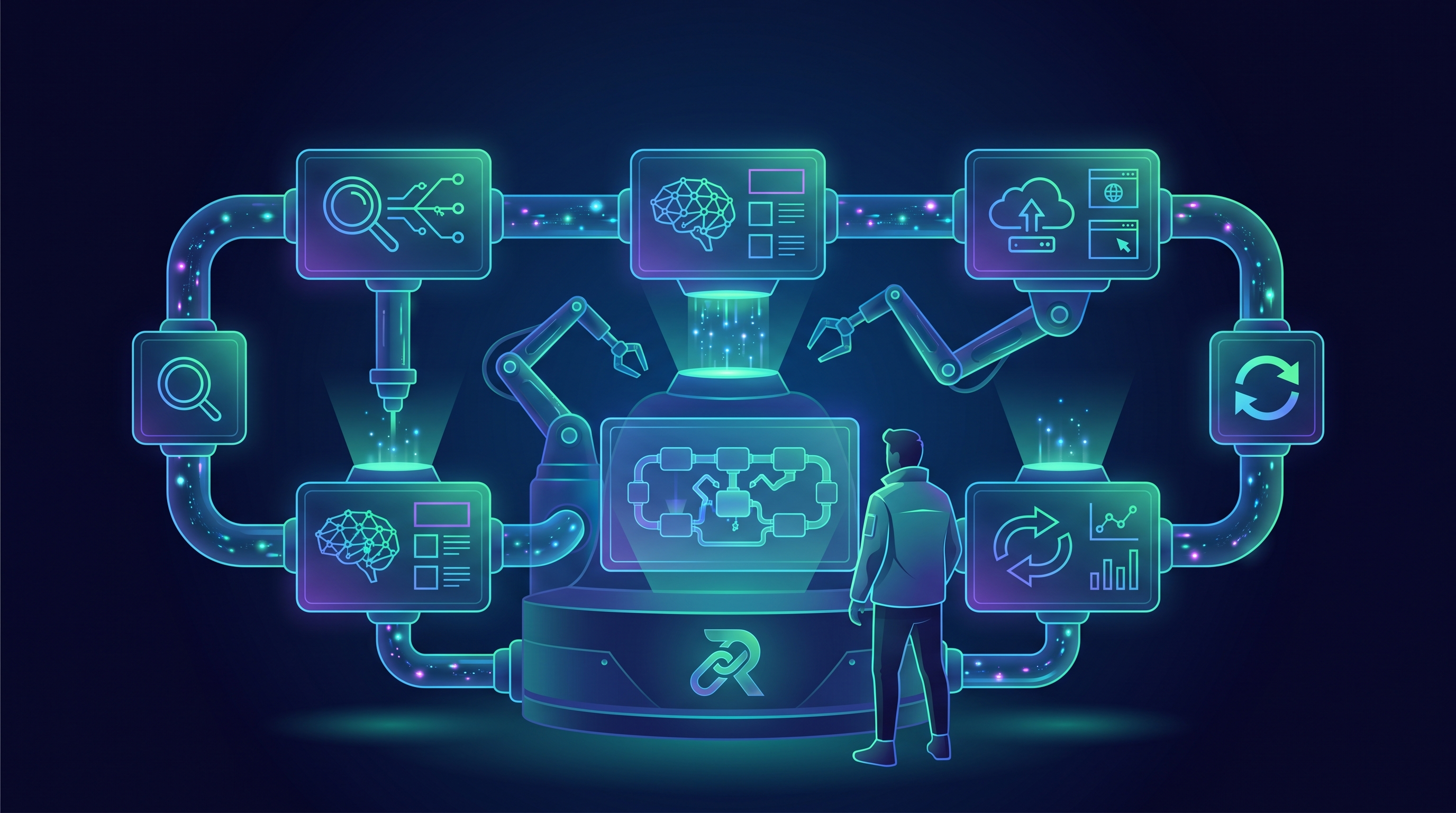
The new stack runs differently. An AI discovery layer scans SERPs, competitor content, and search volume signals continuously. An automated content generation engine produces drafts calibrated to intent, topical depth, and competitive benchmarks. Programmatic publishing connects generation to CMS with no human in the middle. And a continuous optimization loop monitors rank movement and triggers content refresh jobs automatically.
The compounding advantage isn't just speed — it's architecture. Every piece of content the system publishes feeds the next optimization cycle. Internal links are built automatically. Topical clusters deepen with each new article. Humans simply cannot replicate this throughput, and agencies billing hourly have no incentive to.
Why This Moment Is Different From Previous 'AI SEO' Hype Cycles
Earlier waves of AI writing tools were assistants, not systems. They made individual tasks faster but still required human input at every stage — you still had to decide what to write, prompt the tool, review the output, paste it into a CMS, and monitor results manually. The friction just moved; it didn't disappear.
The shift that happened in 2025-2026 is closed-loop automation: discovery through publishing through re-optimization with no manual handoff between stages [3]. The system doesn't wait for a human decision to move from keyword research to content brief to draft to published post. It runs continuously. Solo founders who still treat AI as a faster typewriter are losing to founders who've deployed it as an autonomous operator.
The Four-Stage SEO System Solo Founders Are Running on Autopilot
Most solo founders using AI effectively aren't stitching together a dozen disconnected tools. They've built or adopted a pipeline with four distinct stages, and they've removed themselves from the day-to-day operation of each one.
Stage 1: Automated Keyword Discovery and Opportunity Scoring
Manual keyword research is the first bottleneck solo founders eliminate — and the one that frees up the most strategic time. AI systems can scan competitor content, SERP features, and search volume signals simultaneously, surfacing opportunities that would take a human analyst days to identify.
Opportunity scoring prioritizes low-competition, high-intent keywords that a solo founder's domain can realistically rank for — factoring in domain authority, existing content coverage, and topical cluster gaps. The output isn't a spreadsheet to review and act on. It's a live queue of briefs, pre-prioritized and ready for generation. The founder never touches a keyword tool.
Stage 2: Content Generation That's Built for Rankings, Not Just Reads
AI content generation at scale requires more than a prompt. It requires intent mapping, competitive gap analysis, and structural templating that mirrors what's already ranking while targeting underserved angles. Generic AI writing produces generic content. Rank-calibrated AI writing produces pages that compete.
The best-performing AI content matches the topical depth of top-ranking competitors while covering angles those competitors missed. Structural SEO requirements — heading hierarchies, FAQ schema, internal linking, metadata — are handled automatically at generation time. Solo founders running this correctly are not editing every draft. The system handles structural compliance; the founder's job is to configure the template logic once.
Stage 3: Publishing Without the Manual Overhead
Automated publishing is the stage most solo founders underestimate. Connecting content generation to CMS without a human in the middle eliminates the most time-consuming part of the traditional workflow. Metadata, slug structure, canonical tags, schema markup — all handled at publish time based on pre-configured rules.
Internal linking automation is the most underrated lever in this stage. As the content library grows, the system builds topical authority passively by linking new content to relevant existing pages and updating old pages to link to new ones. This is the kind of ongoing maintenance that manual workflows simply abandon after the first few months.
Stage 4: The Optimization Loop That Most Solo Founders Skip
Publishing is not the end of the SEO workflow. It's the beginning of the optimization cycle. AI systems that track rank movement, click-through rates, and engagement signals can trigger content refresh jobs automatically when a page's performance drops or when a competitor displaces it in the rankings.
This is where the compounding effect becomes visible. Content that was ranking #8 gets refreshed — updated structure, expanded topical coverage, improved answer formatting — and climbs to #3 without any manual intervention. Most solo founders using disconnected AI tools never build this loop. And that's exactly where autonomous systems create a permanent, widening edge [2].
What Solo Founders Are Actually Getting Wrong With AI and SEO
The most common failure mode is using AI as a faster typewriter instead of a system architect. The tool changes; the workflow stays manual. The result is a content graveyard: hundreds of published pages, minimal rankings, and no mechanism for improvement.
The 'More Content' Trap
Publishing velocity without topical strategy is noise. Google's quality signals penalize thin topical coverage regardless of how fast or how cheaply it was produced. A site with 400 loosely related articles covering random keywords will consistently underperform a site with 80 articles organized into tight topical clusters with strong internal link structures.
Solo founders need to build content clusters around their core topics, not spray content across keyword lists that happen to have search volume. An autonomous system configured with a topical authority model will outperform a high-volume generalist content machine every time — because search engines reward depth, not breadth.
Why Disconnected AI Tools Don't Add Up to a System
Using ChatGPT for drafts, Ahrefs for keywords, Surfer for optimization, and a VA to handle publishing is still a manual workflow. It has AI accessories, but it's not an AI system. The bottleneck is coordination — and no collection of individual AI tools eliminates human coordination overhead.
A closed-loop system eliminates the handoffs, not just the individual tasks. When keyword discovery feeds directly into content generation, which feeds directly into publishing, which feeds directly into optimization monitoring, the system runs without any human decision points in the middle. That's the architecture that scales. Disconnected tools with a human in between each stage do not.
Real Growth Patterns: What the Numbers Look Like for AI-Powered Solo Founders
Solo founders running autonomous SEO systems are reporting 30-40x organic growth trajectories within 6-12 months of deployment [1]. The curve is non-linear: the first 90 days are slow as topical authority builds and Google processes new crawl signals. Months 4 through 12 compound rapidly as internal link density increases, content clusters deepen, and ranking keywords multiply.
The most common inflection point is when organic traffic displaces paid acquisition spend. When SEO starts funding itself — when inbound from search reduces or eliminates the paid CAC burden — the economics of building on top of autonomous SEO become impossible to argue against for a solo founder managing runway.
The case pattern repeats: a SaaS founder with zero content team goes from 200 to 8,000 monthly organic sessions in under a year using a fully automated pipeline. The key metric isn't articles published. It's ranking keywords per hour of founder time invested. That ratio is what separates systems from tools.
The Compounding Math of Autonomous SEO
Each published article creates internal linking opportunities that lift adjacent pages. Each optimization cycle improves existing content while the system continues publishing new content in parallel. After six months, a well-configured system is running multiple simultaneous growth loops: new content publishing, underperformer refresh cycles, and authority consolidation across topic clusters.
This is the structural advantage solo founders have over agencies billing hourly — the system's cost doesn't scale with output. Publishing 10 articles per week costs the same as publishing 2 when the generation and publishing pipeline is automated. The marginal cost of the next article approaches zero. The agency model, by contrast, charges for every piece.
How to Evaluate Whether an AI SEO Tool Is Actually a System
The benchmark question is simple: does this tool require a human decision at any stage between keyword discovery and published, optimized content? If the answer is yes at any point, you don't have a system. You have a tool with better UX.
Checklist for evaluating AI SEO platforms: Does it handle automated keyword discovery without manual input? Does it generate content calibrated to SERP context, not just a topic prompt? Does it publish directly to your CMS, or does it produce a draft for review? Does it monitor rankings and trigger re-optimization automatically? Does it build internal links based on topical relationships?
Red flags: tools that produce 'drafts for review', tools that require manual brief creation, tools that treat publishing as an export step rather than an integrated function. Green flags: closed-loop architecture, topical clustering logic, internal linking automation, performance-triggered optimization cycles.
The difference between an AI writing assistant and an autonomous SEO engine is not content quality. It's whether a human is required to keep it running. If you want to see what a genuinely closed-loop pipeline looks like in practice, see how it works.
Questions to Ask Before Adopting Any AI SEO Platform
- Does it handle keyword discovery without manual input?
- Does it publish directly to your CMS or require a human handoff?
- Does it monitor rankings and trigger re-optimization automatically?
- Does it build internal links based on topical relationships, not just manual rules?
- What does the system do when a page drops in rankings — alert you, or fix it?
If the answer to any of these is 'you handle that part,' the tool is an accessory, not a system.
The Founder's Playbook: Setting Up an Autonomous SEO Engine in 30 Days
Week 1: Audit your current content situation. Identify your core topics, existing pages, and ranking gaps. You're not optimizing what exists yet — you're mapping the terrain the system will operate on.
Week 2: Configure your AI SEO system around 3-5 core topic clusters that map directly to your product's ICP search behavior. This is the only strategic decision that matters at setup. Get this right and the system handles everything downstream.
Week 3: Run your first automated content batch. Let the system publish without editing every piece. Trust the template logic you configured. Reviewing every article defeats the purpose of building a system.
Week 4: Review system-level metrics — ranking velocity, crawl coverage, internal link density — not individual article quality. You're a system operator now, not a content manager. The unit of analysis is the pipeline's output, not any single page.
Picking Your Core Topic Clusters (The Only Strategic Decision That Matters)
Topic clusters should map directly to the problems your product solves — not generic industry keywords. If you build project management software for creative agencies, your clusters should be built around the specific search behavior of creative agency operators, not broad project management keywords dominated by enterprise incumbents.
3-5 tightly defined clusters will outperform 20 loosely related topics every time. Once clusters are defined, the system handles keyword expansion, content generation, internal linking, and optimization. The founder's job at this stage is done.
What 'Done' Looks Like When SEO Runs Itself
A fully operational autonomous SEO system requires founder input roughly once per quarter — to adjust topic clusters as the product and ICP evolve. Day-to-day, the system is discovering keywords, publishing content, monitoring rankings, and refreshing underperformers without any input required.
The signal that the system is working: organic traffic growth visible within 60-90 days, compounding without additional founder time investment. You stop thinking about content. You start reading traffic reports.
AI Search Visibility in 2026: What's Changed and What Solo Founders Need to Know
AI Overviews have shifted click distribution in ways that matter for solo founders. Informational queries — particularly top-of-funnel content — are seeing reduced CTR as Google surfaces direct answers in the SERP before the user reaches organic results [4]. This doesn't mean informational content is dead. It means the content structure required to win has changed.
Solo founders need to optimize for both traditional organic rankings and AI Overview inclusion simultaneously. These aren't the same content structure. Traditional rankings reward comprehensive depth. AI Overview inclusion rewards direct answer formatting, structured headers, and FAQ schema that AI systems can parse and cite [3].
The founders adapting fastest are those already running content systems. They update a template and republish at scale overnight. A solo founder managing a manual workflow takes weeks to make the same structural update across a content library.
Bottom-funnel and commercial-intent content remains relatively insulated from AI Overview click cannibalization — a key opportunity for solo founders whose content strategy maps to product-adjacent search behavior rather than generic informational queries [4].
How to Structure Content for AI Overview Inclusion
Direct answer formatting in the first 100 words of each section increases AI Overview pull probability. AI systems scan for clear, extractable answers — not narrative prose that buries the point in paragraph four. FAQ schema and structured headers help AI systems parse and cite your content accurately.
Topical authority across a cluster — not just a single high-performing page — is the strongest signal for consistent AI Overview inclusion. A site that owns a topic cluster gets cited across multiple queries in that cluster. A site with one strong page in an otherwise thin content library gets cited once and then displaced by deeper competitors [3].
The Bottom Line
Solo founders aren't at a disadvantage in organic search anymore. They're at an advantage — if they stop managing SEO manually and start running it as an autonomous system. The founders compounding organic traffic in 2026 aren't doing more work. They've wired together a closed loop: keyword discovery, content generation, publishing, and optimization running without a human in the middle.
The gap between them and everyone else isn't effort. It's architecture.
The window to build this advantage before it becomes table stakes is closing. The founders who configure this system in the next 6-12 months will compound into a structural organic search lead that's extremely difficult to dislodge later. Those who wait will spend that time manually editing AI drafts and wondering why their traffic isn't growing.
Ranklynk runs your entire SEO pipeline — from keyword discovery to published, optimized content — without a single manual step. See how it works and understand exactly what a closed-loop autonomous SEO engine looks like when it's configured for your product.
Frequently Asked Questions
Q: How do solo founders use AI to compete on organic search without a marketing team?
Solo founders use AI to compete on organic search by replacing traditional manual workflows with autonomous, closed-loop SEO systems. Instead of hiring content managers, writers, or SEO agencies, they wire AI directly into their SEO stack to handle every stage of the process automatically. This includes continuous keyword discovery by scanning SERPs and competitor content, automated content generation calibrated to search intent and topical depth, programmatic publishing directly to their CMS, and ongoing rank monitoring that triggers content refresh cycles without human involvement. The key advantage is removing approval chains and human handoffs — when a keyword opportunity surfaces, the system acts on it immediately rather than routing it through weeks of briefs, assignments, and editorial reviews.
Q: Why is organic search now a more level playing field for solo founders in 2026?
The old SEO moat was built on headcount and budget — you needed specialists for keyword research, writers for content, editors for quality control, and project managers to coordinate everything. AI has systematically collapsed the cost of all those functions to near-zero. Keyword research that once took a specialist two days now runs automatically. Content that required a writer and editor can be generated and optimized in minutes. On-page optimization that demanded a dedicated SEO lead is now a one-time configuration decision. Search engines in 2026 also reward topical authority and content freshness, both of which a well-configured AI system can maintain at scale. This means solo founders with zero employees can now out-execute funded startups with five-person SEO teams simply by having a better-architected system.
Q: What does an AI-powered SEO stack for a solo founder look like compared to the traditional approach?
The traditional SEO stack involved manual keyword research in spreadsheets, freelance writers on two-week delivery timelines, editorial review processes, and monthly reporting cycles that showed results 30 days after the fact. Every stage required a human handoff, introducing latency and errors. The AI-powered solo founder stack replaces all of this with four automated layers: an AI discovery layer that continuously scans SERPs and search volume signals, an automated content generation engine that produces intent-matched drafts, a programmatic publishing layer that connects content generation directly to the CMS, and a continuous optimization loop that monitors rankings and triggers content refresh jobs automatically. Internal links are built automatically, topical clusters deepen with each new article, and the entire system compounds over time without human intervention.
Q: What is the compounding advantage solo founders gain from using AI for SEO?
The compounding advantage goes beyond simply producing content faster. It's architectural — every piece of content the AI system publishes feeds the next optimization cycle. Internal links are generated automatically, strengthening topical clusters. Each new article deepens the site's authority on related subjects, which improves rankings across the entire cluster. Over time, the system builds topical authority that search engines reward with higher rankings and greater visibility. Human teams and agencies simply cannot replicate this throughput, and agencies billing hourly have no financial incentive to build systems that reduce the hours they can charge. Solo founders who adopted this approach early are now compounding organic traffic while competitors are still managing manual workflows.
Q: What is the biggest mistake solo founders make with SEO before switching to an AI-powered system?
The biggest mistake is continuing to operate manual SEO workflows — doing keyword research by hand, waiting for freelance writers, managing content calendars manually — while competitors build automated systems that run continuously. Most solo founders haven't made the switch from a manual, human-dependent SEO process to a system-first model, which means they're competing at a structural disadvantage. They're spending time on execution that should be handled by automation, and they're missing keyword opportunities because their workflow is too slow to act on signals in real time. The window to build this organic search advantage is described as still open in 2026, but narrowing — the longer a founder waits to implement an autonomous SEO system, the harder it becomes to close the gap on early adopters who are already compounding.
Q: Can AI-generated SEO content truly rank in search engines, or do search engines penalize it?
Search engines in 2026 evaluate content based on topical authority, relevance, and freshness — not the method used to produce it. When AI content is calibrated to search intent, structured around topical depth, and continuously refreshed through optimization loops, it meets the signals search engines reward. The solo founders outranking funded startups with full marketing teams are doing so with AI-generated content that is systematically aligned with competitive benchmarks and user intent. The key distinction is that poorly structured, generic AI content can underperform, but a well-architected AI SEO system produces content designed to match the specific depth and structure that ranks for target keywords — making the output competitive with or superior to manually produced content.
Q: How quickly can a solo founder build an autonomous SEO system using AI?
The article describes the transition to an AI-powered SEO system as a configuration decision rather than an ongoing labor commitment. Unlike hiring writers or managing an agency relationship, the primary investment is in the initial architecture — connecting an AI discovery layer, a content generation engine, a programmatic publishing integration, and an optimization loop. Once configured, the system runs on its own schedule without requiring weekly editorial meetings or content calendar management. Solo founders who act on this early gain a compounding advantage, as the system builds topical authority over time. The implication is that getting started sooner matters significantly — the founders who moved first are already compounding organic traffic, and the gap widens the longer others wait.
References
[1] https://www.airticler.com/resources/solo-founders/ai-search-visibility. airticler.com. https://www.airticler.com/resources/solo-founders/ai-search-visibility
[2] https://www.averi.ai/how-to/ai-overviews-cut-startup-clicks-here-s-the-fix. averi.ai. https://www.averi.ai/how-to/ai-overviews-cut-startup-clicks-here-s-the-fix
[3] https://www.businessinsider.com/solopreneurs-use-ai-to-boost-content-creation-efficiency-2026-2. businessinsider.com. https://www.businessinsider.com/solopreneurs-use-ai-to-boost-content-creation-efficiency-2026-2
[4] https://www.ranklynk.io/auth/login. ranklynk.io. https://www.ranklynk.io/auth/login